

I helped implement a tax saving strategy for my recently deceased father-in-law that, given reasonable assumptions, will save our family $1,178,397 in taxes over our daughter’s lifetime. To oversimplify, I redirected what would have been my wife’s $500,000 inherited IRA to our daughter's Special Needs Trust (SNT).
Many grandparents of children with disabilities can take the same tax-cutting steps we did to help protect their grandchild’s long-term financial security and independence.
Please note this strategy could also have significant benefits to grandparents who don’t have a grandchild with a disability. Grandparents with children, who are in a substantially higher tax bracket than their grandchildren, can take similar tax-cutting steps.
If you are skeptical, please note that this strategy was published and attributed to me in The Wall Street Journal on December 22, 2025 in an article by Ashlea Ebeling.
The Common Default
Most grandparents with traditional families name their spouse as the primary beneficiary of their IRA and other retirement plans. Then, typically, they name their children equally as the contingent beneficiaries of their IRAs. That means if their spouse predeceases them, their children inherit the IRAs equally. You may also see the words "per stirpes" on the beneficiary form to indicate that if one of the children predecease their parents, then the share of the predeceased child goes to the child or children of the predeceased child.
The Improvement in the Common Default
I suggest adding flexibility to the documents by including “disclaimers” (see below) and in the case of a grandchild with a disability to allow a child to “disclaim” to a SNT.
Some estate attorneys have been using variations of this disclaimer strategy for more than 30 years. The objective has always been to allow grandparents to set up a flexible estate plan that could direct at least a portion of their IRA to a grandchild or to a trust for one or more grandchildren. Over that time many IRAs were directed or disclaimed to grandchildren, saving hundreds of thousands of dollars or more in taxes.
Disclaimer Planning to a SNT
A disclaimer is a legal way to refuse an inherited IRA (or a portion of an IRA or any other asset) so it passes automatically to the next contingent beneficiary named in the beneficiary designation. You aren’t changing the beneficiary form after death, just allowing a named beneficiary to step aside in favor of a contingent beneficiary. For most traditional families, I often prefer estate plans that have a series of disclaimers built in on several levels.
Specifically in the context of this article, I am recommending you consider giving your child the choice of accepting their share of their inherited IRA or disclaiming it into the SNT for their child.
Why IRAs and Retirement Accounts Are Especially Well-Suited for a SNT
IRAs and retirement accounts are fully taxable when distributed. Under the current law known as the SECURE Act, for deaths after December 31, 2019, subject to exception, inherited IRAs must be distributed and taxed within ten years after the death of the IRA owner. This often results in massive income tax acceleration for grown children who may already be in high-income tax brackets.
However, when an inherited IRA passes directly or via disclaimer to a SNT for a beneficiary with a disability who qualifies as an Eligible Designated Beneficiary (EDB), the beneficiary can "stretch" distributions—deferring taxes—over their actuarial life expectancy. For a child who likely will need lifetime support, this difference can be life changing.
In our family's case, we benefited in two ways. First, we avoided the standard ten-year distribution of the inherited IRA rule that would have forced my wife to pay income taxes on her portion of her dad's IRA over ten years. Instead, our daughter’s trust will enjoy a 50-plus-year “stretch” based on our daughter's life expectancy. In addition, our daughter, who will receive taxable distributions from the trust will be in a lower income tax bracket than my wife and I. Combining both tax benefits with reasonable assumptions*, our daughter will enjoy $1,178,397 in additional savings over her lifetime. (Please see the graph below for a timeline of the projected benefit of the strategy we recommend.)
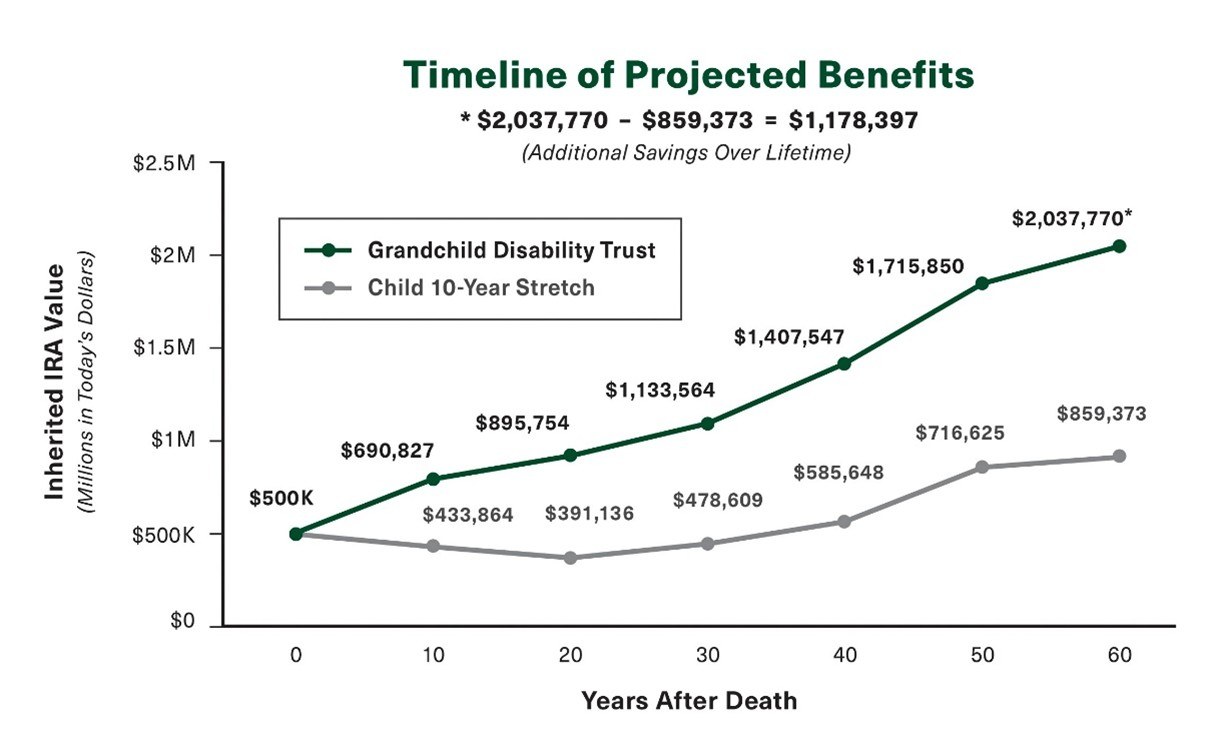
*Assumptions
- $500,000 inherited IRA with a 10-year stretch vs. 60-year lifetime stretch
- 6% rate of return, 3% inflation rate (net rate of return of 3% more than inflation)
- Parent vs. grandchild annual income = $150,000 vs. $18,000 SSDI (assume all after-tax income is spent by both parent and grandchild except for IRA distributions)
- Current income tax rates for federal tax purposes
- 15% tax rate on portfolio income for both parent and grandchild
- No inheritance, estate, or state income tax are included in the analysis
Note: No information provided should be construed as tax, legal or investment advice. Speak with a qualified professional prior to implementation.
This plan doesn't work nearly as well today if the grandchild doesn't have a disability, however, there is still an opportunity to use trusts to save taxes when the grandchild is not disabled but their tax rate is considerably lower than their parents’.
My strong recommendation for grandparents of a grandchild with a disability is to consider naming a properly drafted SNT as a contingent beneficiary of their IRA or retirement plan. If the grandchild doesn’t have a disability, then consider including disclaimer provisions either to a grandchild directly or a standard minor’s trust to take advantage of the grandchild’s lower tax bracket.
What Our Family Actually Did
I requested my father-in-law add a SNT for the benefit of our daughter who has a disability as the contingent beneficiary of my wife’s share of the inherited IRA. He did that. After he passed, my wife disclaimed her share of his IRA to the SNT.
With or without disclaimers, if you want to benefit a grandchild with a disability, you usually need a SNT. The SNT can offer protection when an outright inheritance to a grandchild with a disability could threaten eligibility for means-tested benefits like Supplemental Security Income (SSI) and Medicaid. In addition, it can unnecessarily cause a massive income tax acceleration.
How to Enhance This Strategy
What is better than long-term income-tax deferred investments? Long-term tax-free investments. If grandpa or grandma converts some of their IRA to a Roth and that Roth can eventually go to a SNT, the SNT will have the same “stretch” distribution pattern as a traditional IRA, but all the qualifying distributions will be tax-free.
My wife and I made a $250,000 Roth conversion in 1998. That Roth, including the growth from the time that we converted it until our death which will hopefully be a 50-year period, will eventually pass to our daughter, who will stretch that inherited Roth IRA over her lifetime. Our family might get over 90 years of tax-free growth on that Roth conversion. That Roth conversion story, which also created a million dollar plus benefit for our daughter, along with other benefits of Roth conversion planning, was published in Forbes magazine in the February 28, 2019 edition.
Warning
Drafting the trusts, implementing the disclaimers, and taking all the necessary steps to achieve the goals of this article is a minefield where one misstep can cause a massive income tax acceleration. Those considering this strategy are advised to work with a qualified estate attorney and advisor to avoid mistakes.
Furthermore, there is no rush to do anything with the inherited IRA immediately after a death. You have nine months to make a disclaimer. Don’t let the executor, the trustee, the beneficiary, or the financial institution where the money is invested do anything until you have all your ducks in a row, that is, when the strategy and the mechanics of what to do are clearly defined. I have seen a lot of wonderful disclaimer opportunities ruined because someone did something they should not have done after death.
The banker we dealt with would have made a deadly mistake that would have killed the “stretch” for our daughter had I not been so diligent to make sure everything was done right.
The Takeaway
If a family includes a grandchild with a disability, naming a SNT as a contingent beneficiary of an IRA either directly or through a disclaimer is one of the highest impact planning moves available. Converting part of that IRA to a Roth is like adding the cherry on top.
Directing IRAs or retirement accounts—or better yet Roth IRAs—to a SNT can easily save families with a $500,000 IRA or more hundreds of thousands of dollars per beneficiary (sometimes well over $1M in taxes) and provide lifetime support for a grandchild with a disability. The evidence is in the track record of families who got it right, including mine.
Dear Friend,
This month’s Lange Report is focused on grandparents.
Many grandparents reach a point where the central planning question is no longer “Will I have enough?” but rather how can I balance enjoying retirement, helping my family while I am alive and leaving a meaningful tax-savvy legacy.
The lead article in this newsletter describes a planning strategy I recently implemented for my own family. It describes why optimal distribution planning, including Roth IRA conversions and flexible estate planning can have an immense impact on long-term outcomes. While the example in the article involves disability planning, the broader lesson applies much more widely: the default approaches to spending, Roth conversions, and beneficiary designations often create avoidable tax consequences for families.
To help grandparents spend more, gift more and leave more, we are offering a free, three-part webinar series on Tuesday, March 24th.
The webinar invitation and details for registration follow. I hope you will consider joining us for one or more of the sessions.
Warm regards,

Spend More, Leave More, and Let the IRS Foot the Bill
Strategic Planning for Grandparents with $1 Million+ in Retirement Assets
Attend Jim Lange’s Workshops for FREE this March. Reserve Your Seats Today!
Tuesday, March 24, 2026
Register to attend 1, 2, or all 3 Free Webinars
Session One: 10:00AM - Noon (Eastern)
Safe Withdrawal Rates: How Much Can You Truly Afford to Spend?
Most grandparents that I work with spend way less than they can afford, primarily because they are relying on a depression-era mentality usually inherited from their parents and on outdated rule of thumb.
This session explains the latest safe withdrawal research from Bill Bengen, the originator of the 4% rule, how to apply it to your own planning horizon, and how to integrate portfolio withdrawal strategy into your broader retirement income and spending plan.
In this session you will learn:
- The 4.7% Reality: Why Bill Bengen updated his traditional 4% guideline to 4.7% for a 30-year retirement, effectively giving retirees a 17.5% "raise."
- The Time Horizon Shift: How withdrawal guidance can dramatically change when your planning horizon is shorter, or longer, than 30 years.
- The Gift of Clarity: How a clearer withdrawal plan can support both lifestyle spending and gifting goals.
- All the Pieces of the Puzzle: How portfolio withdrawals fit together with gifting, Roth conversions, Social Security, pensions, and other retirement income sources as interdependent pieces of your larger spending and gifting strategy.

Session Two: 1:00 PM – 3:00 PM (Eastern)
Roth Conversions: Protecting Your Purchasing Power (and Your Legacy)
While Roth conversions can help secure your own lifestyle, the reality is you will likely never spend most of your Roth IRA. So, though it is often still great for you, many grandparents ultimately find that the greatest benefit of Roth planning is having created a massive, tax-free reservoir of funds for your children and/or grandchildren.
In this session, Jim will cover:
- The "SECRET": Why measuring your wealth in "purchasing power," rather than total dollars, is the only reliable way to evaluate if a Roth conversion is right for you.
- The OBBBA Impact: How recent tax-law changes have reshaped the planning landscape and created a limited window for optimal conversions.
- Reducing Lifetime "Tax Drag": How to move money from "forever taxed" accounts to "never taxed" accounts at the lowest possible cost.
- Advanced "Tax-Free" Techniques: How to convert after-tax dollars in IRAs and other retirement plans to Roths at no cost. We also cover a strategy that allows your heirs to make a Roth conversion at their rates after you are gone.

Session Three: 3:30 – 5:30 PM (Eastern)
The Best Estate Plan for Grandparents: The Cascading Beneficiary Strategy
Bonus: Includes a dedicated section on planning for a grandchild with a disability, drawing on strategies published on Forbes.com.
The "common default" estate plan, naming children as equal beneficiaries, can create avoidable income-tax acceleration. This session covers a "cascading" plan designed to add flexibility and improve after-tax outcomes to keep more of your wealth within the family.
You will learn:
- The Power of Disclaimers: How disclaimers build flexibility into your estate plan and why they make so much sense for most families.
- The $1 Million+ Benefit: How disclaiming from a child to a grandchild will save the Lange family over $1.1 million in taxes. To be fair, this is likely far greater because Jim’s daughter has a disability. But, if your children are in a higher tax bracket than your grandchildren, there could still be enormous tax savings.
- The Grandchild "Win-Win": Utilizing trusts to provide for a grandchild’s future (including specialized planning for grandchildren with disabilities) while minimizing the tax bite for the entire family.
- Who Gets What: The high-impact move of directing specific assets to particular family members based on different attributes like tax status (spousal, child, grandchild) and/or their unique tax brackets.

About Your Presenter: James Lange, CPA/Attorney

Jim is the author of 10 best-selling financial books and has been quoted 37 times in The Wall Street Journal. He has published 21 articles for Forbes.com including the one just published, regarding strategies he will cover during the webinar.
Attend Jim Lange’s Workshops for FREE this March. Reserve Your Seats Today!
Tuesday, March 24, 2026
Register to attend 1, 2, or all 3 Free Webinars
Yours FREE! Valuable Bonus Gifts When You Attend:
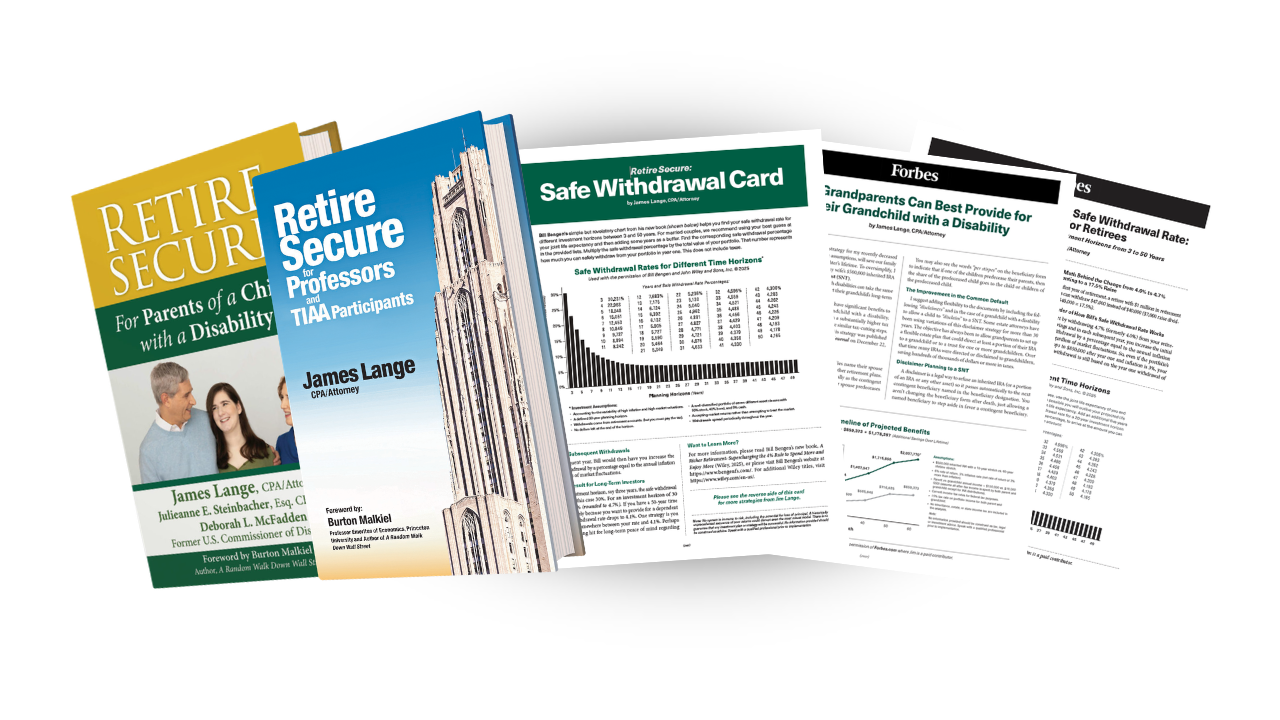
1. Hardcover Book: Retire Secure for Professors and TIAA Participants or Retire Secure for Parents of a Child with a Disability.
2. A laminated Safe Withdrawal Card.
3. Jim’s article published on Forbes.com regarding the increased safe withdrawal rate.
4. Jim’s new article published on Forbes.com for grandparents of a grandchild with a disability.
Disclaimer: Lange Accounting Group, LLC offers guidance on retirement plan distribution strategies, tax reduction, Roth IRA conversions, saving and spending strategies, optimized Social Security strategies, and gifting plans. Although we bring our knowledge and expertise in estate planning to our recommendations, all recommendations are offered in our capacity as CPAs. We will, however, potentially make recommendations that clients could have a licensed estate attorney implement.
Asset location, asset allocation, and low-cost enhanced index funds are provided by the investment firms with whom Lange Financial Group, LLC is affiliated. This would be offered in our role as an investment advisor representative and not as an attorney.
Lange Financial Group, LLC, is a registered investment advisory firm registered with the Commonwealth of Pennsylvania Department of Banking, Harrisburg, PA. In addition, the firm is registered as a registered investment advisory firm in the states of AZ, FL, NY, OH, and VA. Lange Financial Group, LLC may not provide investment advisory services to any residents of states in which the firm does not maintain an investment advisory registration. Past performance is no guarantee of future results. All investing involves risk, including the potential for loss of principal. There is no guarantee that any strategy will be successful. Indexes are not available for direct investment. If you qualify for a free consultation with Jim and attend a meeting, there are two services he and his firms have the potential to offer you. Lange Accounting Group, LLC could offer a one-time fee-for-service Financial Masterplan. Under the auspices of Lange Financial Group, LLC, you could potentially enter into an assets-under-management arrangement with one of Lange’s joint venture partners.
Please note that if you engage Lange Accounting Group, LLC and/or Lange Financial Group, LLC for either our Financial Masterplan service or our assets-under-management arrangement, there is no attorney/client relationship in this advisory context.
Although Jim will bring his knowledge and expertise in estate planning to this workshop and to the meetings, it will be conducted in his capacity as a financial planning professional and not as an attorney. This is not a solicitation for legal services.