
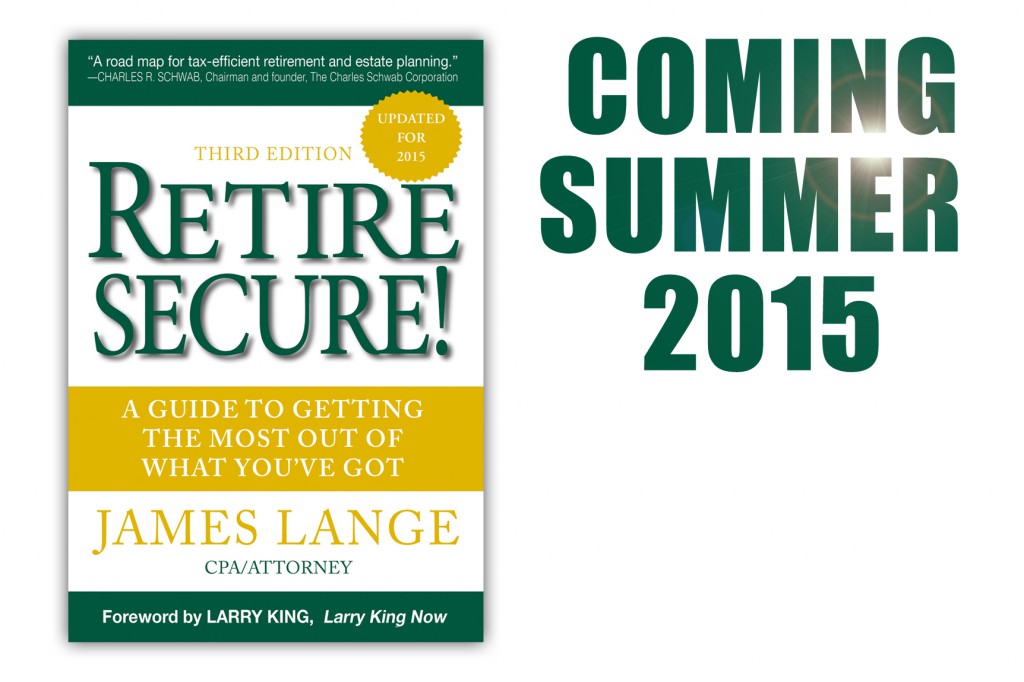
The new edition of Retire Secure! A Guide to Getting The Most out Of What You’ve Got is the distilled and concentrated version of the recommendations we have developed over 30 years. It is particularly useful for IRA and retirement plan owners.
We will soon be sending our clients a copy with a personalized note directing you to what we think will be the most relevant sections for you to read. This personalization has been a huge project, but it’s something that I think will be enormously helpful to you.
Retire Secure! will be available for purchase in bookstores and on Amazon in October. However, if you absolutely cannot wait, the book is available for Kindle and Amazon pre-order here.

The core concepts of the current edition are similar to the two previous editions (Wiley, 2006 and 2009). Recent legislative changes, however, have led to important strategy adjustments that are incorporated in the latest edition.
- In Part 1, The Accumulation Years, we include some new strategies that were not available in 2009.
- In Part 2, The Distribution Years, we cover how to spend down retirement funds in the right order to manage your assets wisely, but that area is more complicated than ever because of some of the new tax laws. We have also updated recommendations for Roth conversions, and the impact of a potential new law for IRA and retirement plan owners and their families — the death of the stretch IRA. It could be devastating for your children. Though there is no perfect answer, I do address some of the best strategies I know to reduce the pain of the likely changes in the IRA law.
- In Part 3, we’ve updated the Eddie and Emily Estate Planning case study. Essentially, it incorporates the updated Lange’s Cascading Bene ficiary Plan, which many of you already have in your wills and trusts.
If you’ve read previous versions of Retire Secure!, I hope you’ll fi nd the updates and changes enlightening. To make the new material easier to find, I have included a section that highlights the changes. And if you’re new to the book, I hope you’ll take this as an opportunity to really educate yourself on these principles and sound practices. There’s mathematical proof that optimizing the strategies you use to approach saving, investing, estate planning, and distributing assets could mean a di erence of millions of dollars over your lifetime and for your heirs.
It’s my fervent wish that Retire Secure! will help you live a happier, healthier, and more secure life!
Jim
 Those of you who have been following me for a while know that that one of my most cherished mantras is “Pay Taxes Later!” An extension of that mantra was my recommendation that, upon your death, your beneficiaries continue to take advantage of the minimum distribution rules to “stretch” your IRA for as long as possible so that they could achieve the maximum tax-deferred growth possible. This used to be a fairly straightforward concept but, with the increase in second and third marriages, as well as non-traditional marriages, it has become much more complicated.
 A nationally recognized IRA, Roth IRA conversion, and 401(k) expert, he is a regular speaker to both consumers and professional organizations. Jim is the creator of the Lange Cascading Beneficiary Plan™, a benchmark in retirement planning with the flexibility and control it offers the surviving spouse, and the founder of The Roth IRA Institute, created to train and educate financial advisors.
 In January of 2015, President Obama proposed eliminating the tax-free benefits of Section 529 college savings plans. Under his proposal, savings would grow tax-deferred, but withdrawals would be taxed as income to the beneficiary (usually the student). His belief was that taxpayers who save in 529 plans are families who can better afford the cost of college than everyone else. In reality, it is estimated that close to ten percent of 529 accounts are owned by households having income below $50,000, and over 70 percent are owned by households with income below $150,000. What isn’t surprising, though, is that the tax revenue realized by this action would have been significant, because as of the end of the 4th quarter of 2014, the assets held in 529 and other college savings plans reached almost a quarter of a trillion dollars. How many students would have been forced to apply for loans if they had been required to pay tax on withdrawals from their college savings plans? Fortunately, the House of Representatives thought differently than the President and, in February of 2015, they passed HR 529. This bill not only maintains the tax-free status of 529 plans, but also makes them more flexible and easier to use. Hopefully the Senate will follow the House’s lead and pass a companion bill with similar provisions.
 Over the years, I’ve been challenged by clients who present me with questions that even King Solomon in his infinite wisdom couldn’t answer. Other questions, complicated though they might be, are much easier to manage because they can be solved by running the numbers.
 The Third Edition of Retire Secure! is almost complete!