

Charitable Remainder Trusts – A Potential Solution To The SECURE Act

Forbes.com Logo White

Charitable Remainder Trusts – A Potential Solution To The SECURE Act

by James Lange, CPA/Attorney

Reprinted with permission of Forbes.com where Jim is a paid contributor.

Happy Older Couple (6) (1)

Big Picture with Charitable Remainder Trusts

Before I get immersed in the details, the big picture that I’m presenting in this post is that there are many situations where your children would get more money and a steadier income if you named a charitable remainder trust as the beneficiary of your IRA than if you named your children directly. If you have a million dollars or more in your IRA, even if you aren’t very charitable, you should at least consider naming a charitable remainder trust as the beneficiary of your IRA.

What is a Charitable Remainder Trust?

First of all, when I say a charitable remainder trust, what am I talking about?

In this context, I am talking about naming a trust as the beneficiary of your IRA or retirement plan. Of course, if you are married, you would name your surviving spouse as the primary beneficiary. In this post, I will compare naming your children as the contingent beneficiary after your spouse (or your children if you don’t have a spouse you are providing for) to naming a charitable remainder trust.

To oversimplify, the trust would provide your beneficiary (let’s assume your child) with a distribution that has some, but not a complete correlation to the income of the trust, and then at the child’s death the amount remaining in the trust would go to the charity of your or even your child’s choice. Actuarially, the charitable remainder trust must be set up in a way that the charity receives 10% of the present value of the bequest at the date of death but that leaves 90% for your children. When you take into the enormous tax benefits of the charitable remainder trust and the draconian tax treatment of leaving your IRA to your children directly, your children often get more value, sometimes by hundreds of thousands of dollars, than if you just leave the IRA outright to them.

Below I present the very favorable math of the charitable trust for your family. Having charity in your heart is a major bonus. If you like the idea of maintaining a significant amount of money in the tax deferred environment and having your beneficiary get regular distributions for the rest of his or her life, especially if it results in more money for your children, then charitable remainder trusts should at least be considered.

The charitable remainder trust can to some extent be treated as a stretch IRA.

To get the best results, leaving your IRA to someone other than your spouse requires strategic planning. Let’s go back to exempt beneficiaries. In addition to your spouse, charities and charitable trusts are also exempt from the 10-year tax acceleration rule. To utilize this exemption to the 10-year tax acceleration rule, you could establish a Charitable Remainder Unitrust (CRUT), or Charitable Remainder Annuity Trust (CRAT) and name it as the beneficiary of your IRA (after naming your spouse as the primary beneficiary assuming you are married).

So, to be clear, this trust is a testamentary trust meaning that it isn’t funded before you and your spouse die. While you and/or your spouse is alive, there is no tax return, no money goes into it, and other than some paper sitting in a fireproof drawer, it doesn’t exist. It is totally revocable meaning you can change it as long as you and/or your spouse is alive. But, after you and your spouse die, if you name it as the beneficiary of your IRA or retirement plan, it becomes irrevocable and the trust comes to life.

Here’s how a CRUT (or a CRAT with minor differences) works at the basic level. When you die or when both you and your spouse are dead, what remains, or a portion of your IRA could be transferred to a CRUT and the IRA can then be liquidated without paying taxes.

The conventional approach would be to leave your IRA directly to your children and/or grandchildren and all of it will be taxed in 10 years. With a CRUT, your children won’t get a lump sum of money when you die, but they also will not face a big tax bill immediately after you die or as big of a tax bill even 10 years after you die. They would receive a regular “income” from the CRUT for the rest of their lives. The distribution would be treated as ordinary income until the amount of the initial IRA plus any interest and dividends earned in the CRUT has been paid to your child. After the ordinary income has been distributed, then capital gains would be distributed. Finally, when your children die, whatever is left in the CRUT goes to the charity of your or their choice.

Although you probably have some charity in your heart, you would most likely rather see your children get the bulk of your money rather than your favorite charity. Me too. The reason that this is an idea worth considering is that the money that goes into the CRUT in this case, your IRA isn’t subject to the new rules governing after-death IRA distributions.

A CRUT, since it is an exempt beneficiary, can mimic the benefits of the stretch IRA by paying out the IRA income over a period of more than ten years and providing your heirs with a steady income over their entire lifetimes. Distributions from a CRUT can be stretched and taxed over your child’s life (if you have no spouse) or after the deaths of you and your spouse. I like to look at everyone’s unique situation and I like to do the math.

Disadvantages of a CRUT

  • You need to have an attorney draft the CRUT.
  • You need to name a trustee.
  • You can expect to pay an additional $500 to $2,000 or sometimes more every year for the remainder of the beneficiary’s life, to maintain the trust from a legal and tax compliance standpoint. You not only need to file a special CRUT tax return, but you also must file a K-1 with the beneficiary which complicates his return. The additional complication and aggravation of drafting and more importantly maintaining the charitable trust for the life of your child or children should not be underestimated.
  • The trustee of the CRUT is required to report the income that the beneficiary receives to the IRS and must send to each beneficiary a form called a K-1 which complicates the beneficiary’s own tax return. If your beneficiary lives for 20 years, it’s not unrealistic to think that the fees required to maintain the trust could exceed $20,000 or even $40,000.
  • Ultimately you could be creating significant complications for less tax savings than you would have realized if you had just left the money to your child instead of the CRUT.
  • If you leave your IRA to a CRUT, it could potentially hurt your family. If the income beneficiary of the trust (most likely, your child) dies prematurely, the remaining balance will go to the named charity and not to your grandchild like it would if you just left the IRA to your child. So, there is a very real risk with a CRUT, and it would likely not be a good choice if your beneficiary has a reduced life expectancy. The answer to that objection is to buy a term life insurance policy on the income beneficiary with a trust for his or her child or children as the beneficiary of the policy.

Advantages of a CRUT

  • Including a CRUT as part of your estate plan may make an enormous difference for the long-term security of your child or children and it may be the best way to maximize the number of dollars your child receives. If you have charity in your heart as well as protecting your family, it may be a wonderful thing.

Let’s compare leaving your million-dollar IRA to a CRUT versus leaving it to your child. What is the best option for the $1 million dollars if she will have to pay income taxes on the entire million (plus growth) within 10 years of your death? Though I could do some post-mortem planning, it will be extremely difficult to protect that distribution from very high tax rates that are projected to get even higher in the future.

To oversimplify, the tax on the $1 million Inherited IRA could be $400,000 leaving your child with net proceeds after taxes of $600,000 plus appreciation.

On the other hand, the CRUT pays no income taxes when you die. So, the income that your child will receive is based on $1 million, not $600,000. What I will show below is that your child may be able to get more money over their lifetime as the beneficiary of a CRUT than if she receives your $1 million IRA outright.

Let’s look at an example. Suppose Alice creates a CRUT that names Roberta as the income beneficiary, and her favorite charity (or charities) as the remainder beneficiary. She stipulates that $1 million of her IRA will be transferred to the trust at her death. Roberta won’t inherit the IRA directly, but she will receive a nice check from the CRUT on a regular basis for her entire life. The amount that she receives is calculated yearly according to a complex formula required by the IRS because there is a minimum amount that must eventually be turned over to the charity in order to get this favorable treatment.

So, which inheritance will benefit Roberta the most, the money outright subject to accelerated taxes or the income from the CRUT? The answer is it depends on what interest rates you assume but perhaps more importantly, and how long Roberta lives.

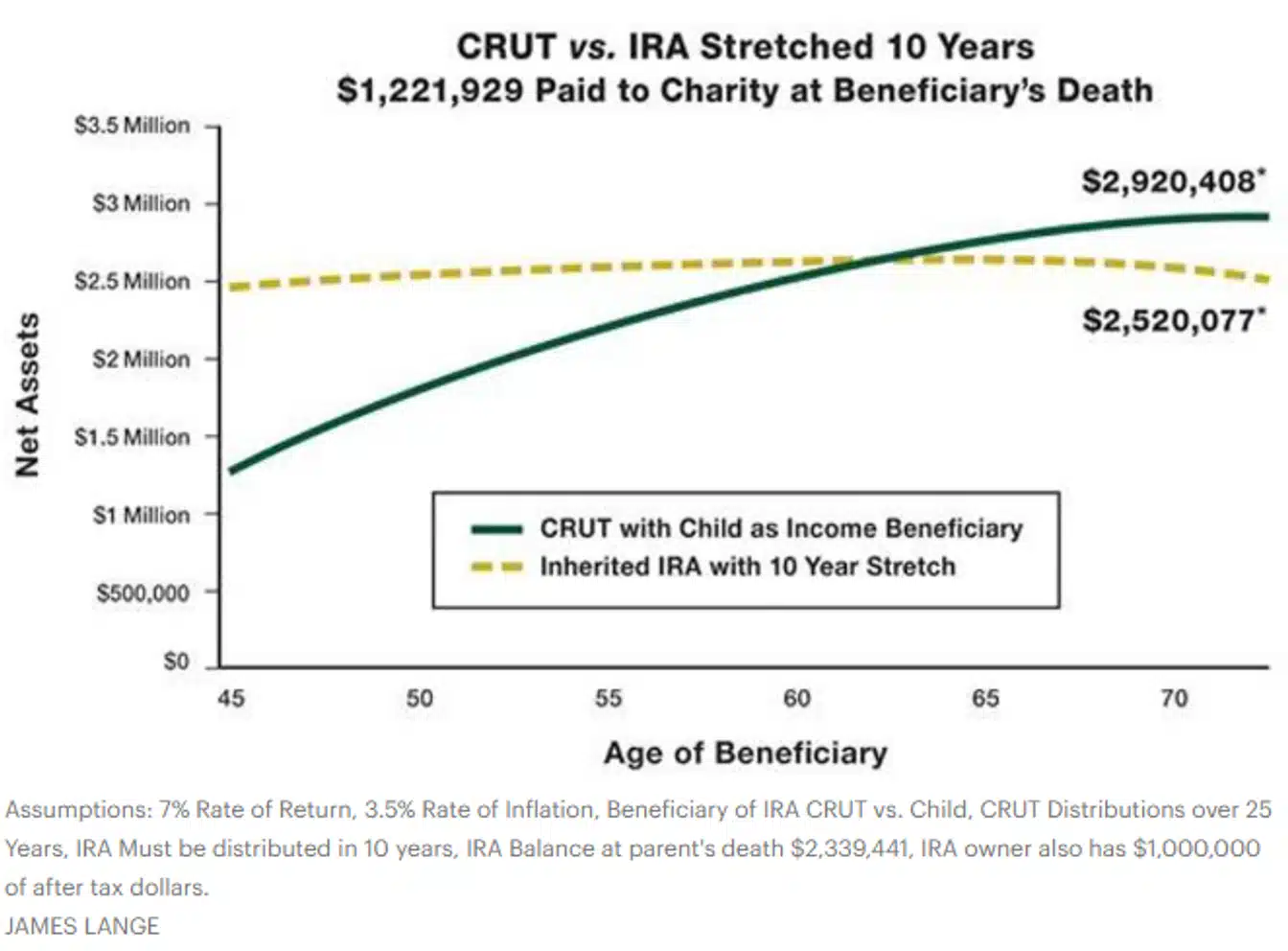
Given certain reasonable assumptions, Roberta would have $400,331 more money if her aunt left her IRA to a charitable trust compared to leaving it outright to Roberta.

Roberta only has to live past the age of 63 to receive more money from the CRUT as compared to inheriting the $1 million IRA stretched over ten years. (The breakeven point may change depending on your circumstances, what assumptions you use, the Section 7520 rate when the CRUT is created and how old your beneficiary is at your death.) The other advantage of the CRUT is that she will have all the protections of a trust including protection from creditors, protection from herself, and in some cases, financial protection from her husband should she divorce or the marriage survives and her husband has different ideas on how she should spend her money. In addition, the charity would get $1,221,929 after Roberta dies.
Key Ideas

  • In many situations it will make more sense to leave your IRA to a charitable trust than to leave it to your children directly. It is possible, even likely, your children will actually end up with more money than if you left the IRA to a charitable trust than if you left it to them outright
  • After the SECURE Act many IRA owners that never had a good reason to closely look at a charitable remainder trust as the beneficiary of their IRA should now consider one.

About Your Presenter: James Lange, CPA/Attorney

James-Lange

Jim is the author of 10 best-selling financial books and has been quoted 37 times in The Wall Street Journal. He has published 21 articles for Forbes.com.


The SECURE Act: Is It Good For You Or Bad For You?

Forbes.com Logo White

The SECURE Act: Is It Good For You Or Bad For You?

by James Lange, CPA/Attorney

Reprinted with permission of Forbes.com where Jim is a paid contributor.

Happy Older Couple (4)

My previous post introduced the potential consequences of the SECURE Act, which is being promoted as an “enhancement” for IRA and retirement plan owners.  This is because it includes provisions allowing some workers to make higher contributions to their workplace retirement plans. I think it is a stinking pig with a pretty bow, so I wanted to give retirement plan owners the good and bad news about it.

I am a fan of Roth IRAs because they allow you to have far more control over your finances in retirement than you might have otherwise had.  You are not required to take distributions from your Roth IRA, but the good news is that they’re not taxable if you do take them.  These tax benefits can be a critical factor for seniors, especially if you are suddenly faced with costly medical or long term care bills.   Saving money in a Roth account can offer financial flexibility to many older Americans – and one good thing about the SECURE Act is that it can help you achieve that flexibility.  Here’s how.

The Good News About The SECURE Act

Under the current law, you are not allowed to contribute to a Traditional IRA after age 70½.  (You can contribute to a Roth IRA at any age as long as you have taxable compensation, but only if your income is below a certain amount.)  The age limitation for making contributions to Traditional IRAs is bad for older workers – and that’s an important point because the Bureau of Labor Statistics estimates that about 19 percent of individuals between the ages of 70 and 74 are still in the workforce.  The SECURE Act eliminates that cutoff and allows workers of any age to continue making contributions to both Traditional and Roth IRAs.

That same provision of the SECURE Act offers a hidden bonus – it means that it will also be easier for older high-income Americans to do “back-door” Roth IRA conversions for a longer period of time.  The back-door Roth IRA conversion, currently blessed by the Tax Cuts and Jobs Act, is a method of bypassing the income limitations for Roth IRA contributions.  The current law prohibits contributions to a Roth IRA if your taxable income exceeds certain amounts.  Those amounts vary depending on your filing status.   But even if you are unable to take a tax deduction for your Traditional IRA contribution, you can still contribute to one because there are no income limitations.  Why bother?  Because, assuming you don’t have any other money in an IRA, you can immediately convert your Traditional IRA to a Roth IRA by doing a back-door conversion.  That’s a good thing because the earnings on the money you contributed can then grow tax-free instead of tax-deferred.

Here’s more good news.  The current law requires Traditional IRA owners to start withdrawing from their accounts by April 1st of the year after they turn 70 ½.  These Required Minimum Distributions (RMDs) can be bad for retirees because the distributions are taxable.  The increase in your taxable income can cause up to 85 percent of your Social Security benefits to be taxed and can also move you into a higher tax bracket.  And once you begin to take RMDs, you are no longer allowed to make additional contributions to your account, even if you are still working.  The SECURE Act increases the RMD age to 72, a change which will allow Traditional IRA owners to save more for their retirements.

There’s a hidden bonus in this change as well.  Increasing the RMD age to 72 will allow retirees more time to make tax-effective Roth IRA conversions.  What does that mean?  Once you are required to take distributions from your Traditional IRA and your taxable income increases, you may find yourself in such a high tax bracket that it may not be favorable to make Roth IRA conversions at all.

The Bad News About The SECURE Act

Now let’s get down to the stinking pig.

The SECURE Act contains provisions about workplace retirement plans that I’m not convinced will be all that good for employees.  Those provisions pale in comparison, though, when compared to the worst part of the SECURE Act – and believe me, it’s bad. That provision requires Traditional and Roth IRAs that are inherited by a non-spouse beneficiary to be distributed within 10 years.  (There are some exceptions for minors and children with disabilities, and IRAs that you leave to your spouse are not subject to the rule at all.)  Withdrawals from Inherited Roth IRAs are not taxable to your beneficiary, so the cost of the SECURE Act to them will be limited in the sense that they will eventually lose the tax-free earnings on their inheritance.  Roth IRAs, however, haven’t been around that long.  They weren’t established until 1997 (as part of the Taxpayer Relief Act), and the amount that you can contribute to them is limited.  Even if you were smart enough to jump on the Roth bandwagon twenty years ago, the big problem that everyone seems to be overlooking is that most of America’s retirement money still lies in taxable Traditional accounts.

The existing law allows owners of Inherited IRAs to “stretch” their RMDs over their lifetimes.  The SECURE Act requires that Inherited Traditional IRAs be distributed within 10 years of the original owner’s death. The SECURE Act essentially means the Death of the Stretch IRA.   Since your heirs will no longer be able to “stretch” the distributions from your IRA over their lifetimes, there will be a massive income tax acceleration for them.  And the younger your heirs are, the worse that acceleration will be.

I talked about the consequences of that tax acceleration in my earlier post.  This provision in the SECURE Act betrays those conscientious savers who socked money away for years under the assumption that they would be able to pass it on to their children in a tax-efficient manner after their deaths. To me, the SECURE Act is particularly egregious because this change comes very late in the game for many IRA and retirement plan owners.  It will be devastating to people who have worked hard their entire lives, played by the rules, and accumulated significant amounts of money in their IRAs and retirement plans. It will be even more devastating for retirees whose IRA and/or retirement plan constitutes the biggest asset in their estate because it potentially means a difference of millions of dollars for their children and grandchildren.

There are some things that you can do to help mitigate the consequences of this bill, and I will cover those in a later post.  Thank you for reading.


About Your Presenter: James Lange, CPA/Attorney

James-Lange

Jim is the author of 10 best-selling financial books and has been quoted 37 times in The Wall Street Journal. He has published 21 articles for Forbes.com.
The Hidden Money Grab In The SECURE Act

Forbes.com Logo White

The Hidden Money Grab In The SECURE Act

by James Lange, CPA/Attorney

Reprinted with permission of Forbes.com where Jim is a paid contributor.

Happy Older Couple (3)

On May 23, 2019 the House of Representatives overwhelmingly passed the SECURE Act (Setting Every Community Up for Retirement Enhancement). A more appropriate name for the bill would be the Extreme Death-Tax for IRA and Retirement Plan Owners Act, because it gives the IRS carte blanche to confiscate up to one third of your IRA and retirement plans.  In other words, it’s a money grab.

The SECURE Act is wrapped with all kinds of goodies that are unfortunately of limited benefit to most established IRA and retirement plan owners.  But if you have an IRA or a retirement plan that you were hoping you could leave to your children in a tax efficient manner after you are gone, you need to be concerned about one provision in the fine print that could cost them dearly. Non-spouse beneficiaries of IRAs and retirement plans are required to eventually withdraw the money from its tax-sheltered status, but the current law allows them to minimize the amount of their Required Minimum Distributions by “stretching” them over their own lifetimes.  This is called a “Stretch IRA”.  Distributions from a Traditional Inherited IRA are taxable, so the longer your beneficiaries can postpone or defer them (and hence the tax), the better off they will be.   The bad news is that the government wants their tax money, and they want it sooner than later.  The ticking time bomb buried in the SECURE Act is a small provision that changes the rules that currently allow your beneficiaries to take distributions from Traditional IRAs that they have inherited and pay the tax over their lifetimes,  virtually cementing “the death of the Stretch IRA.” (The provisions of the SECURE Act also apply to Inherited Roth IRAs, but the distributions from a Roth IRA are not taxable.)

If there is any good news about the SECURE Act, it’s that it does not require your beneficiary to liquidate and pay tax on your entire Traditional IRA immediately after your death.  For many people, that would be a costly nightmare because they would likely be bumped into a much higher tax bracket.  Under the provisions of the SECURE Act, if you leave a Traditional IRA or retirement plan to a beneficiary other than your spouse, they can defer withdrawals (and taxes) for up to 10 years.   (There are some exceptions for minors and children with disabilities etc.) If you leave a Roth IRA to your child, they will still have to withdraw the entire account within 10 years of your death, but again, those distributions will not be taxable.  But any way you look at it, the provisions of the SECURE Act are a huge change from the old rules that allow a non-spouse heir to “stretch” the Required Minimum Distributions from a Traditional Inherited IRA over their lifetime and defer the income tax due.

That’s not the end of the bad news.  Once your beneficiary withdraws all the money from your retirement account, it will no longer have the tax protection that it currently enjoys.  In other words, even if your children inherited a Roth IRA from you and the distributions themselves weren’t taxable, the earnings on the money that they were required to withdraw are another story.  Even if they wisely reinvest all the money they withdrew from their Inherited Traditional or Roth IRA into a brokerage account, they’re still going to have to start paying income taxes on the dividends, interest and realized capital gains that the money earns.

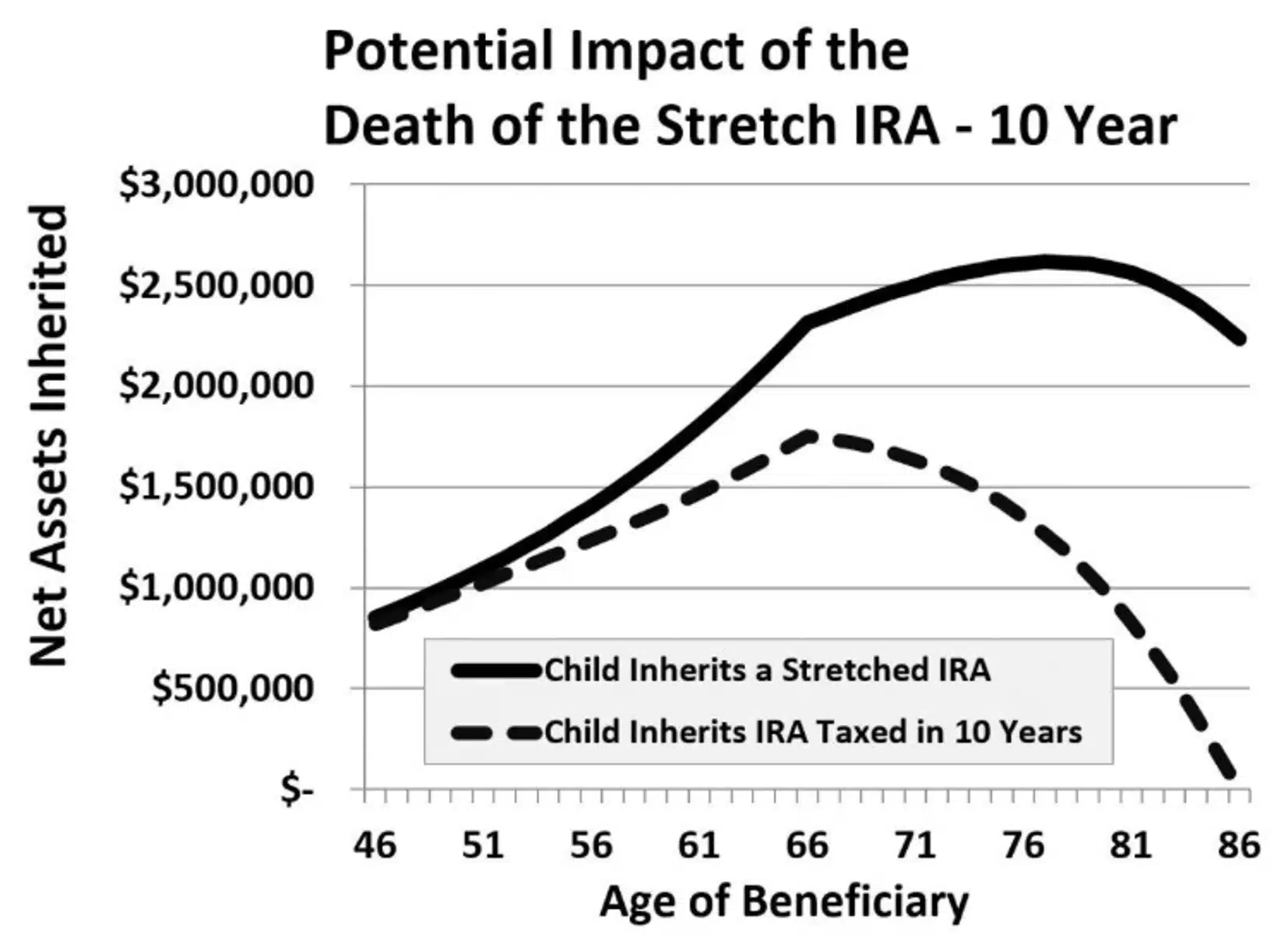
I know there are readers out there who are thinking “it can’t be all that bad”.  Yes, it is that bad.  Here is a graph that demonstrates the difference between you leaving a $1 million IRA to your child under the existing law, and under the SECURE Act:

This graph shows the outcome if a $1 million Traditional IRA is inherited by a 45-year old child, and the Minimum Distributions that he is required to take are invested in a brokerage account that pays a 7 percent rate of return.  Other assumptions are listed below*.  The only difference between these two scenarios is when your child pays taxes! The solid line represents a child who can defer (or “stretch”) the taxes over his lifetime under the existing rules. At roughly age 86, that beneficiary who was subject to the existing law in place still has $2,000,000+.  The dashed line represents the same child if he is required to take withdrawals under the provisions of the SECURE Act.  At age 86, that same beneficiary has $0. Nothing. Nada. The SECURE Act can mean the difference between your child being financially secure versus being broke, yet Congress is trying to gloss over this provision buried in the fine print. I don’t think so!

The House of Representatives passed the SECURE Act by an overwhelming majority, so the probability that the Senate will pass a version of this legislation is quite good. In 2017, the Senate Finance Committee recommended the Death of the Stretch IRA by proposing the Retirement Enhancement and Savings Act (RESA).  In true government fashion, RESA was unbelievably complicated. It allowed your non-spouse beneficiaries to exclude $450,000 of your IRA and stretch that portion over their lifetime – but anything over that amount had to be withdrawn within five years and the taxes paid. And if you had more than one non-spouse beneficiary, the amount that they’d be able to exclude from accelerated tax would have depended on what percentage of your Traditional IRA they inherited.  Imagine trying to plan your estate distribution around those rules!

The Senate is now floating an updated RESA 2019 that seems to say that it will change the original exclusion amount to $400,000.  It will be a good change if it is passed.  That is because instead of each IRA owner getting a $400,000 exclusion, the new version includes language to allow a $400,000 exclusion per beneficiary. When I first read that provision I thought I had either read it wrong, or that it was a typo.    That little detail would be extremely valuable (and make estate planning for IRAs and retirement plans far more favorable), especially for families with more than one child. But even in the Senate version, anything over and above that exclusion amount will have to be distributed (and the taxes paid) within five years of your death (instead of ten years like the House version).

Unfortunately, our “peeps” think the House version of the bill (which has a 10-year deferral period, but no exclusion) will be what eventually becomes law. This is particularly troubling because the Senate version would allow room for far more creative planning opportunities (and tax savings, because of the $400,000 per beneficiary exclusion).  As of the time of this post, Senator Cruz is attempting to hold up the bill, but his reasons have nothing to do with the fine print that affects Inherited IRAs.  The original version of the Act contained provisions about college tuition (Section 529) plans, but those provisions were stripped in the version the House voted on and Senator Cruz wants them restored.  Unfortunately, no one is arguing about the biggest issue with the SECURE Act, which is the massive acceleration of distributions and taxes on your IRA after your death.  And unless someone in Congress objects to the provision in the SECURE Act about Inherited IRAs, your non-spouse beneficiaries will find out the hard way that their elected officials have quietly arranged to pick your pockets upon your death.

I have been a popular guest on financial talk radio lately. Many of the hosts want to blame one political party or the other. I blame all of Congress. This is one of the few truly bipartisan bills that has potential devasting consequences, at least for my clients and readers, and it is highly likely to pass both sides of Congress.  I wonder how many of our legislators in the House actually read this bill or understood what is was they voted for.  Did they realize they are effectively—by accelerating income-tax collection on inherited IRAs and other retirement plans—imposing massive taxes on the families of IRA and retirement plans owners - even those with far less than a million dollars?    Or perhaps they did understand it and hoped that the American public wouldn’t.

If you can’t tell by my tone, I am upset. I am also motivated to examine every strategy that we can use to legally avoid, or at least mitigate, the looming hammer of taxation on your Traditional IRAs and retirement plans. I’m going to address these strategies in a series of posts, so please read them to see how this proposal could affect someone in your specific situation.  Even though the Senate version has a five-year tax acceleration instead of a ten-year, the Senate version could be better for most readers because of the value of the exclusion – especially if you have multiple beneficiaries.

Please check for follow-up posts on this subject.   I will show you some strategies to protect your family from the Death of the Stretch IRA and keep more of your hard-earned money in your hands.

Assumptions used for Graph

  1. $1 Million Traditional IRA inherited by 45-Year Old Married Beneficiary
  2. 7% rate of return on all assets
  3. Beneficiary’s salary $100,000
  4. Beneficiary’s annual expenses $90,000
  5. Beneficiary’s Social Security Income at age 67 $40,000

About Your Presenter: James Lange, CPA/Attorney

James-Lange

Jim is the author of 10 best-selling financial books and has been quoted 37 times in The Wall Street Journal. He has published 21 articles for Forbes.com.