

How Grandparents Can Best Provide for Their Grandchild with a Disability

Forbes.com Logo White

How Grandparents Can Best Provide
for Their Grandchild with a Disability

by James Lange, CPA/Attorney

Reprinted with permission of Forbes.com where Jim is a paid contributor.

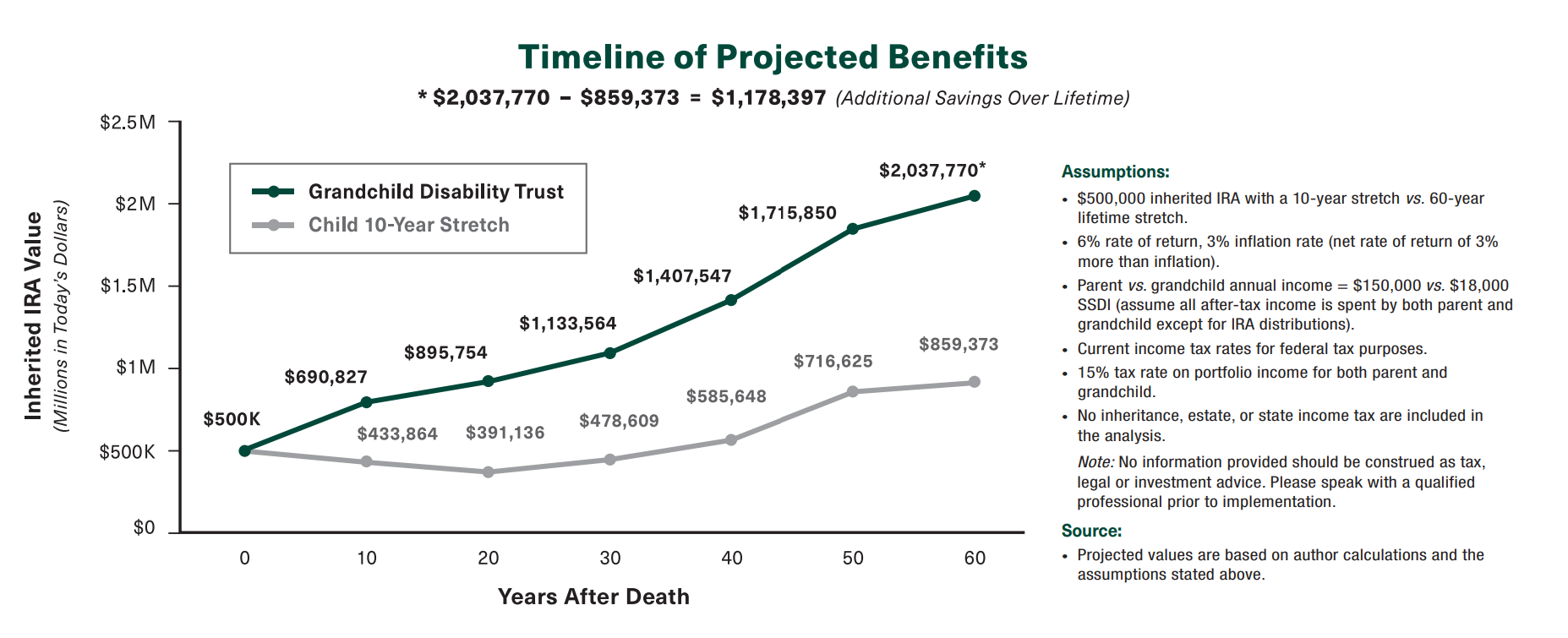
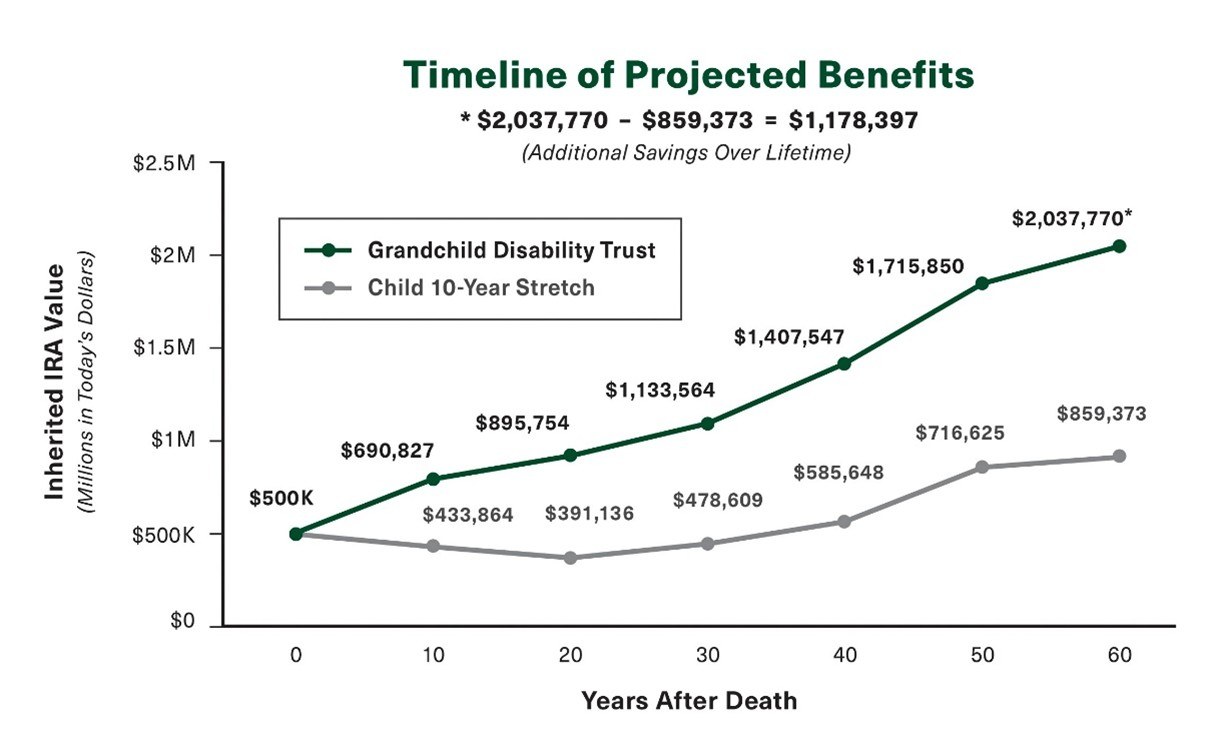
I helped implement a tax saving strategy for my recently deceased father-in-law that, given reasonable assumptions, will save our family $1,178,397 in taxes over our daughter’s lifetime. To oversimplify, I redirected what would have been my wife’s $500,000 inherited IRA to our daughter's Special Needs Trust (SNT).

Many grandparents of children with disabilities can take the same tax-cutting steps we did to help protect their grandchild’s long-term financial security and independence.

Please note this strategy could also have significant benefits to grandparents who don’t have a grandchild with a disability. Grandparents with children, who are in a substantially higher tax bracket than their grandchildren, can take similar tax-cutting steps.

If you are skeptical, please note that this strategy was published and attributed to me in The Wall Street Journal on December 22, 2025 in an article by Ashlea Ebeling.

The Common Default

Most grandparents with traditional families name their spouse as the primary beneficiary of their IRA and other retirement plans. Then, typically, they name their children equally as the contingent beneficiaries of their IRAs. That means if their spouse predeceases them, their children inherit the IRAs equally. You may also see the words "per stirpes" on the beneficiary form to indicate that if one of the children predecease their parents, then the share of the predeceased child goes to the child or children of the predeceased child.

The Improvement in the Common Default

I suggest adding flexibility to the documents by including “disclaimers” (see below) and in the case of a grandchild with a disability to allow a child to “disclaim” to a SNT.

Some estate attorneys have been using variations of this disclaimer strategy for more than 30 years. The objective has always been to allow grandparents to set up a flexible estate plan that could direct at least a portion of their IRA to a grandchild or to a trust for one or more grandchildren. Over that time many IRAs were directed or disclaimed to grandchildren, saving hundreds of thousands of dollars or more in taxes.

Disclaimer Planning to a SNT

A disclaimer is a legal way to refuse an inherited IRA (or a portion of an IRA or any other asset) so it passes automatically to the next contingent beneficiary named in the beneficiary designation. You aren’t changing the beneficiary form after death, just allowing a named beneficiary to step aside in favor of a contingent beneficiary. For most traditional families, I often prefer estate plans that have a series of disclaimers built in on several levels.

Specifically in the context of this article, I am recommending you consider giving your child the choice of accepting their share of their inherited IRA or disclaiming it into the SNT for their child.

Why IRAs and Retirement Accounts Are Especially Well-Suited for a SNT

IRAs and retirement accounts are fully taxable when distributed. Under the current law known as the SECURE Act, for deaths after December 31, 2019, subject to exception, inherited IRAs must be distributed and taxed within ten years after the death of the IRA owner. This often results in massive income tax acceleration for grown children who may already be in high-income tax brackets.

However, when an inherited IRA passes directly or via disclaimer to a SNT for a beneficiary with a disability who qualifies as an Eligible Designated Beneficiary (EDB), the beneficiary can "stretch" distributions—deferring taxes—over their actuarial life expectancy. For a child who likely will need lifetime support, this difference can be life changing.

In our family's case, we benefited in two ways. First, we avoided the standard ten-year distribution of the inherited IRA rule that would have forced my wife to pay income taxes on her portion of her dad's IRA over ten years. Instead, our daughter’s trust will enjoy a 50-plus-year “stretch” based on our daughter's life expectancy. In addition, our daughter, who will receive taxable distributions from the trust will be in a lower income tax bracket than my wife and I. Combining both tax benefits with reasonable assumptions*, our daughter will enjoy $1,178,397 in additional savings over her lifetime. (Please see the graph below for a timeline of the projected benefit of the strategy we recommend.)

James Lange How Grandparents Can Best Provide for Their Grandchild with a Disabilty

*Assumptions

  • $500,000 inherited IRA with a 10-year stretch vs. 60-year lifetime stretch
  • 6% rate of return, 3% inflation rate (net rate of return of 3% more than inflation)
  • Parent vs. grandchild annual income = $150,000 vs. $18,000 SSDI (assume all after-tax income is spent by both parent and grandchild except for IRA distributions)
  • Current income tax rates for federal tax purposes
  • 15% tax rate on portfolio income for both parent and grandchild
  • No inheritance, estate, or state income tax are included in the analysis

Note: No information provided should be construed as tax, legal or investment advice. Speak with a qualified professional prior to implementation.

This plan doesn't work nearly as well today if the grandchild doesn't have a disability, however, there is still an opportunity to use trusts to save taxes when the grandchild is not disabled but their tax rate is considerably lower than their parents’.

My strong recommendation for grandparents of a grandchild with a disability is to consider naming a properly drafted SNT as a contingent beneficiary of their IRA or retirement plan. If the grandchild doesn’t have a disability, then consider including disclaimer provisions either to a grandchild directly or a standard minor’s trust to take advantage of the grandchild’s lower tax bracket.

What Our Family Actually Did

I requested my father-in-law add a SNT for the benefit of our daughter who has a disability as the contingent beneficiary of my wife’s share of the inherited IRA. He did that. After he passed, my wife disclaimed her share of his IRA to the SNT.

With or without disclaimers, if you want to benefit a grandchild with a disability, you usually need a SNT. The SNT can offer protection when an outright inheritance to a grandchild with a disability could threaten eligibility for means-tested benefits like Supplemental Security Income (SSI) and Medicaid. In addition, it can unnecessarily cause a massive income tax acceleration.

How to Enhance This Strategy

What is better than long-term income-tax deferred investments? Long-term tax-free investments. If grandpa or grandma converts some of their IRA to a Roth and that Roth can eventually go to a SNT, the SNT will have the same “stretch” distribution pattern as a traditional IRA, but all the qualifying distributions will be tax-free.

My wife and I made a $250,000 Roth conversion in 1998. That Roth, including the growth from the time that we converted it until our death which will hopefully be a 50-year period, will eventually pass to our daughter, who will stretch that inherited Roth IRA over her lifetime. Our family might get over 90 years of tax-free growth on that Roth conversion. That Roth conversion story, which also created a million dollar plus benefit for our daughter, along with other benefits of Roth conversion planning, was published in Forbes magazine in the February 28, 2019 edition.

Warning

Drafting the trusts, implementing the disclaimers, and taking all the necessary steps to achieve the goals of this article is a minefield where one misstep can cause a massive income tax acceleration. Those considering this strategy are advised to work with a qualified estate attorney and advisor to avoid mistakes.

Furthermore, there is no rush to do anything with the inherited IRA immediately after a death. You have nine months to make a disclaimer. Don’t let the executor, the trustee, the beneficiary, or the financial institution where the money is invested do anything until you have all your ducks in a row, that is, when the strategy and the mechanics of what to do are clearly defined. I have seen a lot of wonderful disclaimer opportunities ruined because someone did something they should not have done after death.

The banker we dealt with would have made a deadly mistake that would have killed the “stretch” for our daughter had I not been so diligent to make sure everything was done right.

The Takeaway

If a family includes a grandchild with a disability, naming a SNT as a contingent beneficiary of an IRA either directly or through a disclaimer is one of the highest impact planning moves available. Converting part of that IRA to a Roth is like adding the cherry on top.

Directing IRAs or retirement accounts—or better yet Roth IRAs—to a SNT can easily save families with a $500,000 IRA or more hundreds of thousands of dollars per beneficiary (sometimes well over $1M in taxes) and provide lifetime support for a grandchild with a disability. The evidence is in the track record of families who got it right, including mine.

How can I leave my IRA to a grandchild with a disability without disqualifying them from SSI or Medicaid?

What is a disclaimer in estate planning, and how can it help my family save on taxes?

Can an inherited IRA be stretched over a lifetime if the beneficiary has a disability?

Why are IRAs and retirement accounts especially well-suited for funding a Special Needs Trust (SNT)?

How can Roth IRA conversions benefit a grandchild with a disability?

About James Lange, CPA/Attorney

James-Lange

Jim is the author of 10 best-selling financial books and has been quoted 37 times in The Wall Street Journal. He has published 21 articles for Forbes.com.
Bill Bengen’s New 30-Year Safe Withdrawal Rate: A 17.5% Raise for Retirees

Forbes.com Logo White

Bill Bengen’s New 30-Year Safe Withdrawal Rate: A 17.5% Raise for Retirees

by James Lange, CPA/Attorney

Reprinted with permission of Forbes.com where Jim is a paid contributor.

Bill Bengen’s research on retirement withdrawals has shaped financial planning for decades. He is widely recognized as the originator of the “4% rule,” a guideline that has been referenced in countless academic papers, financial planning articles, and media discussions about how retirees can safely draw income from their portfolios.

In his latest research, Bill unveils an updated safe withdrawal rate for a traditional 30-year retirement horizon—raising it from 4.0% to 4.7%. This increase effectively represents a 17.5% raise for retirees who follow the framework. The updated guidance is explained in detail in his book A Richer Retirement: Supercharging the 4% Rule to Spend More and Enjoy More.

This article draws heavily on Bill Bengen’s groundbreaking research and recent updates. Bill was kind enough to review this article, and his insights are incorporated throughout.

The Math Behind the Change from 4.0% to 4.7% — A 17.5% Raise

The increase from 4.0% to 4.7% stems primarily from updated assumptions. In the past, Bill based his calculations on a simple 50/50 portfolio of U.S. stocks and bonds. His new model assumes a well-diversified portfolio consisting of multiple asset classes.

For retirees, the impact can be meaningful. In the first year of retirement, a retiree with $1 million in savings could withdraw $47,000 instead of $40,000. That $7,000 increase represents a 17.5% raise in spending power.

Reminder of How Bill’s Safe Withdrawal Rate Works

The method begins by withdrawing 4.7% from your retirement portfolio during the first year. In each following year, you increase that initial withdrawal amount by the annual inflation rate—regardless of how the market performs.

For example, if you withdraw $47,000 in year one and the portfolio declines to $850,000 by the end of that year while inflation runs at 3%, your year-two withdrawal would still be based on the first-year withdrawal amount. In this case, you would increase the $47,000 by 3%, resulting in a withdrawal of $48,410 in year two.

Why Investment Horizons Matter

Few retirees have a perfectly defined 30-year investment horizon. Some individuals will need retirement income for only a few years, while others may require income for forty or even fifty years.

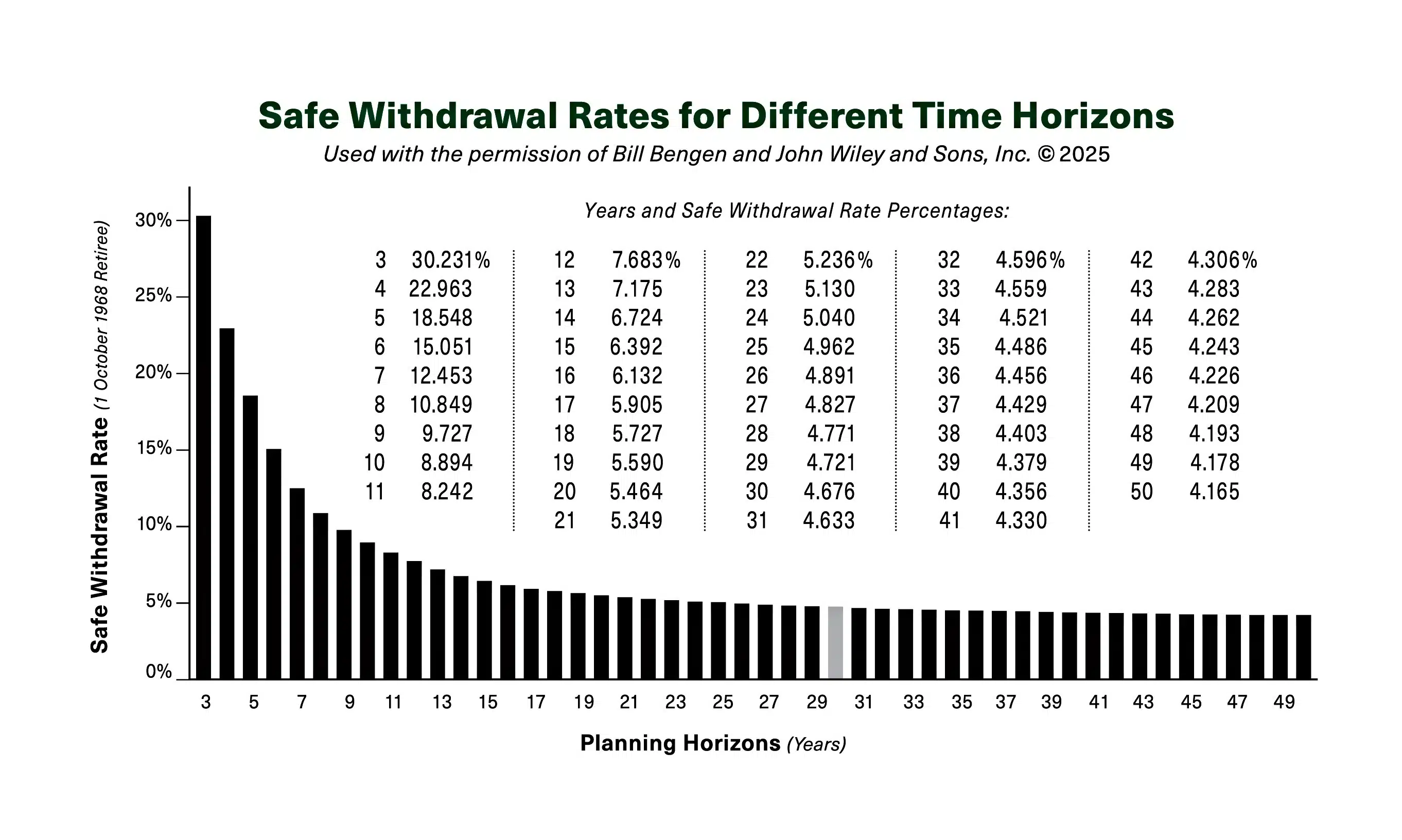
Bill’s updated research includes a chart showing safe withdrawal rates for investment horizons ranging from 3 to 50 years. The chart, reproduced from page 81 of his book, provides a practical roadmap for retirees who want to match their withdrawal strategy to their own realistic planning horizon rather than relying on a one-size-fits-all rule.

For example, someone with a ten-year investment horizon could safely withdraw about 8.894%, while someone planning for twenty years could withdraw about 5.464%.

Bill Bengen Safe Withdrawal Rate ChartWhat the Chart Reveals and Why it Could Be Life Changing

The chart illustrates withdrawal percentages over a 50-year timeline using the experience of retirees who began retirement on October 1, 1968—the worst retirement start date in recorded U.S. history.

Those retirees experienced both a severe bear market and the high inflation of the 1970s. Even under those historically difficult conditions, the updated withdrawal rates held up. This makes the projections conservative, meaning that most retirees are likely to experience outcomes that are even better.

The Practical Impact for Retirees

Understanding safe withdrawal rates allows retirees to estimate how much they can confidently spend without worrying about running out of money.

Beyond the math, the lifestyle implications can be significant. Safely spending more may allow retirees to travel more frequently, pursue hobbies, or enjoy meaningful experiences with family.

My father-in-law, who is 101 years old, sponsors an annual family vacation for all of his children, spouses, grandchildren, and now great-grandchildren. What a legacy! Experiences like these often provide far greater long-term satisfaction than material purchases.

Alternatively, some retirees may choose to make financial gifts to their children when they need it most rather than leaving everything as an inheritance later. Even if you ultimately decide not to increase your spending, the updated research may at least reduce the fear of outliving your money.

If Leaving a Legacy Is a Goal

If you want to preserve assets for heirs, you can adjust your withdrawal rate accordingly. For example, one projection assumes a starting portfolio of $1,000,000 with a 30-year horizon. By reducing the withdrawal rate from 4.67% to about 4.21%, the model suggests you could leave a legacy of at least $500,000 in today’s dollars.

Caveats and Conclusion

No financial model is immune to risk. A historically unprecedented sequence of poor market returns could disrupt even the most carefully constructed framework. Bill himself acknowledges that other withdrawal methods also exist.

However, his framework remains one of the most widely recognized and extensively studied approaches to retirement spending. After more than thirty years of analysis and testing, it continues to provide a practical foundation for retirement planning.

Whether your planning horizon is 3 years, 30 years, or 50 years, Bill’s updated research offers retirees a valuable roadmap for spending confidently while minimizing the risk of running out of money.

Additional Planning Considerations

While Bill’s research focuses on withdrawal rates, a comprehensive retirement plan should also consider tax planning and estate strategies. The suggestions below are not Bill’s, but mine, and there are many exceptions.

  • Optimize Social Security planning so that the spouse with the stronger earnings record waits until age 70 to collect.
  • Consider the equity in your home by evaluating options such as a HELOC or reverse mortgage.
  • Evaluate the potential role of immediate annuities for retirees with long life expectancies.
  • Consider a series of Roth IRA conversions.
  • Spend after-tax dollars first, then traditional IRAs, and Roth IRAs last.
  • Prepare estate planning documents utilizing Lange’s Cascading Beneficiary Plan℠.

When it comes to determining how much money you can safely withdraw from your retirement portfolio, Bill Bengen’s research remains one of the most influential frameworks available. Applying his insights can help retirees pursue both financial security and a fuller, more enjoyable retirement.

We have also created an online companion calculator available. You can enter your planning horizon and portfolio value to estimate your first-year withdrawal amount. Please keep in mind this does not include taxes.

Is the 4% rule for retirement withdrawals still accurate?

How much can I safely withdraw from my retirement savings each year without running out of money?

How can I calculate my safe withdrawal rate if my retirement will be shorter or longer than 30 years?

Why did Bill Bengen change his 4% rule to 4.7%?

How do I determine my retirement investment horizon?

Can I really spend more in retirement than the 4% rule suggests?

About James Lange, CPA/Attorney

James-Lange

Jim is the author of 10 best-selling financial books and has been quoted 37 times in The Wall Street Journal. He has published 21 articles for Forbes.com.
Homeowners: How to Generate $2,400/Month for Life from Your House

Forbes.com Logo White

Homeowners: How to Generate $2,400/Month for Life from Your House

by James Lange, CPA/Attorney

Reprinted with permission of Forbes.com where Jim is a paid contributor.

The Problem

In today’s volatile economic environment, even well-prepared retirees are feeling anxious. Many investors now fear a prolonged downturn in the market and are tempted to reduce their market exposure. But they know that at least historically investors who stay in the market do better. As a result, articles appearing in respected journals are not necessarily recommending wholesale changes to portfolios but are cautioning investors to reduce spending.

I don’t like that advice, especially for homeowners over the age of 62 who want to continue enjoying their retirement without cutting back on meaningful experiences like travel, making lifetime gifts to their children and grandchildren, and sponsoring those treasured multi-generational family vacations. If you fall into that category and own your home outright or have only a modest mortgage remaining, there may be a potentially powerful solution available to you.

A Potential Solution You Probably Have Not Considered

One strategy worth examining is the thoughtful use of your home equity to support your cash flow needs. The equity in your home can be tapped tax-free to create a liquid reserve, provide a steady monthly income stream, or serve as a buffer during periods of market downturn. You can draw on it only when needed, or structure it to provide supplemental income without dipping into your investment portfolio. In essence, it allows you to utilize a portion of your home equity to support current or future spending in retirement.

This idea is not new, and it’s not fringe. Even the most aggressive variation of using the equity in your house for income―a reverse mortgage―is a $1.93 billion dollar market and is expected to expand to $3.2 billion dollars by 2033. In an article I wrote for Forbes.com, Let the Equity of Your Home Pay for Your Roth IRA Conversion, I explored how, in certain circumstances, home equity could be used to fund tax-saving strategies without increasing IRA withdrawals.

At first glance, these ideas might seem counterintuitive, especially to those of us who grew up believing that the ultimate financial milestone was owning your home free and clear. But in many cases, using your home as a financial safety valve may offer more freedom, flexibility, security, and peace of mind than you previously imagined.

Though there are many variations, I will look at a few.

Home Equity Line of Credit (HELOC)

You could take out a home equity line of credit. A HELOC gives you access to tax-free funds if the need arises in the future. If the market goes down and you want to avoid drawing from your portfolio, you can borrow from your HELOC to cover living expenses temporarily. Applying for a HELOC can be a relatively low-cost and noncommittal transaction. Of course, once you draw from it, you must begin making payments. These typically start as interest-only and later include both principal and interest.

Reverse Mortgage

Another strategy, one that often receives more skepticism, is taking out a reverse mortgage. But before we evaluate the pros and cons, let’s start with a couple of real-world examples with identifying details changed to preserve confidentiality.


Two Reverse Mortgage Successes

One of my clients got a reverse mortgage that has paid him $2,000/month for over 20 years and he will continue to receive that payment for the rest of his life. That monthly income allows him to stay in the home he loves and fund the lifestyle he enjoys.

Let’s say he lives another 10 years and dies in his home. He will have spent an additional $540,000 during his retirement, and when the house is sold, the loan is satisfied, and the remaining equity will be distributed to his estate. The estate will be smaller, but the income gave him the freedom to enjoy his life and help out his kids while they were younger.

Another client, recently widowed, lived in a high-maintenance condominium that she loved. After her husband’s prolonged expensive illness, her savings were no longer sufficient to cover taxes, insurance, condo fees, and other living expenses. A reverse mortgage allowed her to stay in her home and live comfortably, even if she lives beyond age 100.

Before I go any further, let me be clear: a reverse mortgage is not the right move for everyone. But for some retirees—particularly those seeking additional monthly income or access to liquidity without tapping investment accounts—it might be a powerful tool. At the very least, understanding how reverse mortgages work can provide peace of mind just knowing that a back-up option exists.

So, what might this actually look like? Let’s walk through a couple of realistic examples, using current numbers.


Scenario 1: A Couple, Both Age 70, with a $1 Million Paid-Off Home

A married couple, both 70, own their home outright and want to supplement their monthly income by about $2,000 without drawing down their IRA or brokerage accounts.

Here is what a reverse mortgage could provide based on current conditions:

  • Monthly payout: $2,389 for the life of the surviving spouse
  • Alternative option: $375,000 line of credit (LOC)
  • Upfront closing costs: approximately $33,700 (can be financed)
  • LOC growth if unused:
    • Year 5: $522,000
    • Year 10: $726,500
    • Year 15: Just over $1 million

Even if the loan balance grows significantly over time due to compounding interest, any remaining equity after the home is sold belongs to the couple or their estate. And thanks to FHA insurance, if the home sells for less than the loan balance, the estate and heirs are not responsible for the shortfall.

Scenario 2: A Couple, Both Age 80, with a $1 Million Paid-Off Home

At age 80, a couple would qualify for more favorable terms because reverse mortgage payouts increase with age:

  • Monthly payout: $3,356 for the life of the surviving spouse
  • Alternative option: $448,000 LOC
  • Upfront closing costs: roughly $33,700 (can be financed)

As in the earlier scenario, an unused LOC will continue to grow, providing a flexible and inflation-resistant source of funds.

A Note if Your House Isn’t Worth $1 Million

Reverse mortgages aren’t just for million-dollar homes. A fully paid-off home worth $440,000 would support a $1,000 per month payment for life under current assumptions.

What if it Passes the Math Test but Flunks the Stomach Test?

For a financial strategy to “work,” it must pass both the math and the stomach test. Our office “ran the numbers” that supported a great return on home equity solutions, but the wife wasn’t comfortable. They worked and sacrificed for 30 years to get their mortgage paid off. That was the end of the discussion.

What Our CPAs Think

Before uploading this article to Forbes.com, I ran the idea by two of our CPAs. They agreed that the strategy makes sense in the scenarios outlined in this article and saw the potential value of using a reverse mortgage under other appropriate conditions as well. But they also pointed out that $33,700 is a lot to pay upfront—especially if you aren’t sure you’ll ever need or use the funds.

So, their primary caution was that reverse mortgages involve meaningful upfront costs and if the line of credit is never tapped, the benefit may not justify the expense. Fair point! That said, when integrated thoughtfully into a long-term cash flow plan, especially in volatile markets, the strategy can offer real advantages.

Why Pay the Cost if You Don’t Plan to Use it Right Away?

There are several reasons. You are essentially locking in access to a tax-free source of funds that grows over time and does not require repayment as long as you remain in the house. The loan amount or income stream can increase, even if housing prices stagnate. The LOC can serve as an emergency reserve or supplement your income at a time when other buckets (like stocks) are temporarily down. And the closing costs can be financed.

Key Advantages of Reverse Mortgages

  • No monthly payments required
  • Proceeds are not taxable income
  • You retain ownership and enjoyment of living in your home
  • Guaranteed ability to remain in your home for life (provided you pay the property taxes and insurance)
  • Flexibility to access funds via monthly payment, lump sum, or growing LOC

Important Caveats

  • If you expect to move or downsize within five years, the upfront costs will likely outweigh the benefits may not be justified.
  • If your highest priority is leaving the largest possible estate, this may not be the best fit.
  • Not all properties (especially condos) are FHA-approved.
  • The FHA lending limit currently caps eligible home value at $1.2 million in Pennsylvania.
  • You must qualify based on income, credit, and other factors.

Final Thoughts

“Buyers beware”―not all FHA reverse mortgages are the same. As with anything, costs, interest rates, and terms vary widely among lenders. The difference can significantly impact how much you can borrow and how much equity is eventually retained by you or by your heirs. Comparison shopping is essential.

Whether or not you decide to pursue a HELOC or reverse mortgage, knowing that these options are available can increase your financial confidence and reduce the pressure to pull funds from investments at the wrong time.

To help evaluate the potential benefits, I consulted Craig Schweiger, Co-Founder and Partner at Federated Reverse Mortgage. I chose Craig because he and his firm had excellent client reviews and a strong reputation for ethical, client-first advice. Craig provided the quotes and calculations cited in this article and also contributed helpful editorial feedback.

Of course, there are many options and providers of home equity type loans. Craig is just one option. I do not receive any compensation from Craig or any other mortgage broker.

Did I Do It Myself?

I used a variation of utilizing the equity of my home to fund expenses in the past. I refinanced several times and used the proceeds of the loan to not only pay off a prior loan but to finance additional spending. I didn’t do a reverse mortgage, but did enjoy the tax-free proceeds of the mortgages. I still have a balance on the mortgage at a low rate making a reverse mortgage unattractive.

Another reason I didn’t go for a reverse mortgage recently is because our estate planning is shaped by the need to provide long-term support for our daughter with a disability.

Variations of using the equity in your home to finance additional spending takes a variety of forms but often is an effective strategy. Even if you decide not to take action, just knowing that at some point in the future, you could potentially borrow money using the equity of your home gives you additional options.

Special thanks to Erika Hubbard for her assistance with writing this article.

The foregoing content reflects the opinions of Lange Financial Group and is subject to change. Content provided herein is for informational purposes only and should not be used or construed as investment advice or a recommendation regarding the purchase or sale of any security. There is no guarantee that the statements, opinions, or forecasts provided herein will prove to be correct.

Past performance may not be indicative of future results. Securities investing involves risk, including the potential for loss of principal. There is no assurance that any investment plan or strategy will be successful, or that markets will recover or react as they have in the past.

Can I really generate income for life from my house without selling it?

How much monthly income can I generate from my house?

What are my options for generating income or liquidity from my home equity?

Is a reverse mortgage the only way to generate income for life from your house?

Is a reverse mortgage safe, and will my heirs still inherit anything?

About Your Presenter: James Lange, CPA/Attorney

James-Lange

Jim is the author of 10 best-selling financial books and has been quoted 37 times in The Wall Street Journal. He has published 21 articles for Forbes.com.

Run the Numbers, Then Check Your Gut

Forbes.com Logo White

Run the Numbers, Then Check Your Gut

by James Lange, CPA/Attorney

Reprinted with permission of Forbes.com where Jim is a paid contributor.

There are things in life that are not a matter of opinion. They are a matter of math.

We do not believe that financial decisions, whether they are about Roth IRA conversions, a snowbird lifestyle, or a gifting program for your children and grandchildren, should be based on an inclination or an unexamined “gut feeling.” Financial decisions should be based on a combination of goals and math. That isn’t to say ignore your gut either. Do the math yourself or get professional help and then decide.

If no one “runs the numbers” and you make critical financial decisions based on your gut, you will likely fail to optimize your and your family’s wealth and security.

We believe in using peer-reviewed mathematical principles and adhering to proven academic data-driven planning to enhance your finances. Yes, the results will depend on the assumptions used to make the projections. But you can begin by using assumptions that you think are reasonable, then you can or someone you hire can “run the numbers” using alternate assumptions to test multiple options. The goal of running the numbers is to arrive at the best solution given your personal goals, values, and your individual financial situation.


Roth Accounts

I have a reputation for being a strong advocate for Roth IRA conversions for people of all ages. But that generalization doesn’t reflect what I really believe. I like to find the best mathematical solution consistent with a client’s values. It just so happens for most clients, at some point in their lives, the client and their family can benefit considerably from a series of Roth IRA conversions. Running the numbers and doing the math can also help you determine the appropriate timing and the amount of a Roth conversion.

I will be the first to admit that Roth IRA conversions are not beneficial for every person or every situation. But follow the math. If you run the numbers projecting the growth for not only your life expectancy, but also for the life expectancy of your children, you will likely get a better result than your gut might have led you to believe.


The Desire to be a Snowbird

Roth conversions are only one example where doing the math can make a major difference. What if you want to rent or buy a second home. Can you afford it? Do the math. Just recently a client who never considered spending several months in Florida every year because he didn’t think he could afford it found out he could easily afford it after doing the math.


Using Disclaimers in Beneficiary Designations is Also About Numbers

I also think that doing the math is very important when it comes to estate planning. Disclaimers allow named beneficiaries to “disclaim” a bequest and then that bequest goes to the “next in line.” A common disclaimer option would be to allow the surviving grandparent to disclaim to their children or at least make a partial disclaimer instead of accepting the bequest themselves. Their children, in turn, could then further disclaim into a trust for their children if that made sense financially.

Disclaimers have been a staple of our estate planning recommendations for many years. But the rubber meets the road after a death. The survivor has nine months to think about and assess their financial situation before they decide whether to either keep, disclaim, or partially disclaim a bequest.

Disclaimers can be advantageous if the first named beneficiary doesn’t really need or want all the money left to them. The consequences, if they have never considered a disclaimer strategy, could easily lead to higher taxes. Furthermore, through the use of disclaimers, the secondary beneficiaries (usually your children equally), will likely benefit from the funds (after the first death) while they are younger and perhaps need it more to improve their immediate living circumstances. The impact of a bequest earlier in their lives might be much greater than if they had to wait until the second death to receive any inheritance.

But the entire point of the disclaimer discussion is, we think, using math to inform your decisions. It plays a critical role in deciding whether to or how much or which assets to disclaim. That doesn’t mean you should never follow your gut―just let your gut be led by an informed decision.


Minimizing Taxes by Considering the Tax Consequences to the Beneficiary

We also advocate for a strategy we call “who gets what.” Once again math plays a key role. When thinking about a will or bequests to family and charities, most people will seek an outcome that all beneficiaries will accept as fair and in character with the decedent’s character. But what is often forgotten in the quest for fairness and generosity is consideration of the tax implications of those bequests. This argument parallels the logic behind the disclaimer technique mentioned above.

We love employing the calculation strategy of “who gets what.” Yes, it takes a bit more thought and evaluation, and perhaps even requires the help of a financial professional to be thorough, but the benefits to your heirs can be significant.


Some Common Examples of Varying Tax Consequences

In most cases, Traditional IRAs, subject to exception, are going to be fully taxable to your heirs. The SECURE Act, that subject to exception, effectively killed the stretch IRA, stipulates that income taxes will be due on your IRA within ten years after your death. But the SECURE Act’s restrictions don’t apply if you leave your IRA to your spouse. After-tax dollars and life insurance proceeds are generally not subject to income taxes. Tax exempt charities don’t pay taxes on any bequest. All these different types of inheritances have different tax implications for your beneficiaries.


Who Gets What: Spouse vs. Children

Doing the math might lead you to leave certain assets to certain beneficiaries and/or the survivor might choose to disclaim certain assets. For example, assume you have a large IRA and a large after-tax brokerage account. Assume your spouse doesn’t need all your money. You can plan either outright or by disclaimer to leave the IRA to your spouse (where she can get a bigger stretch than your kids) and the after-tax dollars (or at least some of them) to your children.


Who Gets What: Charity vs. Children

On this topic, first, let me focus on the smartest solution for donations or inheritances that are left to charity after you and your spouse pass. The drafting mistake of leaving after-tax money to charity is one of the most common errors we see in wills we have not drafted.

In most cases, Traditional IRAs are going to be fully taxable to your heirs. A 501(c)(3) charity that is recognized by the IRS as being tax-exempt does not care in what form they receive an inheritance. They never have to pay taxes on the money they receive. To them, a dollar is a dollar. So, a charity will look at bequests of Traditional IRAs, Roth IRAs, after-tax dollars, or life insurance in the same light. In sharp contrast, your heirs will face substantially different tax implications depending on the type of asset they receive and their financial circumstances.

So, if you were planning to leave $100,000 of your after-tax dollars to a charity but change the plan and instead leave $100,000 of your Traditional IRA money to that charity, you are in effect leaving your beneficiaries an extra $24,000 all at Uncle Sam’s expense! (That assumes your beneficiaries are in the 24% tax bracket.)

This is a simple tweak to your estate plan that can be very beneficial to your heirs. On a smaller bequest, smaller savings. On a bigger bequest, even larger savings. Again, this isn’t rocket science, just math. But the vast majority of estate planners miss it.


Who Gets What: Children in Different Tax Brackets

Many IRA owners have children who can reasonably be predicted to be in significantly different tax brackets. The different income tax brackets of your beneficiaries may create an opportunity for tax savings by simply changing who gets what. For example, imagine you have two adult children, and one child is in the 12% tax bracket and the other in the 32% bracket.

Consider increasing the purchasing power of both of your children after you die and reducing the share going to Uncle Sam by switching who gets what.

Let’s keep it simple and assume you have a $1,000,000 Roth IRA and a $1,400,000 Traditional IRA. The status quo is each of your children will receive 50% of both assets. If you forget growth, each child will get a $500,000 Inherited Roth and a $700,000 Inherited Traditional IRA. The IRS will get $308,000 which represents the taxes both kids will have to pay on the Inherited Traditional IRA. ($700,000 times 12%= $84,000 and $700,000 times 32% = $224,000.)

Let’s assume instead you leave the $1,000,000 Roth IRA to the child in the 32% bracket and the $1,400,000 in your Traditional IRA to the child in the 12% bracket. The IRS would get only $168,000 in taxes. This means your children would get an extra $140,000 worth of purchasing power, which is the difference between the amount paid to the IRS in the two scenarios. Of course, if you include future growth, both from the time you draft your documents to death and the years following, the benefits are even greater.

Did I oversimplify this example and not take into consideration many things that would cause this estimated tax savings to change? Yes. But I wanted to make the point clearly. By doing the math and shifting who gets what, there might be significant tax savings that could benefit both your children.

There will be times when your gut overrules the math. For example, if you don’t have after-tax dollars to pay for a Roth IRA conversion, in many cases the mathematically optimized plan might be to take out a home equity loan and use those proceeds to pay for the conversion. But that option may not sit well with you. That is okay. But, that said, I have had many clients face that situation and though their gut told them not to do the conversion, after seeing the math, they decided to tap into a home equity loan to pay the taxes and make the conversion.

I am not saying you should never do what your gut is telling you. But, if you, or with the help of an appropriate financial professional, run the numbers and do the math at least you will have a lot more information to work with, and chances are you will make better decisions.


Disclaimer: Lange Accounting Group, LLC offers guidance on retirement plan distribution strategies, tax reduction, Roth IRA conversions, saving and spending strategies, optimized Social Security strategies, and gifting plans. Although we bring our knowledge and expertise in estate planning to our recommendations, all recommendations are offered in our capacity as CPAs. We will, however, potentially make recommendations that clients could have a licensed estate attorney implement.

Asset location, asset allocation, and low-cost enhanced index funds are provided by the investment firms with whom Lange Financial Group, LLC is affiliated. This would be offered in our role as an investment advisor representative and not as an attorney.

Lange Financial Group, LLC, is a registered investment advisory firm registered with the Commonwealth of Pennsylvania Department of Banking, Harrisburg, PA. In addition, the firm is registered as a registered investment advisory firm in the states of AZ, FL, NY, OH, and VA. Lange Financial Group, LLC may not provide investment advisory services to any residents of states in which the firm does not maintain an investment advisory registration. Past performance is no guarantee of future results. All investing involves risk, including the potential for loss of principal. There is no guarantee that any strategy will be successful. Indexes are not available for direct investment. If you qualify for a free consultation with Jim and attend a meeting, there are two services he and his firms have the potential to offer you. Lange Accounting Group, LLC could offer a one-time fee-for-service Financial Masterplan. Under the auspices of Lange Financial Group, LLC, you could potentially enter into an assets-under-management arrangement with one of Lange’s joint venture partners.

Please note that if you engage Lange Accounting Group, LLC and/or Lange Financial Group, LLC for either our Financial Masterplan service or our assets-under-management arrangement, there is no attorney/client relationship in this advisory context.

Although Jim will bring his knowledge and expertise in estate planning, it will be conducted in his capacity as a financial planning professional and not as an attorney. This is not a solicitation for legal services.

Can running the numbers help me plan for income for life from your house?

Why do so many retirees miss out on valuable financial opportunities?

Should home equity be part of my overall financial plan?

How does estate planning connect to my home equity strategy?

What if the numbers support a strategy but my gut says no?

About Your Presenter: James Lange, CPA/Attorney

James-Lange

Jim is the author of 10 best-selling financial books and has been quoted 37 times in The Wall Street Journal. He has published 21 articles for Forbes.com.
Dying Rich is a Bad Plan

Forbes.com Logo White

Dying Rich is a Bad Plan

by James Lange, CPA/Attorney

Reprinted with permission from Forbes.com where Jim is a regular contributor.

One of the most common mistakes financially savvy people make is dying with too much money. They fail to come up with a long-term spending and distribution plan. To some extent, we fall back on familiar patterns. If we have enough money to do what we want to do, and we do not feel as if we are depleting our savings, we do not give sufficient thought to gifting and distribution planning. But we should! 

Without a thoughtful spending and distribution plan, you may accumulate too much money. And after your death, that money won’t all go to your kids. Uncle Sam will take a huge cut—especially after the SECURE Act. Your children, who may be in their sixties (if not older) when you die, will inherit what is left after taxes. 

Furthermore, their inheritance later in life will not be as meaningful as smaller gifts received earlier. I suspect you are giving some monetary gifts to your children and even funding 529 plans for your grandchildren. But it is also likely that your “spending and gifting efforts” are far too conservative. Do not die with the regret that had you spent more and gifted more earlier, that money could have made a huge difference to you, your spouse, and your kids and grandkids as well as your favorite charities. 

Face it. Dying with too much money is a lousy plan for someone as bright and thoughtful as you. 

I am not saying you should spend flagrantly. Hope for the best and prepare for the worst—including a potential long downturn in the market, an expensive illness, or a long period of incapacitation. But so many investors save much more than they will need, even accounting for these and other contingencies. 

A much better plan would be to try to gauge how much you can actually afford to spend and gift—and then start doing it or at least move in the direction of spending and/or gifting more. 

Think about this for a minute. Let's say that somebody gave you or you inherited $100,000 tomorrow. Would it have a significant impact on your life? Or would it just add more to your investments? Would you suddenly decide to eat out more often or go on one more vacation? Not likely. But think of receiving a gift of that amount (adjusted for inflation roughly $50,000) 30 years ago. How would that have changed your life? 

Well, your children might be in that same situation now. 

Parents also frequently underestimate their children’s stress level about money. Adult children don't necessarily want to count on an expectancy (that is the amount that you'll leave them after you die). With an uncertain job market and the expense of raising kids and college tuition, it is very possible that your adult children may be facing significant financial stresses. Wouldn’t it be a good idea to help them now, when they truly need help? 

For example, maybe they could buy a house or move to an area that they cannot afford right now that has good public schools. Or alternatively, they could use some money for private schools or parochial schools. Or maybe they could just use some money for some things that you denied yourself when you were their age. 

Wouldn’t it be a better plan to use some of that money while you are alive so you and your kids can experience additional enjoyment, stress reduction and a better life all around? 

Many parents worry that giving too much money too early may reduce motivation. How early is too early? Is your kid an irresponsible 20-year-old or a responsible 50-year-old with an excellent work ethic and a history of thoughtful saving and spending? You can decide and make decisions based on your good judgment. And you can also make recommendations for how your gift is to be used, such as providing money for Roth IRAs and retirement plan contributions. I am confident you can think of ways that will help your kids no matter their circumstances. 

And literal gifting is not the only option. I have long recommended sponsoring a family vacation annually, if you can manage to corral the extended family, or whenever it is possible. Or, what about just taking a month or two and heading South in the winter without the kids. Yesterday I was speaking to a thoughtful client who would love to do just that and could clearly afford to do that. It wasn’t even on his radar. Another client could afford to spend an extra $10,000/month. He bragged to me that he was going on an expensive vacation in Europe. I asked him if he was traveling business or first class and of course his answer was no. Well, at least I got them thinking about it. 

I am not advocating spending and being generous to the point of putting yourself in financial jeopardy, but with your help, you and your family will have a much better life if you have a good distribution plan. 

There are other ways to spend money too. I often hear, “I have everything I want. What else should I spend money on?” Personally, I’m also a big believer in spending money on personal healthcare. 

I like having the services of a concierge MD, and I suspect you would too. Any time I have a problem, I call or email and get a response, and, if needed, an appointment. I also spend money on supplements and other things that are not covered by health insurance. 

Without my personal trainer, I would not keep on top of my strength training, which is particularly important as we get older. 

I work with a nutritionist who, after getting results of a variety of tests, developed my ideal eating plan. Of course I don’t strictly follow the plan, but I am eating more healthier meals than I ever have―selected with my wellness in mind. I schedule tests not covered by insurance to get helpful information. For example, one test revealed I had dangerously high mercury levels. I paid good money for a treatment plan that was also not covered by insurance, but significantly reduced my mercury readings. To me that was money well spent. 

The bottom line is that you need to look realistically at your finances. Speak with your financial advisor or work out how much you can safely spend. Map out what you might conceivably need for your long-term security, even overestimate what you think you will need. Then think about your kids and the charities you support and come up with a plan to distribute some money in a manner that will have the biggest impact. 

So, please consider these observations. Hopefully, this article will at least get you thinking and gifting more. If you do, I believe you and your family will live a happier life.

Why do so many retirees end up dying with too much money?

What are the risks of not having a retirement spending and gifting plan?

How do I know how much I can afford to spend and gift in retirement?

Will gifting money to my children early reduce their motivation to work?

What are some overlooked ways to put a retirement spending and gifting plan into action?

About Your Presenter: James Lange, CPA/Attorney

James-Lange

Jim is the author of 10 best-selling financial books and has been quoted 37 times in The Wall Street Journal. He has published 21 articles for Forbes.com.

SECURE 2.0 Helps You Shift From Taxable To Tax-Free Savings— But Your Employer Must Change Retirement Plan Documents To Allow The Option

Forbes.com Logo White

SECURE 2.0 Helps You Shift From Taxable To Tax-Free Savings— But Your Employer Must Change Retirement Plan Documents To Allow The Option

by James Lange, CPA/Attorney

Reprinted with permission of Forbes.com where Jim is a paid contributor.

Parents-with-their-kids.webp

SECURE 2.0 improves Roth retirement options, including allowing employer matching contributions direct to a Roth retirement plan and delays Required Minimum Distributions (RMDs) for many.

On December 29, 2022, as part of the omnibus spending bill, President Biden signed into law the SECURE 2.0 Act of 2022 (SECURE 2.0). The law contains significant changes to employer-provided retirement plans and individual retirement plans and has particularly meaningful changes for Roth accounts. I colorfully described the original SECURE Act of 2019 as a stinking pig wrapped in ribbon (primarily due to the death of the stretch IRA), but SECURE 2.0 actually lives up to its name. It provides significant savings enhancements for retirement planning and allows for increased Roth contributions and conversion opportunities including:

  • Match and Nonelective Contributions Can Now Be Roth
  • Roth SIMPLE and SEP IRAs
  • Student Loan Matching Contributions Permitted
  • No More Roth 401(k) RMDs

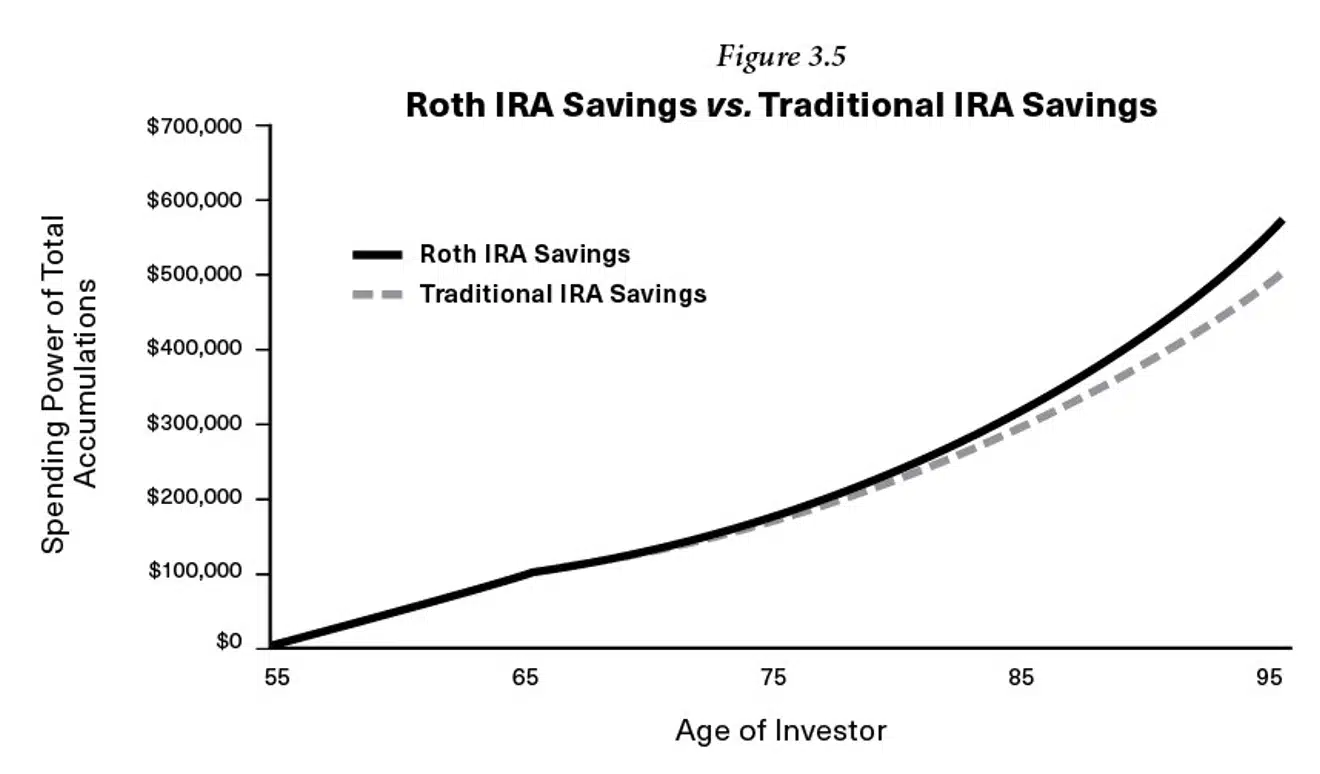
I have long been a proponent of Roth IRAs and SECURE 2.0 will allow many more Roth saving options, which I will highlight below. As I have written before, the Roth IRA (or work Roth retirement plan) is superior, in most cases, to the deductible IRA (or work traditional retirement plan). And depending on the investment period and your current and future tax brackets, even making the most conservative of assumptions, the Roth IRA will often provide more purchasing power than a traditional deductible IRA. See Figure 3.5 below.

Assumptions for Figure 3.5: Roth IRA Savings vs. Traditional IRA Savings

  • Contributions to a Roth IRA are made in the amount of $7,000 per year, beginning in 2022, for a 55-year-old investor, for 11 years until he reaches age 65.
  • Contributions to a regular deductible IRA are made in the amount of $7,000 per year by a different 55-year-old investor, for 11 years until he reaches age 65. This investor’s IRA contribution creates an income tax deduction for him of 24 percent, or $1,680. I will give the best-case scenario and say that this investor did not spend his tax savings. Instead, he invested his tax savings into his after-tax investment account and did not spend it.
  • The investment rates of return on the Traditional IRA, the Roth IRA and the after-tax investment accounts are all 6 percent per year.
  • For the after-tax monies, the rate of return includes 70 percent capital appreciation, a 15 percent portfolio turnover rate (such that much of the appreciation is not immediately taxed), 15 percent dividends, and 15 percent ordinary interest income.
  • Ordinary income tax rates are 24 percent for all years.
  • Tax rates on realized capital gains are 15 percent.
  • Beginning at age 72, the RMDs from the Traditional IRA are reinvested into the after-tax savings account.
  • The balances reflected in the figures reflect spending power, which is net of an income tax allowance of 24 percent on the remaining Traditional IRA balance. If the full amount was actually withdrawn in one year, however, the tax bracket may be even higher and make the Roth IRA appear more favorable.

Employees and Employers, Take Notice

The first huge change for people who are still working is that employers will now be able to provide employees with the option to receive matching and nonelective contributions to a Roth account for their 401(k)/403(b)/457(b) plans. Under prior law, all employer contributions had to be deposited to a traditional account (pre-tax), not a Roth—employees could choose a Roth account for their contribution, but the employer could not.

This is an optional provision for employers. Employers must change their plan documents to provide this option. Employees won’t have this option immediately unless their employer has changed their plan offerings since the beginning of the year. Employers are not required to provide the options.

One of the purposes of this article is to not only educate employees, but also to encourage all employers, both in the for profit and not for profit worlds, to amend their plans immediately. In most cases, every month employers delay amending their plan, it is hurting their employees. Plan documents without this vital plan amendment will limit valuable options for employees to save for their retirement in the most effective manner. Plus, this additional feature comes at no cost to the employer.

All taxes on Roth contributions will be the employee’s responsibility and the match will be immediately vested. Almost all younger workers should take advantage of this provision and most mid and even some late-career employees should also.

I had the pleasure of interviewing Burton Malkiel earlier this year and he kept stressing the importance of regular Roth contributions, especially for younger workers. Systematic contributions to a retirement plan act like dollar cost averaging and doing it with Roths is usually more effective than with traditional contributions. Again, while this provision is effective for 2023, employees will not have the option if their employer has not updated plan documents and payroll systems.

We are updating our 401(k) at Lange to allow our employees to take advantage of this option, and I hope all employers do the same.

It is understood that if your employer offers matching contributions for your retirement plan, you should contribute at least the amount necessary to receive the full amount that the employer is willing to match. Both under the old law and under the new law, the employee’s contribution can be to a Roth or a traditional account. After you pay the taxes on a Roth matching contribution, it will grow income-tax free with no taxes due when the money is withdrawn. Traditional contributions will be made on a pre-tax basis, and taxes will be owed when the money is withdrawn.

The employer match provides an immediate positive return on your investment and is the easiest way to maximize your retirement savings. It is a win-win scenario.

For employees who want to contribute the most possible, allow me to frame the “Roth versus a traditional contribution” scenarios. Let’s assume the employer has a 50% match policy and the employee contributes $30,000 per year in 2023 ($22,500 maximum plus the $7,500 catch up if age 50 or older).

The employer’s contribution would be $15,000. If the employer’s contribution goes to the traditional portion of the plan, the employee, in effect, receives $10,000 in immediate purchasing power because of the 33% income tax liability when the funds are withdrawn. If the employer’s share goes to the Roth, then the employee is receiving $15,000. The employee will need to pay the tax on the contribution—he can’t deduct the contribution—but in effect, the contribution is $5,000 higher when measured in purchasing power, not including the income-tax free growth on the contribution.

SEPS and SIMPLEs

SECURE 2.0 also expands the opportunity for some employees to save to a Roth account. One such opportunity, starting in 2023, is to allow employee contributions to SIMPLE and SEP IRAs to be Roth and in an analogous manner, employees are also allowed (if offered by the plan) to treat their employer SEP contributions as Roth. I usually prefer a 401(k) plan to a SIMPLE or SEP, but still welcome the change.

Student Loan Match

Starting in 2024, employer’s will be permitted to offer matching contributions for employees who are paying off student loans without additional contributions from the employee. Under these circumstances, the employer match can be based on the qualified employee student loan payments—it will be as if the loan payments were elective deferrals into the plan. Again, it is up to the employer to allow this option, but it would be a huge benefit to help an employee participate in an available employer match who would otherwise not be saving. It is very imaginable that these individuals might feel overwhelmed by the debt and unable to mark additional money to save for retirement. On the other hand, this will cost an employer money if they choose to add this option to their retirement plan.

No RMD for Roth 401(k)s and Roth 403(b)s

Finally, starting in 2024, SECURE 2.0 aligns employer-sponsored Roth plans with Roth IRAs and now the employer plans will also be exempt from the RMD requirements (just as Roth IRAs are) while the participant is alive. This avoids the extra effort and hassle of rolling over a 401(k) or 403(b) to a Roth IRA just to avoid the RMD. The process will be much simpler and not force an employee out of an employer plan who otherwise may want to remain.

Increased Age for RMDs (and Additional Time for Roth Planning)

Currently, the age for RMDs is 72 (before the SECURE Act, the RMD age was 70½). Under SECURE 2.0, the ages for RMDs have changed again:

  • If you were born before 1950, RMDs started at age 70½
  • If you were born in 1950, RMDs start at age 72
  • If you were born between 1951 and 1959, RMDs start at age 73
  • If you were born in 1960 or later, RMDs start at age 75

Note: There is a discrepancy within the bill that needs to be corrected. For those individuals born in 1959, the bill inadvertently reads that they have two ages to begin taking their RMDs: age 74 and 75. The table above reflects how experts perceive the intention of the bill. Stay tuned for a technical amendment in the future. For some, you will now have an extra three (3) years for additional planning considerations, including accelerating more Roth conversions and/or smoothing out Roth conversions over a period of time to lower Income Related Monthly Adjusted Amount (IRMAA) for Medicare charges, net investment income taxes, and possibly, capital gains tax brackets.

The important part about the increased age for RMDs from a Roth conversion standpoint, is obviously there will be a longer window to make lower cost Roth IRA conversions.

In conclusion, employers please update your documents to better serve your employees. For people still working, assuming that Roth accumulations make sense for you, when your employer does offer the Roth option for the employer portion, strongly consider taking advantage of it.


What is SECURE 2.0 and how does it affect retirement planning?

Does SECURE 2.0 allow employer matching contributions to go into a Roth account?

How does SECURE 2.0 impact required minimum distributions (RMDs)?

Does SECURE 2.0 create new Roth opportunities for workers?

What should employers know about SECURE 2.0 plan changes?

About Your Presenter: James Lange, CPA/Attorney

James-Lange

Jim is the author of 10 best-selling financial books and has been quoted 37 times in The Wall Street Journal. He has published 21 articles for Forbes.com.
Spend the Right Money First When You Retire (Including a New Wrinkle in Our Bedrock Principle)

Forbes.com Logo White

Spend the Right Money First When You Retire
(Including a New Wrinkle in Our Bedrock Principle)

by James Lange, CPA/Attorney

Reprinted with permission of Forbes.com where Jim is a paid contributor.

Happy Older Couple

For more than twenty years, I have advocated “Pay Taxes later, except for the Roth.”  This applied in the accumulation stage when you are accumulating money for retirement, the distribution stage when you are deciding which assets to spend first, and even in the estate planning stage.  I always said there were some exceptions to this bedrock foundational principal, but this was a great starting point for general advice.

Since the SECURE Act became effective on January 1, 2020, the exception to this general rule became much bigger for many IRA and retirement plan owners.

What follows comes from our newest book, Retire Secure for Professors, which has great information for all IRA owners.  Non-professors could skip the chapters on TIAA and still get a lot of value from the book.  Please see the end of this article to learn how you can request a copy of the book for you and/or any friends or colleagues who you think might find it valuable.

Following is an excerpt from Retire Secure for Professors:

The next big question is:  In what order should you spend the money you have saved for retirement?  Subject to exception, you should spend your after-tax dollars before your retirement plan or IRA dollars.

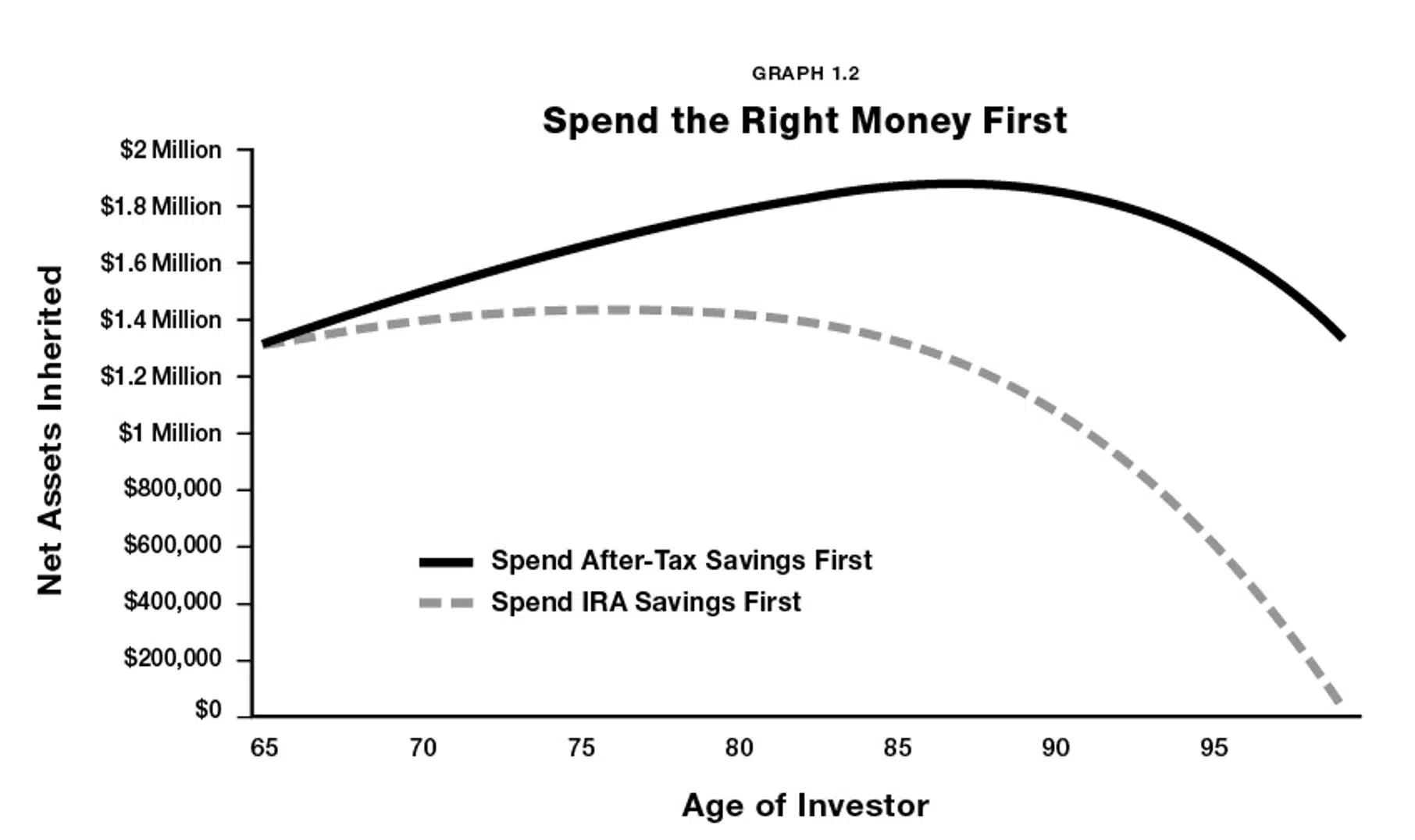
Please look at the graph that follows.  Both couples start with the same amount of money in a regular brokerage account—which I refer to as after-tax dollars—and in their retirement plans.  The graph below indicates, subject to exceptions, that most readers should spend their after-tax dollars first and then IRA and retirement plan dollars.  The solid line shows what happens to the first couple who spend their after-tax dollars first and withdraw only the minimum from the IRA when they are required to (more on RMDs in the next section).  They pay-taxes-later.  The dashed line shows what happens to the second couple who spend their IRA first.  They pay-taxes-now.

Graph 1.2: Spend the Right Money First


Detailed assumptions for Graph 1.2: Spend the Right Money First

  1. Investor retires at age 65 with $1.1 million in qualified retirement accounts and $300,000 in after-tax accounts.
  2. Assumes annual Social Security income of $25,000 + spousal of $12,500.
  3. 25% ordinary tax rates.
  4. Beginning annual spending of $90,000; adjusted for inflation annually by 3.5%.
  5. 7% rate of return.

The only difference between the dashed line and the solid line in this graph is that the first couple retained more money in the tax-deferred IRA for a longer period.  Even starting at age 65, the decision to defer income taxes for as long as possible gives the first couple an extra $625,591 if the couple lives to age 87.  If one of them lives longer, paying taxes later will be even more valuable to them.

Subject to exception, I generally prefer you not spend your Roth IRA dollars unless there is a compelling reason.  The Roth IRA grows income tax-free for the rest of your life, your spouse’s life and for 10 years after you and your spouse are gone.  In addition, there is no required minimum distribution for you or your spouse with a Roth IRA.

So, in general, the last dollars you want to spend are your Roth IRA dollars.  Of course, there may be time when it makes sense to spend your Roth dollars before other retirement plan dollars if it keeps you in a lower tax bracket.

That said, subject to exceptions, you and your spouse will realize a benefit by deferring the income taxes due on your retirement plans for as long as possible and generally hold off on spending your Roth IRA.  And with the SECURE Act now part of the law, your children, and grandchildren (subject to some important exceptions, which I will cover in Chapter 5) will have to pay income taxes on the Inherited Traditional IRA within 10 years of your death.

A New Wrinkle in our Bedrock Principle

Since the passage of the SECURE Act, adhering to the pay-taxes-later rule in the distribution stage might not always be the best advice.  With income tax rates likely on the rise, for some professors it might make more sense to plan for a transition from the taxable world (most TIAA accounts, IRAs, retirement assets, etc.) to the tax-free world (Roth IRAs, 529 plans, life insurance, your children’s Roth IRAs, etc.).  To get the best result, it is best to analyze each situation on a case-by-case basis.

In short, the SECURE Act dramatically accelerates the taxes on your retirement plan after your death.  For your children, losing the lifetime stretch on an inherited retirement account can carry a huge tax burden.  I will cover this idea more in Chapter 5.

One reasonable strategy for some professors with significant IRAs and retirement plans who will not likely spend all their money is to make taxable withdrawals from the retirement plan and/or IRA, pay the tax, and then gift the net proceeds.  The gift could be invested in something that grows tax-free like a 529 plan, your children’s Roth IRAs, life insurance, etc.  That serves the purpose of getting some money out of your estate and allows tax-free growth for your children.

As a result, for many faculty members, an earlier transition from the taxable world to the tax-free world might work better than the standard rule of “pay taxes later.”

What order to withdraw retirement accounts is most tax-efficient?

Does the SECURE Act change what order to withdraw retirement accounts?

Should I spend my Roth IRA first or last when deciding what order to withdraw retirement accounts?

How much can choosing the right order to withdraw retirement accounts actually save?

When does the standard "pay taxes later" rule for what order to withdraw retirement accounts NOT apply?

About Your Presenter: James Lange, CPA/Attorney

James-Lange

Jim is the author of 10 best-selling financial books and has been quoted 37 times in The Wall Street Journal. He has published 21 articles for Forbes.com.

Who Gets What? A Guide to Tax-Savvy Charitable Bequests

Forbes.com Logo White

Who Gets What?
A Guide to Tax-Savvy Charitable Bequests

by James Lange, CPA/Attorney

Reprinted with permission of Forbes.com where Jim is a paid contributor.

Happy Older Couple (1)

After reading this post, you are likely to think—that is so obvious.  How could I and my estate attorney both have missed this?  Don’t feel bad.  We have reviewed thousands of wills and trusts and in our experience, hardly anyone gets this right.  The mistake often costs families tens of thousands of dollars or more.

I’m referring to the decisions that you make when you when you are crafting your estate plan and are trying to figure out who gets what.  In this post I want to focus on the smartest solution for donations or inheritances that you leave to a charity after you and your spouse pass.  There are several critical ideas to cover, but the most fundamental is:  what are the tax implications to each recipient if they inherit your money?  By being very selective about who receives which type of money—whether Traditional or Roth IRAs, after-tax brokerage accounts, life insurance, etc.—you can dramatically cut the share that goes to the IRS and increase the amount going to your family.

In most cases, Traditional IRAs subject to exception, are going to be fully taxable to your heirs.  After the dreaded SECURE Act that effectively killed the stretch IRA, income taxes will be due on your IRA within a maximum of ten years after your death.  Inherited Roth IRAs have the advantage of being able to continue to grow for ten more years after your death and then can be withdrawn tax-free.  After-tax dollars and life insurance are generally not subject to income taxes.  All of these different types of inheritances have different tax implications for your beneficiary…unless your beneficiary is a tax-exempt charity.

First and foremost, a charity that is recognized by the IRS as being tax-exempt does not care in what form they receive an inheritance.  They never have to pay taxes on the money they receive.  To them, a dollar is a dollar.  So, a charity will look at bequests of Traditional IRAs, Roth IRAs, after-tax dollars, or life insurance in the same light.  In sharp contrast, your heirs will face substantially different tax implications depending on the type of asset they receive after your death.  Please note in this post we are only addressing income taxes, not estate or transfer taxes.

Imagine this scenario.  You want to leave $100,000 to charity after you and your spouse die.  You have both Traditional IRAs and after-tax dollars.  For the sake of simplicity, I am going to say that your child is in the 24% tax bracket.  So, Who Gets What?  In most of the estate documents that we review we see instructions directing that the charitable bequest come from after-tax funds—usually found in the will or a revocable trust.  The problem is that your will (or revocable trust) does not control the disposition of your IRAs or retirement plans.  By naming that charity as a beneficiary in your will or trust, you will likely be donating after-tax money to charity.  The charity gets $100,000 so the “cost” of the bequest to your heirs is $100,000.  Restated, the amount that your children inherit is reduced by $100,000 because you made that bequest to charity.

But what if you decide to leave $100,000 to XYZ charity through your Traditional IRA and/or retirement plan beneficiary designation?  It makes no difference for the charity because they get $100,000 tax free.  If your heirs receive $100,000 from your IRA, they will have to pay taxes on the money.  Assuming that they are in a 24% tax bracket, that would be $24,000—leaving them with $76,000 after the government takes their share.  And the tax bite is even worse if your heirs are in a higher tax-bracket or live in a state that taxes Inherited IRAs.  So if you leave your Traditional IRA money to a charity that doesn’t pay taxes, you are in effect leaving your beneficiaries an extra $24,000!

This is a simple tweak to your estate plan that can be very beneficial to your heirs.  On a smaller bequest, smaller savings.  On a bigger bequest, even larger savings.

Consider the purchasing power, after taxes, available to your beneficiary if you have $100,000 in a Traditional IRA and $100,000 of after-tax dollars, and we switch who gets what.

Scenario 1

Leave $100,000 to charity through your will or revocable trust and $100,000 to your heirs as the beneficiary of your Traditional IRA.

Impact on the charity:  They get $100,000 and pay no tax.

Impact on your heirs: $100,000 IRA money - 24% taxes = $76,000.

Scenario 2

Leave $100,000 to charity through your IRA beneficiary designations and $100,000 to your heirs in your will or revocable trust.

Impact on the charity:  They get $100,000 and pay no tax.

Impact on your heirs: $100,000 and pay no federal tax.

This simple switch of who gets what saved this family $24,000.  The savings would be even greater with a larger bequest or if your beneficiary’s tax bracket was higher.

Let’s imagine another scenario.  Suppose that your child is well off and, as a parent, you are totally comfortable with reducing his or her inheritance by $100,000.  Does that mean you can leave even more money to charity?  Yes!

You could leave $131,579 to charity through your IRA or retirement plan beneficiary designation.  The same tax implications apply.  A $131,579 IRA bequest will only “cost” your child $100,000.  ($131, 579 times 24% = $31,579).  If you left that $131,579 IRA to your children instead of charity, your children would have to pay $31,579 in taxes leaving them $100,000.

By switching who gets what, you accomplish one of two things:

  1. You save $24,000 in federal taxes for your child, or
  2. If you increase your bequest to the charity to $131,579, you still only remove $100,000 from your heir’s total inheritance, and you increase the charitable gift by $31,579.

Who loses out with this strategy?  You guessed it.  The IRS.  You are dramatically cutting the share that the IRS receives—giving the IRS a smaller piece of the pie.  And I think that all of us can safely agree that we want more money to go to our kids, more money to go to our favorite charities, and less money to go to the IRS.

If you are only leaving a minimal amount to charity, it probably isn’t worth the time and aggravation to change your documents.  If you are leaving a substantial amount to charity, it probably is worth it.

Finally, the application of the concept of who gets what can also save families a lot of money in taxes even without any charitable bequest involved.  It is likely that not all your beneficiaries are in the same bracket.  The different income tax brackets of your beneficiaries may create an opportunity for tax savings by changing who gets what.  But you will have to wait for my next post to read about that technique.

Investment advisory services provided by Lange Financial Group, LLC. Content provided herein is for informational purposes only and should not be used or construed as investment advice or a recommendation regarding the purchase or sale of any security. All information or ideas provided should be discussed in detail with an advisor, accountant, or legal counsel prior to implementation. Securities investing involves risk, including the potential for loss of principal. There is no assurance that any investment plan or strategy will be successful.


What are tax-savvy charitable bequests and why do they matter?

Why are Traditional IRAs the best asset for tax-savvy charitable bequests?

How much can tax-savvy charitable bequests actually save my family?

Do tax-savvy charitable bequests need to be written in my will?

When are tax-savvy charitable bequests not worth the effort?

About Your Presenter: James Lange, CPA/Attorney

James-Lange

Jim is the author of 10 best-selling financial books and has been quoted 37 times in The Wall Street Journal. He has published 21 articles for Forbes.com.

Charitable Remainder Trusts – A Potential Solution To The SECURE Act

Forbes.com Logo White

Charitable Remainder Trusts – A Potential Solution To The SECURE Act

by James Lange, CPA/Attorney

Reprinted with permission of Forbes.com where Jim is a paid contributor.

Happy Older Couple (6) (1)

Big Picture with Charitable Remainder Trusts

Before I get immersed in the details, the big picture that I’m presenting in this post is that there are many situations where your children would get more money and a steadier income if you named a charitable remainder trust as the beneficiary of your IRA than if you named your children directly. If you have a million dollars or more in your IRA, even if you aren’t very charitable, you should at least consider naming a charitable remainder trust as the beneficiary of your IRA.

What is a Charitable Remainder Trust?

First of all, when I say a charitable remainder trust, what am I talking about?

In this context, I am talking about naming a trust as the beneficiary of your IRA or retirement plan. Of course, if you are married, you would name your surviving spouse as the primary beneficiary. In this post, I will compare naming your children as the contingent beneficiary after your spouse (or your children if you don’t have a spouse you are providing for) to naming a charitable remainder trust.

To oversimplify, the trust would provide your beneficiary (let’s assume your child) with a distribution that has some, but not a complete correlation to the income of the trust, and then at the child’s death the amount remaining in the trust would go to the charity of your or even your child’s choice. Actuarially, the charitable remainder trust must be set up in a way that the charity receives 10% of the present value of the bequest at the date of death but that leaves 90% for your children. When you take into the enormous tax benefits of the charitable remainder trust and the draconian tax treatment of leaving your IRA to your children directly, your children often get more value, sometimes by hundreds of thousands of dollars, than if you just leave the IRA outright to them.

Below I present the very favorable math of the charitable trust for your family. Having charity in your heart is a major bonus. If you like the idea of maintaining a significant amount of money in the tax deferred environment and having your beneficiary get regular distributions for the rest of his or her life, especially if it results in more money for your children, then charitable remainder trusts should at least be considered.

The charitable remainder trust can to some extent be treated as a stretch IRA.

To get the best results, leaving your IRA to someone other than your spouse requires strategic planning. Let’s go back to exempt beneficiaries. In addition to your spouse, charities and charitable trusts are also exempt from the 10-year tax acceleration rule. To utilize this exemption to the 10-year tax acceleration rule, you could establish a Charitable Remainder Unitrust (CRUT), or Charitable Remainder Annuity Trust (CRAT) and name it as the beneficiary of your IRA (after naming your spouse as the primary beneficiary assuming you are married).

So, to be clear, this trust is a testamentary trust meaning that it isn’t funded before you and your spouse die. While you and/or your spouse is alive, there is no tax return, no money goes into it, and other than some paper sitting in a fireproof drawer, it doesn’t exist. It is totally revocable meaning you can change it as long as you and/or your spouse is alive. But, after you and your spouse die, if you name it as the beneficiary of your IRA or retirement plan, it becomes irrevocable and the trust comes to life.

Here’s how a CRUT (or a CRAT with minor differences) works at the basic level. When you die or when both you and your spouse are dead, what remains, or a portion of your IRA could be transferred to a CRUT and the IRA can then be liquidated without paying taxes.

The conventional approach would be to leave your IRA directly to your children and/or grandchildren and all of it will be taxed in 10 years. With a CRUT, your children won’t get a lump sum of money when you die, but they also will not face a big tax bill immediately after you die or as big of a tax bill even 10 years after you die. They would receive a regular “income” from the CRUT for the rest of their lives. The distribution would be treated as ordinary income until the amount of the initial IRA plus any interest and dividends earned in the CRUT has been paid to your child. After the ordinary income has been distributed, then capital gains would be distributed. Finally, when your children die, whatever is left in the CRUT goes to the charity of your or their choice.

Although you probably have some charity in your heart, you would most likely rather see your children get the bulk of your money rather than your favorite charity. Me too. The reason that this is an idea worth considering is that the money that goes into the CRUT in this case, your IRA isn’t subject to the new rules governing after-death IRA distributions.

A CRUT, since it is an exempt beneficiary, can mimic the benefits of the stretch IRA by paying out the IRA income over a period of more than ten years and providing your heirs with a steady income over their entire lifetimes. Distributions from a CRUT can be stretched and taxed over your child’s life (if you have no spouse) or after the deaths of you and your spouse. I like to look at everyone’s unique situation and I like to do the math.

Disadvantages of a CRUT

  • You need to have an attorney draft the CRUT.
  • You need to name a trustee.
  • You can expect to pay an additional $500 to $2,000 or sometimes more every year for the remainder of the beneficiary’s life, to maintain the trust from a legal and tax compliance standpoint. You not only need to file a special CRUT tax return, but you also must file a K-1 with the beneficiary which complicates his return. The additional complication and aggravation of drafting and more importantly maintaining the charitable trust for the life of your child or children should not be underestimated.
  • The trustee of the CRUT is required to report the income that the beneficiary receives to the IRS and must send to each beneficiary a form called a K-1 which complicates the beneficiary’s own tax return. If your beneficiary lives for 20 years, it’s not unrealistic to think that the fees required to maintain the trust could exceed $20,000 or even $40,000.
  • Ultimately you could be creating significant complications for less tax savings than you would have realized if you had just left the money to your child instead of the CRUT.
  • If you leave your IRA to a CRUT, it could potentially hurt your family. If the income beneficiary of the trust (most likely, your child) dies prematurely, the remaining balance will go to the named charity and not to your grandchild like it would if you just left the IRA to your child. So, there is a very real risk with a CRUT, and it would likely not be a good choice if your beneficiary has a reduced life expectancy. The answer to that objection is to buy a term life insurance policy on the income beneficiary with a trust for his or her child or children as the beneficiary of the policy.

Advantages of a CRUT

  • Including a CRUT as part of your estate plan may make an enormous difference for the long-term security of your child or children and it may be the best way to maximize the number of dollars your child receives. If you have charity in your heart as well as protecting your family, it may be a wonderful thing.

Let’s compare leaving your million-dollar IRA to a CRUT versus leaving it to your child. What is the best option for the $1 million dollars if she will have to pay income taxes on the entire million (plus growth) within 10 years of your death? Though I could do some post-mortem planning, it will be extremely difficult to protect that distribution from very high tax rates that are projected to get even higher in the future.

To oversimplify, the tax on the $1 million Inherited IRA could be $400,000 leaving your child with net proceeds after taxes of $600,000 plus appreciation.

On the other hand, the CRUT pays no income taxes when you die. So, the income that your child will receive is based on $1 million, not $600,000. What I will show below is that your child may be able to get more money over their lifetime as the beneficiary of a CRUT than if she receives your $1 million IRA outright.

Let’s look at an example. Suppose Alice creates a CRUT that names Roberta as the income beneficiary, and her favorite charity (or charities) as the remainder beneficiary. She stipulates that $1 million of her IRA will be transferred to the trust at her death. Roberta won’t inherit the IRA directly, but she will receive a nice check from the CRUT on a regular basis for her entire life. The amount that she receives is calculated yearly according to a complex formula required by the IRS because there is a minimum amount that must eventually be turned over to the charity in order to get this favorable treatment.

So, which inheritance will benefit Roberta the most, the money outright subject to accelerated taxes or the income from the CRUT? The answer is it depends on what interest rates you assume but perhaps more importantly, and how long Roberta lives.

Given certain reasonable assumptions, Roberta would have $400,331 more money if her aunt left her IRA to a charitable trust compared to leaving it outright to Roberta.

Roberta only has to live past the age of 63 to receive more money from the CRUT as compared to inheriting the $1 million IRA stretched over ten years. (The breakeven point may change depending on your circumstances, what assumptions you use, the Section 7520 rate when the CRUT is created and how old your beneficiary is at your death.) The other advantage of the CRUT is that she will have all the protections of a trust including protection from creditors, protection from herself, and in some cases, financial protection from her husband should she divorce or the marriage survives and her husband has different ideas on how she should spend her money. In addition, the charity would get $1,221,929 after Roberta dies.

Key Ideas

  • In many situations it will make more sense to leave your IRA to a charitable trust than to leave it to your children directly. It is possible, even likely, your children will actually end up with more money than if you left the IRA to a charitable trust than if you left it to them outright
  • After the SECURE Act many IRA owners that never had a good reason to closely look at a charitable remainder trust as the beneficiary of their IRA should now consider one.

Why consider a charitable remainder trust as IRA beneficiary after the SECURE Act?

Will my kids actually get more money with a charitable remainder trust as IRA beneficiary?

What are the downsides of using a charitable remainder trust as IRA beneficiary?

How much of the IRA goes to charity when using a charitable remainder trust as IRA beneficiary?

Who should consider a charitable remainder trust as IRA beneficiary?

About Your Presenter: James Lange, CPA/Attorney

James-Lange

Jim is the author of 10 best-selling financial books and has been quoted 37 times in The Wall Street Journal. He has published 21 articles for Forbes.com.

The SECURE Act: Is It Good For You Or Bad For You?

Forbes.com Logo White

The SECURE Act: Is It Good For You Or Bad For You?

by James Lange, CPA/Attorney

Reprinted with permission of Forbes.com where Jim is a paid contributor.

Happy Older Couple (4)

My previous post introduced the potential consequences of the SECURE Act, which is being promoted as an “enhancement” for IRA and retirement plan owners.  This is because it includes provisions allowing some workers to make higher contributions to their workplace retirement plans. I think it is a stinking pig with a pretty bow, so I wanted to give retirement plan owners the good and bad news about it.

I am a fan of Roth IRAs because they allow you to have far more control over your finances in retirement than you might have otherwise had.  You are not required to take distributions from your Roth IRA, but the good news is that they’re not taxable if you do take them.  These tax benefits can be a critical factor for seniors, especially if you are suddenly faced with costly medical or long term care bills.   Saving money in a Roth account can offer financial flexibility to many older Americans – and one good thing about the SECURE Act is that it can help you achieve that flexibility.  Here’s how.

The Good News About The SECURE Act

Under the current law, you are not allowed to contribute to a Traditional IRA after age 70½.  (You can contribute to a Roth IRA at any age as long as you have taxable compensation, but only if your income is below a certain amount.)  The age limitation for making contributions to Traditional IRAs is bad for older workers – and that’s an important point because the Bureau of Labor Statistics estimates that about 19 percent of individuals between the ages of 70 and 74 are still in the workforce.  The SECURE Act eliminates that cutoff and allows workers of any age to continue making contributions to both Traditional and Roth IRAs.

That same provision of the SECURE Act offers a hidden bonus – it means that it will also be easier for older high-income Americans to do “back-door” Roth IRA conversions for a longer period of time.  The back-door Roth IRA conversion, currently blessed by the Tax Cuts and Jobs Act, is a method of bypassing the income limitations for Roth IRA contributions.  The current law prohibits contributions to a Roth IRA if your taxable income exceeds certain amounts.  Those amounts vary depending on your filing status.   But even if you are unable to take a tax deduction for your Traditional IRA contribution, you can still contribute to one because there are no income limitations.  Why bother?  Because, assuming you don’t have any other money in an IRA, you can immediately convert your Traditional IRA to a Roth IRA by doing a back-door conversion.  That’s a good thing because the earnings on the money you contributed can then grow tax-free instead of tax-deferred.

Here’s more good news.  The current law requires Traditional IRA owners to start withdrawing from their accounts by April 1st of the year after they turn 70 ½.  These Required Minimum Distributions (RMDs) can be bad for retirees because the distributions are taxable.  The increase in your taxable income can cause up to 85 percent of your Social Security benefits to be taxed and can also move you into a higher tax bracket.  And once you begin to take RMDs, you are no longer allowed to make additional contributions to your account, even if you are still working.  The SECURE Act increases the RMD age to 72, a change which will allow Traditional IRA owners to save more for their retirements.

There’s a hidden bonus in this change as well.  Increasing the RMD age to 72 will allow retirees more time to make tax-effective Roth IRA conversions.  What does that mean?  Once you are required to take distributions from your Traditional IRA and your taxable income increases, you may find yourself in such a high tax bracket that it may not be favorable to make Roth IRA conversions at all.

The Bad News About The SECURE Act

Now let’s get down to the stinking pig.

The SECURE Act contains provisions about workplace retirement plans that I’m not convinced will be all that good for employees.  Those provisions pale in comparison, though, when compared to the worst part of the SECURE Act – and believe me, it’s bad. That provision requires Traditional and Roth IRAs that are inherited by a non-spouse beneficiary to be distributed within 10 years.  (There are some exceptions for minors and children with disabilities, and IRAs that you leave to your spouse are not subject to the rule at all.)  Withdrawals from Inherited Roth IRAs are not taxable to your beneficiary, so the cost of the SECURE Act to them will be limited in the sense that they will eventually lose the tax-free earnings on their inheritance.  Roth IRAs, however, haven’t been around that long.  They weren’t established until 1997 (as part of the Taxpayer Relief Act), and the amount that you can contribute to them is limited.  Even if you were smart enough to jump on the Roth bandwagon twenty years ago, the big problem that everyone seems to be overlooking is that most of America’s retirement money still lies in taxable Traditional accounts.

The existing law allows owners of Inherited IRAs to “stretch” their RMDs over their lifetimes.  The SECURE Act requires that Inherited Traditional IRAs be distributed within 10 years of the original owner’s death. The SECURE Act essentially means the Death of the Stretch IRA.   Since your heirs will no longer be able to “stretch” the distributions from your IRA over their lifetimes, there will be a massive income tax acceleration for them.  And the younger your heirs are, the worse that acceleration will be.

I talked about the consequences of that tax acceleration in my earlier post.  This provision in the SECURE Act betrays those conscientious savers who socked money away for years under the assumption that they would be able to pass it on to their children in a tax-efficient manner after their deaths. To me, the SECURE Act is particularly egregious because this change comes very late in the game for many IRA and retirement plan owners.  It will be devastating to people who have worked hard their entire lives, played by the rules, and accumulated significant amounts of money in their IRAs and retirement plans. It will be even more devastating for retirees whose IRA and/or retirement plan constitutes the biggest asset in their estate because it potentially means a difference of millions of dollars for their children and grandchildren.

There are some things that you can do to help mitigate the consequences of this bill, and I will cover those in a later post.  Thank you for reading.


What are the main SECURE Act pros and cons for IRA owners?

Do the SECURE Act pros and cons affect Roth IRAs differently than Traditional IRAs?

How do the SECURE Act pros and cons impact older workers still earning income?

Why is the death of the stretch IRA the most discussed item in SECURE Act pros and cons?

Are there strategies to capture the SECURE Act pros while limiting the cons?

About Your Presenter: James Lange, CPA/Attorney

James-Lange

Jim is the author of 10 best-selling financial books and has been quoted 37 times in The Wall Street Journal. He has published 21 articles for Forbes.com.