
Required Minimum Distributions: The Government Wants Their Money!

Required Minimum Distributions, The Government Wants Their Money, James Lange - The Roth Revolution BlogOver the years, I’ve met with many clients who have managed to accumulate small fortunes over the course of their working careers – even though their incomes were never even high enough to put them in the top two or three tax brackets. I call these clients my “savers.” These individuals seem to share one trait – mainly that they simply don’t feel the need to spend money if they don’t have to. Instead, they set the money aside for the times when they absolutely must spend and, more often than not, they spend far less than what they could.

It’s these clients who seem to suffer the greatest shock when they turn 70 ½ and are required to start withdrawing money from their qualified retirement plans. They object, “But I don’t need the money! I just want to leave it sit there in case I need it some day!” And I have to tell them that it doesn’t matter if they need the money or not. The money that they squirreled away in their retirement plans for a rainy day has grown all these years without being taxed, and now the government wants their tax money!

There’s no avoiding the Required Minimum Distribution rules on traditional retirement plans. Failure to take a distribution when required, in fact, will cost you a penaly tax of 50% on the amount not withdrawn. Individuals who hate the RMD rules and have a spiteful streak might enjoy an interesting (and legal) tip presented in Chapter 5 that allows them to take advantage of the withholdings on the distribution to wait until the very last minute to pay the IRS their due, while also avoiding a late payment penalty. They can also learn of a possible way to completely avoid tax on their Required Minimum Distributions – and also a general increase in their tax bracket – by sending their RMD direct to a charity. I encourage everyone, though, to read Chapter 5 so that you have a good understanding of the RMD rules. Later chapters address proposed legislative changes to the rules that may not strike you as being significant, and unless you have a good understanding of how they currently work.

My next post will talk about rolling your old retirement plan to an IRA. There have been a lot of changes in the laws about this, so I hope you will stop back to get a summary of what you can expect.

Happy Reading!

Jim

Jim Lange A nationally recognized IRA, Roth IRA conversion, and 401(k) expert, he is a regular speaker to both consumers and professional organizations. Jim is the creator of the Lange Cascading Beneficiary Plan™, a benchmark in retirement planning with the flexibility and control it offers the surviving spouse, and the founder of The Roth IRA Institute, created to train and educate financial advisors.

Jim’s strategies have been endorsed by The Wall Street Journal (33 times), Newsweek, Money Magazine, Smart Money, Reader’s Digest, Bottom Line, and Kiplinger’s. His articles have appeared in Bottom Line, Trusts and Estates Magazine, Financial Planning, The Tax Adviser, Journal of Retirement Planning, and The Pennsylvania Lawyer magazine.

Jim is the best-selling author of Retire Secure! (Wiley, 2006 and 2009), endorsed by Charles Schwab, Larry King, Ed Slott, Jane Bryant Quinn, Roger Ibbotson and The Roth Revolution, Pay Taxes Once and Never Again endorsed by Ed Slott, Natalie Choate and Bob Keebler.

If you’d like to be reminded as to when the book is coming out please fill out the form below.

Save

IRA Withdrawals: Should you withdraw from your Roth or traditional IRA first?

IRA Withdrawal
Those of you who have attended my workshops or read the previous editions of my book may remember a rule of thumb I used to use that said, “Spend your after-tax dollars first, use traditional IRA withdrawals second, and then withdraw your Roth”. Well, guess what? The changes in the tax laws now mean that there are no more rules of thumb! My new advice is, “Spend your after-tax dollars first, and then withdraw traditional and Roth IRA dollars strategically to optimize tax results”.

Changes in the tax law that affect capital gains and individual tax brackets, as well as new taxes that are aimed specifically at high income taxpayers mean that the advice I used to give in the past is now far too simplistic. Chapter 4 presents detailed information on how capital gains and other taxes should affect your decision to withdraw money from a traditional versus a Roth account. Would you have thought that your marital status could affect your decision too? Is it possible to minimize the tax on your IRA withdrawals? (Hint: oh, yes.) If you have IRA and Roth money left over when you die, is it better to leave one type of account over another to a child at your death?

Chapter 4 covers many new rules that you did not have to worry about in the past, which should certainly affect these decisions. I’d like to give you one word of caution, though. Each of the scenarios presented in this chapter is based on a specific set of variables. In one scenario, I changed only the account from which the taxpayer made the withdrawal, and the outcome is significantly different. Please don’t assume that your personal circumstances will result in the same outcome shown in these scenarios, but ask us to run the numbers for you!

Be sure to stop back for my next post, which will cover some ideas for managing your Required Minimum Distributions!

Save

Save

More on The Traditional IRA vs Roth IRA

Retire Secure A Guide to Getting the Most Out of What You've Got, James Lange 2015Over the years, I’ve been challenged by clients who present me with questions that even King Solomon in his infinite wisdom couldn’t answer. Other questions, complicated though they might be, are much easier to manage because they can be solved by running the numbers.

Chapter 3 of the new edition of Retire Secure! quantifies a number of “what if” scenarios that are frequently presented to me by my clients. What if I’m in an average tax bracket, and I need to cash in my retirement account? What if I’m in the highest tax bracket, and I need to withdraw all or part of my retirement account? What if I’m in a high tax bracket now, but am in a lower tax bracket when I need to withdraw all or part of my retirement account? What happens if I’m in a high tax bracket now, but I lose my job and am in a very low tax bracket when I need to withdraw all or part of my retirement account? What happens if I’m in a high tax bracket, but my heir is in a low tax bracket? All of these are very significant considerations if you have to choose between a Traditional IRA vs a Roth IRA.

Questions like these can be accurately answered by using quantitative analysis. Chapter 3 presents a series of hypothetical scenarios which prove that certain tax situations definitely do favor the use of one type of account over another. In some situations, the Traditional IRA is better, and in others, the Roth IRA is better. If your choice is Traditional IRA vs Roth IRA, you may find some of these scenarios thought-provoking. As with the previous chapters, the assumed rate of return has been reduced to a conservative 6%, so the differences in the illustrations will be even more pronounced if you earn a higher rate of return on your own investments. The illustrations should only be used as a general guide. In order to get the most accurate answer for your specific situation, please consider asking us to run the numbers for you.

All this discussion about the Traditional IRA vs Roth IRA debate reminds me: you really should take a look at my next post about Chapter 4. It delves into some surprising new details about spending retirement accounts!

Jim

Jim Lange A nationally recognized IRA, Roth IRA conversion, and 401(k) expert, he is a regular speaker to both consumers and professional organizations. Jim is the creator of the Lange Cascading Beneficiary Plan™, a benchmark in retirement planning with the flexibility and control it offers the surviving spouse, and the founder of The Roth IRA Institute, created to train and educate financial advisors.

Jim’s strategies have been endorsed by The Wall Street Journal (33 times), Newsweek, Money Magazine, Smart Money, Reader’s Digest, Bottom Line, and Kiplinger’s. His articles have appeared in Bottom Line, Trusts and Estates Magazine, Financial Planning, The Tax Adviser, Journal of Retirement Planning, and The Pennsylvania Lawyer magazine.

Jim is the best-selling author of Retire Secure! (Wiley, 2006 and 2009), endorsed by Charles Schwab, Larry King, Ed Slott, Jane Bryant Quinn, Roger Ibbotson and The Roth Revolution, Pay Taxes Once and Never Again endorsed by Ed Slott, Natalie Choate and Bob Keebler.

If you’d like to be reminded as to when the book is coming out please fill out the form below.
Which Is Better the Traditional or the Roth IRA

Retire Secure! Third Edition, A Guide To Making The Most Out Of What You've Got, James Lange
A theme which appears consistently throughout the third edition of Retire Secure! is the question of which is better – the traditional or Roth IRA. Changes in the law since Edition Two was written, as well as additional changes that our current administration is pressing for, make it the million dollar question.

In order to answer the question, we dedicated Chapter 2 to comparing the pros and cons of each type of account as they exist under the current law. If you are not familiar with the rules of each IRA account, it is probably worth your time to read this chapter. Subsequent chapters address the proposed changes to the rules, and how they might affect your decision when reviewing your retirement plan options. And, due to popular demand, I’ve added a section about the IRS ordering rules, which explains how to avoid tax and penalty if you need to withdraw money from a Roth account before five years has passed.

The IRA illustrations were calculated using a 6% rate of return, and the maximum contribution amount as established by the IRS. We also ran an illustration that shows, for those who don’t have a lot of time left to save, the difference in the accounts when contributions are made for a very limited number of years.

A final note about tax brackets: when Edition Two was written, the maximum tax rate was 35%. Subsequent changes in the tax laws increased the maximum rate to 39.6%. This difference of almost 5% is more significant than you might think. The impact of the increased tax brackets is discussed in detail in subsequent chapters, but the concept is first introduced in Chapter 2.

Check back soon for an update on Chapter 3!

Jim

Jim Lange A nationally recognized IRA, Roth IRA conversion, and 401(k) expert, he is a regular speaker to both consumers and professional organizations. Jim is the creator of the Lange Cascading Beneficiary Plan™, a benchmark in retirement planning with the flexibility and control it offers the surviving spouse, and the founder of The Roth IRA Institute, created to train and educate financial advisors.

Jim’s strategies have been endorsed by The Wall Street Journal (33 times), Newsweek, Money Magazine, Smart Money, Reader’s Digest, Bottom Line, and Kiplinger’s. His articles have appeared in Bottom Line, Trusts and Estates Magazine, Financial Planning, The Tax Adviser, Journal of Retirement Planning, and The Pennsylvania Lawyer magazine.

Jim is the best-selling author of Retire Secure! (Wiley, 2006 and 2009), endorsed by Charles Schwab, Larry King, Ed Slott, Jane Bryant Quinn, Roger Ibbotson and The Roth Revolution, Pay Taxes Once and Never Again endorsed by Ed Slott, Natalie Choate and Bob Keebler.

If you’d like to be reminded as to when the book is coming out please fill out the form below.

Save

Sneak Peek at the Updated Retire Secure!

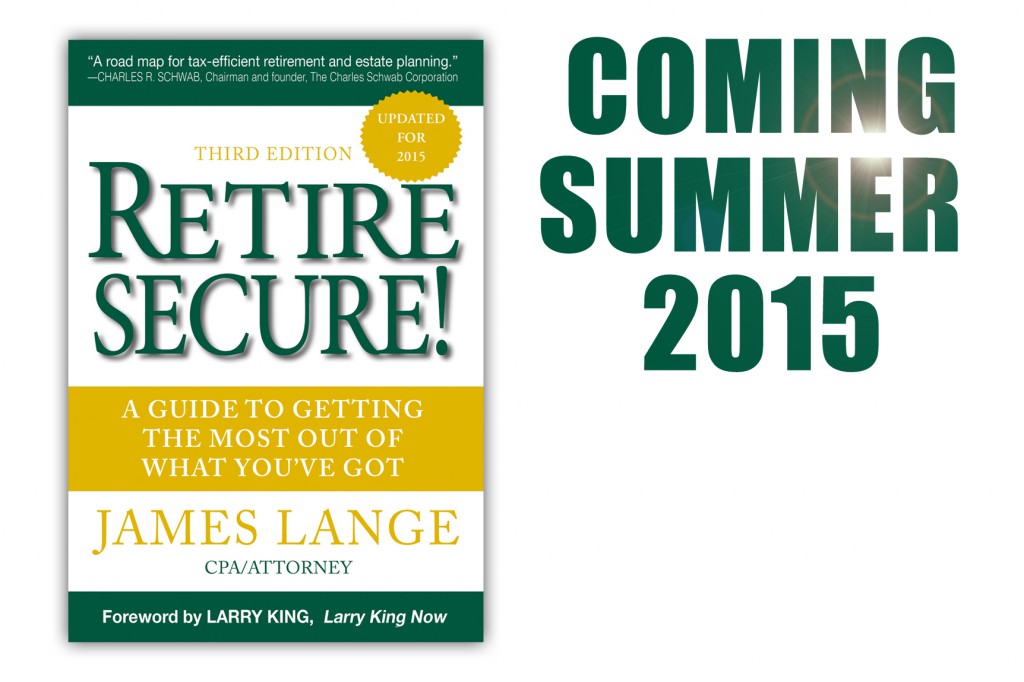
Retire Secure A Guide to Getting the Most Out of What You've Got, James Lange 2015The third edition of Retire Secure! has been completed and will be going to the printer shortly. Some of you may be thinking, “So what? I already read that book.” Since the second edition of Retire Secure! was published in 2009, there have been two major revisions to the tax code and several landmark court decisions that have significantly changed the way we approach the cases we handle in our office. We try to keep you informed of these changes through our newsletters. If you’re a client, we also meet with you at least once a year to review your situation and, if needed, we help you make changes so that you can achieve the best results possible based on the current laws.

So why should you read this book? Reviewing their finances regularly isn’t a top priority for a lot of individuals – although it should be – and it is human nature to become complacent about things that we’d really rather not have to think about. When we were writing Edition 3, though, I found that so much has changed since I published Edition 2 that it became necessary for me to discuss many of the old laws and the old solutions we used to use, and then explain why the old solutions are no longer effective under the new laws. The legislative changes also created new and possibly unforeseen problems for taxpayers that require proactive management on their parts. Without proactive management, those individuals can pay far more in taxes than they need to. Ultimately, it is their wealth that suffers from their lack of attention.

I’ve been accused of being a self-appointed ambassador of information, and I guess that’s true. I believe this information is so important that everyone should read my book from cover to cover, but I’m enough of a realist to know that not all of you share my enthusiasm for the subject matter. Since I’m a nice guy, though, I’ll respect your time and use this blog to point out the highlights of what’s changed in every chapter. Hopefully a sneak peek at what’s contained within will inspire you to read the whole book.

Happy Reading!

Jim

Jim Lange A nationally recognized IRA, Roth IRA conversion, and 401(k) expert, he is a regular speaker to both consumers and professional organizations. Jim is the creator of the Lange Cascading Beneficiary Plan™, a benchmark in retirement planning with the flexibility and control it offers the surviving spouse, and the founder of The Roth IRA Institute, created to train and educate financial advisors.

Jim’s strategies have been endorsed by The Wall Street Journal (33 times), Newsweek, Money Magazine, Smart Money, Reader’s Digest, Bottom Line, and Kiplinger’s. His articles have appeared in Bottom Line, Trusts and Estates Magazine, Financial Planning, The Tax Adviser, Journal of Retirement Planning, and The Pennsylvania Lawyer magazine.

Jim is the best-selling author of Retire Secure! (Wiley, 2006 and 2009), endorsed by Charles Schwab, Larry King, Ed Slott, Jane Bryant Quinn, Roger Ibbotson and The Roth Revolution, Pay Taxes Once and Never Again endorsed by Ed Slott, Natalie Choate and Bob Keebler.

If you’d like to be reminded as to when the book is coming out please fill out the form below.

Save

More on Retire Secure! Third Edition…Coming Soon!

Retire Secure! Third Edition, A Guide To Making The Most Out Of What You've Got, James LangeThe third edition of Retire Secure!, Retire Secure! A Guide to Making the Most Out of What You’ve Got is set to be released in the coming months, (stay tuned for exact date). This revised Third Edition of Retire Secure! covers how to develop an estate plan that, among other goals, seeks to continue the tax-favored status of your retirement plans or IRAs long after your death using the stretch or inherited IRA—a strategy that has been, and continues to be, threatened by congress. Lange has a history of staying ahead of the curve, seeing trends and changes in the tax laws and developing strategies for his clients in advance to keep them on the right path toward their financial goals. He was among the first to predict the coming changes to the tax law on Roth IRAs and wrote a peer-reviewed article for The Tax Advisor (official journal of the AICPA) that would go on to win article of the year in 1998. He is continuing this trend in this Third Edition by laying out the possibility of the death of the stretch or inherited IRA as we know it, and providing avenues to reach the same or better outcomes for your family including the use of charitable remainder unitrusts, or CRUTS and life insurance.

Lange offers up plenty of new content in this Third Edition including cutting edge analysis on the unique synergy between Roth IRA conversions and Social Security Maximization that his office has been developing. Using Social Security maximization techniques including spousal benefits like “Apply & Suspend,” and timing small appropriate Roth IRA conversions to take advantage of lower tax brackets in retirement can make hundreds of thousands of dollars of difference in your retirement portfolio… and he’s got the study to prove it.

Virtually every chapter of Retire Secure! contains recommendations, analysis, and case studies that have come from a deep understanding of tax law, estate planning, investing, and “running the numbers” and are proven to work.

Read this upcoming book and make the most out of what you’ve got for your retirement and your family’s future security.

Jim LangeA nationally recognized IRA, Roth IRA conversion, and 401(k) expert, he is a regular speaker to both consumers and professional organizations. Jim is the creator of the Lange Cascading Beneficiary Plan™, a benchmark in retirement planning with the flexibility and control it offers the surviving spouse, and the founder of The Roth IRA Institute, created to train ad educate financial advisors.

Jim’s strategies have been endorsed by The Wall Street Journal (33 times), Newsweek, Money Magazine, Smart Money, Reader’s Digest, Bottom Line, and Kiplinger’s. His articles have appeared in Bottom Line, Trusts and Estates Magazine, Financial Planning, The Tax Adviser, Journal of Retirement Planning, and The Pennsylvania Lawyer magazine.

Jim is the best-selling author of Retire Secure! (Wiley, 2006 and 2009), endorsed by Charles Schwab, Larry King, Ed Slott, Jane Bryant Quinn, Roger Ibbotson and The Roth Revolution, Pay Taxes Once and Never Again endorsed by Ed Slott, Natalie Choate and Bob Keebler.

Please complete the form below to receive reminders about the upcoming release of Retire Secure! Third Edition

Save