Roth IRA vs Traditional IRA: What Makes the Roth Stand Out?

Roth IRA vs Traditional IRA: What Makes the Roth Stand Out?When planning for retirement, one of the most important decisions investors face is choosing between a Roth IRA vs Traditional IRA. While both accounts are designed to help you build long-term savings, the way each is taxed can significantly affect future growth, retirement income, and overall purchasing power. Understanding how tax-free growth compares to tax-deferred growth is critical, especially as income levels, tax brackets, and retirement timelines evolve. This is why the Roth IRA vs Traditional IRA comparison continues to be one of the most searched and debated topics in retirement planning.

The analysis below draws from Retire Secure! for Professionals and TIAA Participants by James Lange, a nationally recognized CPA, attorney, and retirement planning expert. Throughout the book, Lange explains the long-term advantages of a Roth IRA, particularly the impact of tax-free compounding over time. These Roth IRA benefits can become especially meaningful when future tax rates, required minimum distributions, and estate planning considerations are factored in. The section that follows explores these ideas in depth, showing how Roth IRAs and Traditional IRAs perform under different tax scenarios and why, in many cases, tax-free growth may offer a lasting advantage.


What Makes a Roth IRA So Great When Compared with a Traditional IRA?

The advantages of compounding interest on both tax-deferred investments and on tax-free investments far outweigh paying yearly taxes on the capital gains, dividends, and interest of after-tax investments. As you saw in Chapter 2, you are generally better off putting more money in tax-deferred and tax-free accounts than in less efficient after-tax investments. Remember that with regular after-tax investments, you must pay income taxes on annual dividends, interest, and, if you make a sale, on capital gains.

The Roth is always a much better choice than the nondeductible IRA. You do not get a tax deduction for either, but all the money in the Roth IRA will be tax-free when it is withdrawn. The growth in the nondeductible IRA will be taxable.

The advantage the Roth IRA holds over a Traditional IRA builds significantly over time because of the increase in the purchasing power of the account. Let’s assume you make a $6,000 Roth IRA contribution (not including the $1,000 catch-up contribution if over age 50). The purchasing power of your Roth IRA will increase by $6,000, and that money will grow income tax-free.

On the other hand, let’s assume you contribute $6,000 to a deductible Traditional IRA and you are in the 24% tax bracket. In that case, you will receive a tax deduction of $6,000 and get a $1,440 tax break (24% × $6,000). This $1,440 in tax savings is not in a tax-free or tax-deferred investment. Even if you resist the temptation to spend your tax savings on a nice vacation and put the money into an investment account instead, you will be taxed each year on realized interest, dividends, and capital gains. This is inefficient investment growth.

The $6,000 of total dollars added to the Traditional IRA offers only $4,560 of purchasing power ($6,000 total dollars less $1,440 that represents your tax savings). The $1,440 of tax savings equates to $1,440 of purchasing power, so the purchasing power for both the Roth IRA and the Traditional IRA are identical in the beginning. However, in future years, the growth on the $6,000 of purchasing power in the Roth IRA is completely tax free. The growth in the Traditional IRA is only tax-deferred, and the $1,440 you invested from your tax savings is taxable every year.

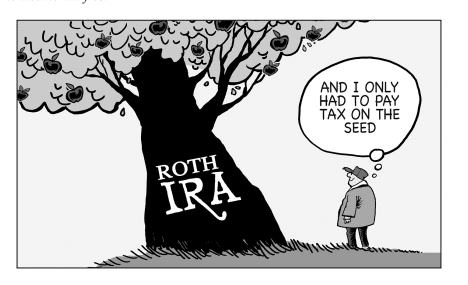
One of the few things in life better than tax-deferred compounding is tax-free compounding.

Traditional IRA, the tax savings you realize from a Traditional IRA contribution are neither tax-free nor tax-deferred. When you make a withdrawal from your Traditional IRA, the distribution is taxable. But when you (or your heirs) make a qualified withdrawal from a Roth IRA, the distribution is income-tax free.

Should I Contribute to a Traditional Deductible IRA or a Roth IRA?

As stated earlier, a Roth versus a nondeductible IRA is a no-brainer: if given the choice, always go for the Roth. But for those individuals with a choice between a Roth IRA (or work retirement plan) and a fully deductible IRA (or work retirement plan), how should you decide? The conclusion is, in most cases, the Roth IRA is superior to the deductible IRA (and nonmatched retirement plan contributions like 401(k)s).

To determine whether a Roth IRA would be better than a Traditional IRA, you must take into account:

  • The value of the tax-free growth of the Roth versus the tax-deferred growth of the Traditional IRA including the future tax effects of withdrawals.
  • The tax deduction you lose by contributing to a Roth IRA rather than to a fully deductible IRA.
  • The growth, net of taxes, on savings from the tax deduction from choosing a deductible Traditional IRA.

In most circumstances, the Roth IRA is significantly more favorable than a Traditional IRA. (A number of years ago, I published an article in The Tax Adviser, a publication of the American Institute of Certified Public Accountants, which offered the mathematical proof that the Roth IRA was often a more favorable investment than a Traditional IRA.) The Jobs and Growth Tax Relief Reconciliation Act of 2003 (JGTRRA) and subsequent tax legislation changed tax rates for all brackets and reduced tax rates for dividends and capital gains. After these tax law changes, I incorporated the changes into the analysis of the Roth versus the Traditional IRA. The Roth was still preferable in most situations, although the advantage of the Roth was not quite as great as before JGTRRA. However, our country is currently facing unprecedented financial challenges, and I would not be surprised to see the government intend to reduce our tax rates any time soon. And, if the tax rates on dividends and capital gains, or even the ordinary tax rates increase, the Roth’s advantage will be even greater.
Roth IRA vs Traditional IRA


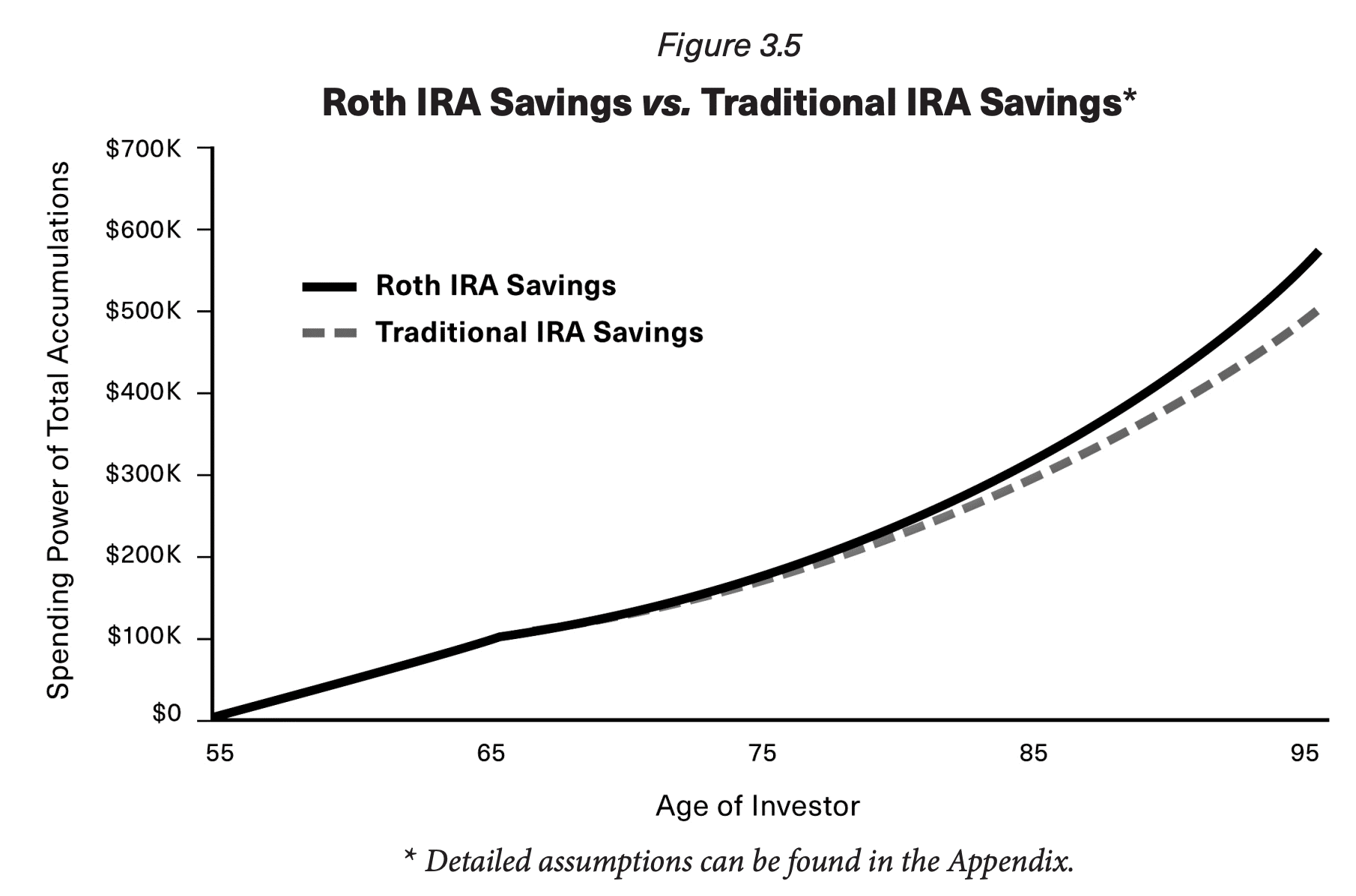
Figure 3.5 shows the value to the owner of contributing to a Roth IRA versus a regular deductible IRA measured in purchasing power.

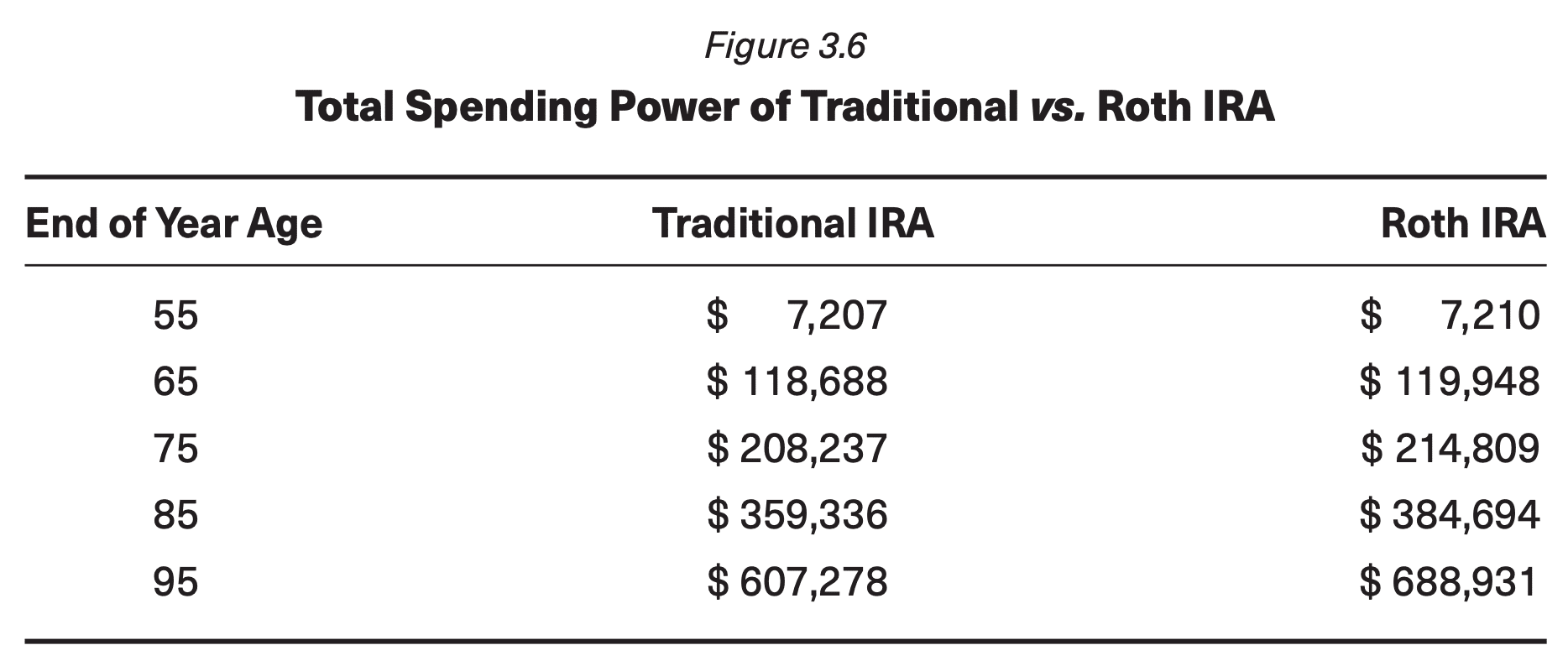
The amounts reflected in the figure show that saving in the Roth IRA is always more favorable than saving in the Traditional IRA, even if the contributions are made for a relatively small number of years. If tax rates become higher in the future, or if a higher rate of return is achieved, the overall Roth IRA advantage will be larger. Given a long-time horizon (such as when monies are passed to succeeding generations), the Roth IRA advantage becomes even bigger. The spending power of these methods at selected times is shown in Figure 3.6 on page 70.
Roth IRA vs Traditional IRA

The very limited (11-year) contribution period and very conservative (6%) rate of return. In short, it demonstrates that, even with minimal contributions, shorter time frames, and very conservative rates of return, the Roth IRA will still provide more purchasing power than a Traditional IRA.

The Effect of Lower Tax Brackets in Retirement

I will usually recommend the Traditional IRA over a Roth IRA if you drop to a lower tax bracket after retiring and have a relatively short investment time horizon. Under these circumstances, the value of a Traditional deductible IRA could exceed the benefits of the Roth IRA. It will be to your advantage to take the high tax deduction for your contribution and then, upon retirement, withdraw that money at the lower tax rate.

For example, if you are in the 24% tax bracket when you are working and make a $6,000 tax-deductible IRA contribution, you save $1,440 in federal income taxes. Then, when you retire, your tax bracket drops to 12%. Let’s assume that the Traditional IRA had no investment growth—an unrealistic assumption for a taxpayer who chooses to invest his IRA in a certificate of deposit which, at the time of writing, paid historically low interest rates. If he makes a withdrawal of $6,000 from the Traditional IRA, he will pay only $720 in tax—for a savings of $720.

Roth IRA vs Traditional IRA

If you drop to a lower tax bracket after retiring and have a short investment time horizon, I usually recommend the Traditional IRA or 403(b) over a Roth IRA or 403(b).

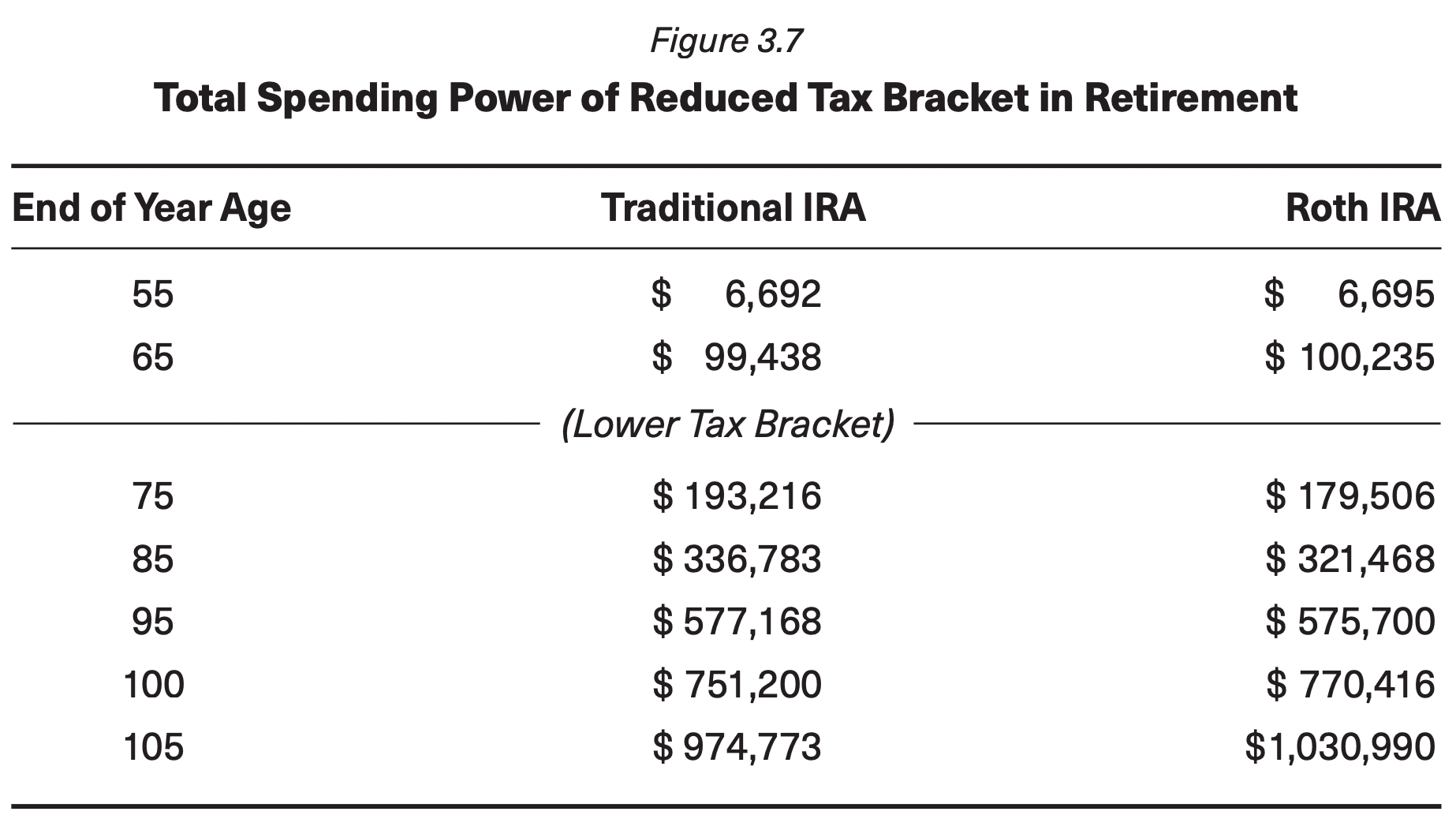
The advantage diminishes over time. So I ran the analysis again, starting with the same assumptions as in the previous example, except that, beginning at age 66, the ordinary income tax bracket is reduced from 24% to 12%.

The spending power of these methods at selected times is shown in Figure 3.7 on the next page. You can see that, under this particular set of circumstances, the Traditional IRA would be more beneficial to you during your lifetime. Note, however, that the Roth offers more spending power from age 100 on. Of course, most people will not survive until 100, but we show the analysis to point out that even facing a reduced tax bracket, the Roth IRA will become more valuable with time—an advantage for your heirs.
Roth IRA vs Traditional IRA

If you anticipate that your retirement tax bracket will always remain lower than your current tax rate and that your IRA will be depleted during your lifetime, I usually recommend that you use a Traditional deductible IRA over the Roth IRA.

Unfortunately, once the RMD rules take effect at age 72 for tax-deferred IRAs and retirement plans, many individuals find that they are required to withdraw so much money from their IRAs that their tax rate is just as high as their pre-retirement tax rate. And, when their RMDs are added to their Social Security income, some taxpayers find themselves in a higher tax bracket than when they were working. For these people, a Roth IRA contribution is usually preferable to a Traditional IRA.

These numbers demonstrate that even with a significant tax-bracket disadvantage, the Roth IRA can become preferable with a long enough time horizon. Furthermore, when you consider the additional estate planning advantages, the relative worth of the Roth IRA becomes more significant. (Please see Chapter 15 for a more detailed discussion of making a Roth conversion in a higher tax bracket when you will likely be in a lower tax bracket after retirement.)


Roth IRA vs Traditional IRA: Key Takeaways

When evaluating a Roth IRA vs Traditional IRA, the long-term impact of taxes often matters more than the upfront deduction. While Traditional IRAs can provide immediate tax savings, Roth IRAs offer the potential for tax-free growth and tax-free withdrawals, which may significantly increase purchasing power over time. As shown in the analysis above, factors such as future tax rates, investment time horizon, required minimum distributions, and estate planning goals all play a role in determining which account is more advantageous. Understanding these differences is essential when building a retirement strategy designed to last.

Is a Roth IRA or Traditional IRA better for long-term growth?

Are withdrawals taxed differently in a Roth IRA vs Traditional IRA?

Does a Roth IRA eliminate required minimum distributions (RMDs)?

Can I contribute to both a Roth IRA and a Traditional IRA?

How do income limits affect Roth IRA eligibility?

What happens to a Roth IRA or Traditional IRA when passed to heirs?

Does a Roth IRA protect against future tax increases?

The Incredible Tax Advantage of Young Beneficiaries

Let’s Talk About Your Kids:
The Advantage of Estate Planning with Young Beneficiaries

The Incredible Tax Advantage of Young Beneficiaries

Let’s talk about your beneficiaries, your kids and grand kids.

In the second video in this series, we learned that estate planning that leaves retirement assets directly to children and grandchildren offers extraordinary tax advantages to your family.  The basic premise being that a young beneficiary has a long life-expectancy, and sustaining money in the tax deferred environment for an extended period allows for the most growth. At least this is how things work under the current law.

I think we can agree that, in drafting estate planning documents, the primary concern for most couples is to provide for the surviving spouse. As we have discussed, transferring assets to a spouse is a fairly straightforward process and does have some tax advantages. Then, they hope that when they are both gone, there will be something left for their kids, and then for their grandchildren.  But, I am suggesting that, depending on family circumstances, it might be smart to leave money to kids or grandkids at the first death.

Let’s say that after you die, your spouse is in good health and has more money than he or she will ever need.  Under those circumstances, you have met our first criteria for an estate plan:  providing for the surviving spouse.  In this case, leaving at least a portion of your IRA to your children is perhaps a viable and tax-savvy option.  With their longer life expectancy, they will have lower required minimum distributions which means more of your money will continue to grow tax-deferred.  Flexible estate planning at its finest! It’s a winning scenario, especially if you look at the family as a whole with the idea of establishing a legacy.

If we take it one step further with your beneficiaries.

It’s even better, tax-wise, to name your grandchildren.  Imagine the advantages of minimizing tax-free distributions from an inherited Roth account over a long lifetime! If you scroll up to video two in the series, you can watch me run the numbers for just that scenario.  It’s a game-changing strategy.

We cannot over-stress, however, that naming minor children or grandchildren as beneficiaries will also require some additional estate planning to protect them from themselves—no Ferrari at 21 for you my grandson—and, potentially, creditors.  We recommend that all minors’ shares are held in well-drafted trusts.  Additionally, it is critical that the trust meets five specific conditions to qualify as a designated beneficiary of an IRA or a Roth IRA (you can find reference to the five conditions in my book, Retire Secure! on Page 307, and you can download a copy of the book at www.paytaxeslater.com/books. Under current law, a well-drafted trust will allow them to stretch an inherited IRA or Roth IRA over their lifetime. If the trust doesn’t meet all five of the conditions, then the trust will not qualify as a beneficiary and income taxes will be accelerated. Without attention to the details, it could go from an estate planning dream to a nightmare.

So, let’s pull it all together.

Even if you have specific bequests that you want to see honored—a gift to a charity or a cause or a family friend—I suspect that it is still safe to say that your primary beneficiaries will be your surviving spouse, your children, and your grandchildren.  That being the case, stay tuned to learn why Lange’s Cascading Beneficiary Plan is probably the best estate planning solution for you.

Until next time!

-Jim


P.S. If you want to do a little advanced study on this topic before the next post and video, go to https://paytaxeslater.com/estate-planning/.

Special Alert About the Equifax Data Breach

The Equifax Data Breach:
All You Need To Know

The Equifax Data Breach - What Should You Do

The recent data breach at Equifax has sparked a lot of discussion about how vulnerable the personal information of all Americans may be to theft.  Is there anything you can do to protect yourself in our computer-driven society?  While the Equifax hack was by far the largest in history, it’s not the first and will not be the last.  In 2017 alone, Verizon, Blue Cross Blue Shield/Anthem, Dun and Bradstreet, Chipotle, Washington State University, and even the IRS have discovered that they’ve been hacked – exposing the personal information of millions of Americans to thieves.  The breach at Equifax was so far-reaching that several corporate officers have retired, and many on Capitol Hill are calling for a complete investigation.  With over 143 million Americans at risk of being involved in this massive breach, you could very easily be affected.

What You Can Do If Your Information Has Been Compromised

So what can you do to protect yourself?  You probably know that Equifax has set up a website where you can check to see if your number has been exposed.  If your information was exposed in the breach, you can get free credit monitoring for one year.   In my opinion, that’s like closing the barn door after the horse has gotten out.  They’re happy to let you know that someone has opened up a fraudulent account in your name, but it’s still up to you to clean up the mess if they do!  And what happens when your year of free credit monitoring is over?  If you don’t pay for credit monitoring every year for the rest of your life, you may never know if someone is using your identity at some point down the road.

What Does Freezing Your Credit Report Do?

Some experts are recommending that you place a freeze on your credit files.  A freeze prevents lenders from even accessing your credit report.  The advantage to freezing your file is that, if they do not know your credit history, lenders will not offer credit to a thief who is trying to use your identity.   What are the disadvantages of freezing your credit files?  First, it’s not an easy process.  There are three major credit reporting bureaus, and you will have to place three separate freezes.  You can do so by using these links:

Equifax freeze

Transunion freeze

Experian freeze

If you are a Pennsylvania resident, the law permits the credit bureau to charge you $10 to freeze your file.  Equifax has agreed to waive their fee, but only after public pressure.

Unfortunately, the data breach at Equifax has caused all three credit reporting agencies to be overwhelmed with requests to freeze accounts.  Many consumers are complaining that they can’t even get into the websites or if they do get in, that the site crashes after they fill out the application form.  If you have not already frozen your account, you may have a better chance of getting through if you try before 7:00 a.m., or after 11:00 p.m.  Another disadvantage of freezing your credit files is that if you need to apply for credit yourself – for a car loan, a home equity loan or even a medical credit card – you must first remove the freeze from your files.  You will need a PIN number to remove the freeze and, if you lose your PIN number, you will be facing a time-consuming and difficult process to get another one.

The Equifax Data Breach and Your Tax Return

Opening phony credit accounts in your name, unfortunately, could be just the tip of the iceberg.  The Internal Revenue Service (IRS), which has issued more than $20 billion in fraudulent tax refunds over the past few years, could be plundered unless there is intervention by Congress.  By law, the IRS must process your tax return within a specified period – generally 45 days – or they have to pay you interest on your refund.  To meet those guidelines, they’ve adopted a “pay first, ask questions later” philosophy.  In our practice, it’s not uncommon to see a client get a tax refund check and then an audit notice a year later! The IRS’s system requires little more than a name, date of birth and Social Security number to process tax returns - information which was exposed in the Equifax data breach – and they accept returns as soon as January 1st.   On the other hand, employers aren’t required to submit updated employment information to the IRS until March.  By that time, about half of all of the refund checks have already been issued!

Protecting Yourself After the Equifax Hack

So what can you do to protect yourself?  If you don’t want to freeze your credit files, then you should be checking your credit reports regularly for fraudulent activity.  Most of the major credit card companies allow you to request that you be notified if a charge is processed on your account that exceeds a certain dollar amount.  You should consider placing an alert for an amount that exceeds your normal spending threshold.   If you are traditionally a procrastinator when it comes to filing your tax return, don’t wait - get it filed as soon as possible.  Even if you owe, you don’t have to pay the IRS until April 15th.  If you have any credit card debt, get it paid off.  Financial institutions that fall victim to fraudsters because of the Equifax data breach will have to pass the cost of their losses on to their customers – and you don’t want to be one of the unlucky ones footing the bill.

Last but not least – whatever you do to protect yourself, make sure that you do the same for those who might not, including children and elderly parents!

Stay safe out there!

Jim


Stop the Sneaky Tax!

It’s Time to Stop the Sneaky Tax!

Those of you who follow my blog know that I have been somewhat obsessed with the legislation that I call the Death of the Stretch IRA.  If you’re new to my blog, please read some of the preceding posts – they’ll tell you just how much this legislation will cost IRA owners.  The worst part of the Death of the Stretch IRA is that most beneficiaries (your children and grandchildren) won’t have a clue about how much of their inheritance they have lost to taxes.  When they inherit your IRA after you die, your beneficiaries will suddenly have more money than they had before.  Our government is counting on them to be content with their higher bank balance, and is hoping that they never notice that an enormous chunk of their inheritance ended up in Uncle Sam’s pockets before the remainder found its way to them.   That’s what makes this tax so nefarious and, well, sneaky!

Our government has a lot of expensive problems right now – they’re looking to come up with a viable heath care system, build a wall on our southern border and I can’t even begin to imagine how much it will cost to repair the damage done by Hurricane Harvey.  The Treasury doesn’t even have enough money to pay for their day-to-day operations, much less all of this – they’re going to be raising the debt ceiling next month!  I’d bet my own IRA on the fact that the government is planning to include the Death of the Stretch IRA – and the $1 Trillion in revenue that it will generate – as part of an appropriations or budget action that will be voted on before the end of 2017.

You Can Help Stop the Sneaky Tax

If you are a loyal reader, you know that we have been writing our clients and friends to warn them about the sneaky tax, and working on solutions to minimize the damage that this legislation will do.  Now it’s time to send a shot across their bow and tell the government that they’d better find their revenue someplace else besides your IRA.  We are asking your help to start a grass-roots protest against the Sneaky Tax which would kill the stretch IRA—an incredibly useful estate planning tool.  This new law would be so absolutely devastating to so many families across the country, our clients included, that we can’t just sit by and watch it happen.

Write Your Congressman Now

Please help us get the message to our legislators that we will not stand for them picking the pockets of our children and grandchildren.  Please consider going to www.stopthesneakytax.com to add your name to the list of people who are unhappy with this proposed new law and send an email to your Congressmen asking them to say NO to the sneaky tax.  You can also keep up to date with what is going on with this law by joining our new private Facebook group: SOS Save Our Stretch!  Stop the Sneaky Tax!  You can join the group by going to www.saveourstretch.com.  For a limited time, joining the Facebook group will entitle you to a free Advance Reader Copy of Jim’s newest book – The 5 Greatest Tax-Saving Strategies for Protecting Your Family from the New Tax Law.

Sign our Petition to STOP Washington’s Planned Trillion Dollar IRA Sneaky Tax at www.stopthesneakytax.com.

Join our Facebook Group for breaking news and updates at www.saveourstretch.com.

And please forward this to everyone you know who has an IRA!

-Jim

Action you can take:
Forward this petition to all of your friends’
Join our Facebook Group and for a limited time get a FREE advanced reader copy of my upcoming book dedicated to stopping the sneaky tax.

You can view my previous posts on the Death of the Stretch IRA by clicking the links below;

Will New Rules for Inherited IRAs Mean the Death of the Stretch IRA?
Are There Any Exceptions to the Death of the Stretch IRA Legislation?
How will your Required Minimum Distributions Work After the Death of the Stretch IRA Legislation?
Can a Charitable Remainder Unitrust (CRUT) Protect your Heirs from the Death of the Stretch IRA?
What Should You Be Doing Now to Protect your Heirs from the Death of the Stretch IRA?
How Does The New DOL Fiduciary Rule Affect You?
Why is the Death of the Stretch IRA legislation likely to pass?
The Exclusions for the Death of the Stretch IRA
Using Gifting and Life Insurance as a Solution to the Death of the Stretch IRA
Using Roth Conversions as a Possible Solution for Death of the Stretch IRA
How Lange’s Cascading Beneficiary Plan can help protect your family against the Death of the Stretch IRA
How Flexible Estate Planning Can be a Solution for Death of the Stretch IRA
President Trump’s Tax Reform Proposal and How it Might Affect You
Getting Social Security Benefits Right with the Death of the Stretch IRA
The Best Age to Apply for Social Security Benefits after the Death of the Stretch IRA
Part II: The Best Age to Apply for Social Security Benefits after the Death of the Stretch IRA
Social Security Options After Divorce: Don’t Overlook the Possibilities Just Because You Hate Your Ex
Is Your Health the Best Reason to Wait to Apply for Social Security?
Roth IRA Conversions and the Death of the Stretch IRA
How Roth IRA Conversions can help Minimize the Effects of the Death of the Stretch IRA
How Roth IRA Conversions Can Benefit You Even if The Death of Stretch IRA Doesn’t Pass
The Death of the Stretch IRA: Will the Rich Get Richer?
The Best Time for Roth IRA conversions: Before or After the Death of the Stretch IRA?
Roth IRA Conversions and the Death of the Stretch IRA
Part II: How Roth IRA Conversions Can Help Protect You Against the Death of the Stretch IRA
Roth IRA Recharacterizations and the Death of the Stretch IRA
The Risk of Roth IRA Recharacterizations & The Death of the Stretch IRA

Recharacterizing Roth IRA Conversions? – Your Ace in the Hole When the Death of the Stretch IRA Passes?

What Are The Risk of Roth IRA ReCharacterizations?

The Risk of Roth IRA Recharacterizations and The Death of the Stretch IRA James Lange

This post is the last in a series about how you might be able to use Roth IRA conversions as a defense against the Death of the Stretch IRA.

Disclaimer: Please note that the Tax Cuts and Jobs Act of 2017 removed the ability for taxpayers to do any “recharacterizations” of Roth IRA conversions after 12/31/2017. The material below was created and published prior the passage of the Tax Cuts and Jobs Act of 2017. 

How does a Roth IRA Conversion Work?

Suppose you have an IRA worth exactly $1 million, and that it happens to be invested equally in ten different mutual funds of $100,000 each. Then suppose we run the numbers for you and figure out that $100,000 is the optimal amount for you to convert to a Roth IRA.  How does a Roth IRA Conversion work?

Well, one idea would be to start by ranking your funds according to how much you expect them to fluctuate in value.  Maybe you are holding a portion of your IRA in Certificates of Deposit at your bank.  Most people would expect that money to be “safer” because it generally doesn’t fluctuate in value.  Then suppose you have a portion of your IRA invested in large cap stocks.  You’ve noticed the value changing as the stock market moves up and down but, in your case, we’ll say this fund fluctuates an “average” amount compared to your other holdings.  Then suppose that you also a portion of your IRA invested in small cap stocks, and that fund has been known to lose 20 percent of its value overnight.  We’ll call that one the “riskiest.”

So which part of your IRA should you convert?  You could convert the CDs or the ones that you consider to be the safest.  Or you could convert the small cap stocks – the one you consider to be the riskiest.  Maybe you’d like to convert part of each fund that you own.  Let’s look at the possible outcomes.

You can certainly convert your CDs but, in my opinion, going through all that paperwork to avoid paying taxes on the one or two percent you’ve probably earned on them doesn’t seem worth the time or trouble.  What about converting a little bit from each fund you own?  I’d prefer that to converting the CDs, but it still seems like more work than necessary.  What about your “riskiest” fund – the one that has the value that fluctuates wildly?  Let’s assume that you converted $100,000 of that fund.  What position might you be in a year down the road?

Well, suppose that fund doubles in value.  You now have a Roth IRA worth $200,000 but you only had to pay tax on a $100,000 conversion.  Good for you!   But suppose the fund went down in value, and now you have a Roth IRA worth $50,000.  Worse yet, you’ve paid $25,000 in income taxes, and now you’re really mad at me.

Recharacterize Your Roth IRA Conversion

Remember, as long as you act by the October tax deadline, you can recharacterize, or undo, your conversion.  This flexibility can give you enormous peace of mind while you’re waiting for the details of the Death of the Stretch IRA to be finalized. A recharacterization will NOT get back the money your investment may have lost – you will need to wait for the market to come back up for that.  What the recharacterization can do is get back the money you paid in income taxes, if the account goes down in value.

A Risk of Roth IRA Conversions

As beneficial as Roth IRA conversions and recharacterizations can be, there is always one risk I make clients aware of when discussing them.  It has to do with the IRS itself.  Have you ever known anyone who has gotten tied up in an endless and stupid loop of government red tape?  Let me tell you about a married couple I know, who have always filed jointly.  The wife, whose name has always been listed second on the tax return, started a consulting business and, as she was required to, made an estimated tax payment for the income she earned.  The couple filed a joint return and waited for their refund to arrive.  They finally received a letter from the IRS and opened it, only to find that there was no refund enclosed.  Worse yet, there was a letter saying that no refund would be coming because they had overstated the amount of tax they had paid – a transgression that not only caused the IRS to completely wipe out their refund but add a significant amount of penalties and interest to their tax bill.

Armed with copies of canceled checks, the wife went down to the local IRS office and demanded they retract their letter – which they eventually did.  But do you want to know why it happened in the first place?   When the wife made the estimated tax payment for her business, she paid it using her own Social Security number because that was the number shown on the 1099s she’d received for her consulting work.  Unfortunately, when they received her check, the IRS didn’t recognize her as a taxpayer.  Even though she’s always filed jointly with her husband, her name and Social Security number were listed on the second line of the return, not the first.  And because hers was not the first name – even though it was a joint tax return – the IRS could find no record of her, and her tax payment just went into a big black hole!

Unfortunately, we have found that the IRS sometimes has trouble putting two and two together.  If both your conversion and recharacterization forms aren’t filled out exactly right, you could risk getting a nasty letter in your mailbox.  We fight those battles with the IRS on behalf of our clients, but if you’re a do-it-yourselfer, you need to know that it’s not unheard of for them to have a record of just one form or the other – but not both.  If it happens to you, you need to stick to your guns and get it sorted out.  A Roth IRA conversion can be your best defense against the Death of the Stretch IRA, and you can change your mind as long as you recharacterize by the deadline!

Thanks for reading, and stop back soon!

-Jim

For more information on this topic, please visit our Death of the Stretch IRA resource.

P.S. Did you miss a video blog post? Here are the past video blog posts in this video series.

Will New Rules for Inherited IRAs Mean the Death of the Stretch IRA?
Are There Any Exceptions to the Death of the Stretch IRA Legislation?
How will your Required Minimum Distributions Work After the Death of the Stretch IRA Legislation?
Can a Charitable Remainder Unitrust (CRUT) Protect your Heirs from the Death of the Stretch IRA?
What Should You Be Doing Now to Protect your Heirs from the Death of the Stretch IRA?
How Does The New DOL Fiduciary Rule Affect You?
Why is the Death of the Stretch IRA legislation likely to pass?
The Exclusions for the Death of the Stretch IRA
Using Gifting and Life Insurance as a Solution to the Death of the Stretch IRA
Using Roth Conversions as a Possible Solution for Death of the Stretch IRA
How Lange’s Cascading Beneficiary Plan can help protect your family against the Death of the Stretch IRA
How Flexible Estate Planning Can be a Solution for Death of the Stretch IRA
President Trump’s Tax Reform Proposal and How it Might Affect You
Getting Social Security Benefits Right with the Death of the Stretch IRA
The Best Age to Apply for Social Security Benefits after the Death of the Stretch IRA
Part II: The Best Age to Apply for Social Security Benefits after the Death of the Stretch IRA
Social Security Options After Divorce: Don’t Overlook the Possibilities Just Because You Hate Your Ex
Is Your Health the Best Reason to Wait to Apply for Social Security?
Roth IRA Conversions and the Death of the Stretch IRA
How Roth IRA Conversions can help Minimize the Effects of the Death of the Stretch IRA
How Roth IRA Conversions Can Benefit You Even if The Death of Stretch IRA Doesn’t Pass
The Death of the Stretch IRA: Will the Rich Get Richer?
The Best Time for Roth IRA conversions: Before or After the Death of the Stretch IRA?
Roth IRA Conversions and the Death of the Stretch IRA
Part II: How Roth IRA Conversions Can Help Protect You Against the Death of the Stretch IRA
Roth IRA Recharacterizations and the Death of the Stretch IRA
The Risk of Roth IRA Recharacterizations & The Death of the Stretch IRA


Can a Charitable Remainder Unitrust (CRUT) Protect your Heirs from the Death of the Stretch IRA?

Can a Charitable Remainder Unitrust Protect Your Heirs From the New IRA Tax Rules James Lange

This post is the fourth in a series about the Death of the Stretch IRA.  If you’re a new visitor to my blog, this post might not make much sense to you unless you back up and read the three posts, How will your Required Minimum Distributions Work After the Death of the Stretch IRA Legislation?, Are There Any Exceptions to the Death of the Stretch IRA Legislation?, & Will New Rules for Inherited IRAs Mean the Death of the Stretch IRA? immediately before this one.  Those posts spell out the details of the proposed legislation that will cost your family a lot of money.  If you’re familiar with the specifics of the legislation, then please read on, because I’m going to talk about some possible solutions to the problems that will be caused by the Death of the Stretch IRA.

What is the best way to protect my IRA, once this Stretch IRA legislation is passed?

Many people have asked me, “What is the best way to protect my IRA, once this legislation is passed?  Well, the Senate Finance Committee did say that some people could be excluded from the new tax rules – my post of February 28th discusses them – so let’s look at how they might figure into your game plan.

I firmly believe in providing the surviving spouse with as much protection as possible, so I usually recommend that you name your spouse as your primary beneficiary and give him the right to disclaim your IRA to someone else.  If your spouse needs the money, that’s great.  He is excluded from the legislation, so he can still “stretch” your IRA after your death.

But suppose you have no spouse, or that your surviving spouse will not need your IRA because he has sufficient assets of his own?  In that case, your IRA will likely go to your child or children.  And the problem with that is that children are not excluded from these new rules unless they are disabled or chronically ill.   So here is one possible solution that can protect your children from the harsh new tax structure.

Let’s assume that you have an IRA that is worth $1.45 million, and that your beneficiary is your child.  Under the proposed new rules, your child can exclude $450,000 of your IRA and stretch it over the remainder of her life.  The remaining $1 million, though, will be subject to the new rules and will have to be withdrawn from the IRA within five years.  Even if she tries to spread the withdrawals out over five years to minimize the tax bite, she’ll still have to include about $200,000 in her income every year.   Depending on her income from other sources, that will probably push her up into a higher tax bracket.  The current maximum tax rate is 39.6 percent, so it’s possible that your child would have to pay $400,000 in federal income taxes – even more, if the state you live in taxes IRA distributions.

Can a Charitable Remainder Unitrust (CRUT) provide a possible solution to the Death of the Stretch IRA?

Can a Charitable Remainder Unitrust (CRUT) provide a possible solution to the Death of the Stretch IRA, and protect your child from these taxes?  If you look at my post on February 28th, you’ll see that charities and charitable trusts are excluded from the five-year rule! And while the CRUT has to comply with certain IRS rules regarding how and when money can be withdrawn, the IRA that is inside the trust is not subject to tax UNTIL you take withdrawals from it.  So if your child receives the minimum possible from the trust every year, it is possible that he can avoid much of the income tax acceleration that will happen once this legislation is passed.

Will your child have more money over the long term with the income from the $1 million that goes into the trust, or if he has to follow the new IRA rules and has to withdraw your IRA and pay taxes within five years, leaving him with an after-tax amount of about $600,000?  I’ll answer like a lawyer – it depends.   One of the very real problems with a charitable trust is that, once the beneficiary dies, any money that is left over goes directly to the charity.  So if your child dies after receiving just one distribution from the trust, the charity will end up receiving more money from your IRA than your family will.  There are some possible ways to manage this risk, though, such as taking out a term insurance policy on the life of your child.  So if he does die prematurely, the proceeds of the life insurance can replace the money that will go to the charity.

For some people, a CRUT can be a bad idea.  There is a cost to draft the legal documents, but that cost is nothing compared to the cost of maintaining the CRUT over the long term.  The Trustee must file a tax return for the CRUT to show the IRS how much has been paid to the beneficiary.  The CRUT’s tax return produces a form that has to be included with the beneficiary’s tax return, just like a W-2 or 1099, and the extra paperwork means a higher tax preparation fee for the beneficiary every year.  My rule of thumb is that it’s not worth the money or headaches to establish a CRUT and name it as your beneficiary if your IRA balance is below $1 million.

I encourage you to watch this short video to learn more about the pros and cons of Charitable Remainder Unitrusts, and how they can be used to help shield your retirement savings from the Death of the Stretch IRA legislation.  However, do not take action and establish a CRUT until the final legislation has passed.  If you are using Lange’s Cascading Beneficiary Plan, the current Stretch IRA rules will produce a far more favorable result than the trust.

Please stop back soon,
Jim

For more information on this topic, please visit our Death of the Stretch IRA resource.


P.S. Did you miss a video blog post? Here are the past video blog posts in this video series.

Will New Rules for Inherited IRAs Mean the Death of the Stretch IRA?

Are There Any Exceptions to the Death of the Stretch IRA Legislation?

How will your Required Minimum Distributions Work After the Death of the Stretch IRA Legislation?

Can a Charitable Remainder Unitrust (CRUT) Protect your Heirs from the Death of the Stretch IRA?

What Should You Be Doing Now to Protect your Heirs from the Death of the Stretch IRA?

How Does The New DOL Fiduciary Rule Affect You?

Why is the Death of the Stretch IRA legislation likely to pass?

The Exclusions for the Death of the Stretch IRA

Using Gifting and Life Insurance as a Solution to the Death of the Stretch IRA

Using Roth Conversions as a Possible Solution for Death of the Stretch IRA

How Lange’s Cascading Beneficiary Plan can help protect your family against the Death of the Stretch IRA

How Flexible Estate Planning Can be a Solution for Death of the Stretch IRA

Save

The Best Response to the New Estate Laws

The top estate planners in the country warn IRA and retirement plan owners to develop an appropriate response to the new estate tax laws just passed this December. We are now in a completely different tax environment ripe for the cruelest trap of all: where the standard language of traditional wills and trusts forces too much money (now up to $5,000,000) into a trust limiting the surviving spouse to income and the right to invade principal for health, maintenance and support.  If the trust is overfunded, which is likely under the new law, less discretionary income is available for the surviving spouse.  Furthermore, if this common trust is the beneficiary of an IRA or retirement plan, massive income taxes are also triggered – all this can be avoided with appropriate language in wills and trusts and appropriate beneficiary designations of IRAs, Roth IRAs and retirement plans.

Under the new estate tax laws, older traditional estate plans are not helpful, but harmful, because of the severe restrictions they place on the surviving spouse, something most couples do not want.  Many IRA and retirement plan owners have this detrimental language in their existing wills and trusts and don’t even know it. IRA and retirement plan owners with assets between $600,000 and $5,000,000 are particularly vulnerable. Both spouses have likely become quite accustomed to making expenditure decisions based on desire in addition to need. To lose that control would be devastating. Without a review of their older traditional estate plan they could be  thinking they have left everything under the control of their spouse, but in reality, they have not.

I encourage you to have your will reviewed and updated to comply with the estate planning law.  In Pittsburgh?  Please join us for one of our FREE workshops entitled, “How to Avoid the Cruelest Trap of All:  Don’t Unknowingly Restrict Your Surviving Spouse’s Independence or Access to the Family Money After the Tax Relief Act of 2010.”   See our location and times on www.paytaxeslater.com.  Not in Pittsburgh, you can purchase this workshop to view in the comfort of your own home for just $97 – to order call our office at 412.521.2732.

Beneficiary Designations in a Second Marriage

Estate planning can be tricky to begin with — toss in a second spouse and children from different marriages and relationships and it becomes even more difficult.

Recently, Jim Lange came across an article in the Pittsburgh Post-Gazette that dealt with the estate planning challenges caused by divorce and remarriage.  The example that was used was that after 15 years of a second marriage, a husband was getting ready to retire with $1 million in his IRA.  His second wife was shocked to learn that she had no ownership rights to the account.

One of the proposed solutions listed in the article was a tool called a QTIP trust (qualified terminable interest property trust).  In this case, a QTIP trust would be listed as the beneficiary of the husband’s IRA and would then provide an income stream for the surviving spouse while protecting a portion of the assets for the children.

Jim thinks that this is the wrong approach and offered his solution in a letter to the editor.  Jim’s first point is that naming a QTIP trust as the beneficiary of an IRA accelerates income and taxes to the detriment of both the surviving spouse and the children.  The surviving spouse is left with only an income stream and the kids don’t inherit anything until the second spouse dies.  He’s also concerned about the fees generated by the QTIP trust solution — attorneys have to be paid to draft the trust and annual CPA and trustee fees have to be paid after the first death.

Instead, Jim prefers to leave a certain percentage of the IRA to the surviving spouse and give the rest to the children of prior marriages.  It’s a simple solution that provides more money for the heirs and less for the IRS.

Coincidentally, the topic of the June 3rd edition of our radio show, The Lange Money Hour, was trusts — so, we started the show with a discussion about the Post-Gazette article.  A special thank-you to a guest who agreed to join us on short notice — Tom Crowley, Senior Wealth Planner and VP at PNC Wealth Management.  While Tom agreed with Jim about the tax consequences of naming a QTIP trust as beneficiary of an IRA, he pointed out that in his practice, some clients are willing to sacrifice more money in taxes in order to gain greater control over the distribution of the funds.

During the rest of the show, Jim went on to explain the ins and outs of various trusts including living trusts, spendthrift trusts, charitable trusts and trusts for minors.  Keep in mind that every case needs to be evaluated on an individual basis.  If you have questions about any of these trusts or think that you need a thorough review, be sure to call the office at 412-521-2732 and a member of the Lange team can help.