Roth IRA Conversions Early in 2016 Present Potential Advantages

Disclaimer: Please note that the Tax Cuts and Jobs Act of 2017 removed the ability for taxpayers to do any “recharacterizations” of Roth IRA conversions after 12/31/2017. The material below was created and published prior the passage of the Tax Cuts and Jobs Act of 2017. 

Let’s face it. The stock market has declined a lot in the past few months.

Many people wonder if they should move to cash and do nothing with their investments. While we do not recommend trying to time the future moves in the stock market, the reality is that it is better to buy low and let it grow more in the future. This is especially true for Roth IRA conversions which result in long-term advantages when the account grows after the conversion. So maybe the time to convert is now.

Lange Roth IRA Money Nest Egg

But, what if the market continues to decline after you convert? One good thing about the current tax law is that you can undo a 2016 conversion as late as April 15, 2017 and perhaps even to October 15, 2017. This gives you a long time, over a year, to see if it grows. If it really dives after you convert, you can even do another conversion at a lower price and undo the first conversion later. The technical term for the undoing of a conversion is a recharacterization, because the Roth IRA is recharacterized as a traditional IRA by moving it back to the original or a different traditional IRA account. Converting early in the year is often recommended as it gives the account more time to grow before a decision must be made on a potential recharacterization.

We have written many articles about Roth IRAs and Roth conversions and included discussions of the extensive advantages they provide. We discuss conversions in our book Retire Secure! and we have written an entire book on Roth IRAs called The Roth Revolution. Both of these books can be purchased on Amazon, but we would be happy to send you a copy for free. To receive a free copy, call us at 412-521-2732, or email admin@paytaxeslater.com and ask for one. Just reference this newsletter offer! These articles and discussions go into much deeper detail on the many strategic ways to do Roth conversions to your advantage, depending on your current situation.

The Roth conversion amount will add to your taxable income, so there are many tax traps to consider when deciding how much to convert, such as …

  • Higher tax rates and related tax surcharges and phaseouts of deductions first implemented for 2013 could result in extra tax if you convert too much.
  • For people who are covered by Medicare parts B and/or D, and pay Medicare premiums, converting too much in 2016 can raise the Medicare premiums in 2018.
  • Also, for medium- or lower-income people who get Social Security income, a conversion can make more of the Social Security subject to tax and also can turn tax-free long-term capital gains and qualified dividends into taxable amounts.

However, paying extra tax can sometimes be worth it in the long run if the Roth IRA account grows a lot after the conversion. These are just some of the things that should be considered in determining the best conversion amount.

Other considerations include the current and future financial and income tax situations of you and your beneficiaries. As we move further into an election year, the possibility of tax law changes looms ahead. Since future tax laws can affect the long-term success of a conversion early in 2016, they should also be considered.

Due to all these considerations and more, we stress the importance of “running the numbers” to be certain that the decisions you are making about Roth IRA conversions are absolutely right for your situation. In general, we like Roth IRA conversions for taxpayers who can make a conversion and stay in the same tax bracket they are currently in, and have the funds to pay for the Roth conversion from outside of the IRA. It is best to run the numbers to determine the most appropriate time and amount for your situation. This is a service that we have provided for hundreds of clients and currently offer free for our assets under management clients. We like to do these number running sessions with the clients in the room. This allows them the opportunity to bring up questions, adjust the scenarios, and feel extremely comfortable with the final decisions.

We usually find many people hesitant to make any changes in their investments when they decline in value. However, you should not pass up the opportunity to do a Roth conversion in a troubled market, as it could provide you and your family more financial security in the long run. Because of the many things to be considered when doing a Roth conversion, we suggest you discuss how much to convert in 2016 with your qualified advisor.

If you are interested about learning about whether a Roth IRA conversion is right for you, please click here and fill out our pre-qualification form. If you qualify, we will contact you to schedule an appointment with either James Lange or one of his tax experts.

Unfortunately, this Free Second Opinion is for qualified Western Pennsylvania residents only.

Save

Save

Save

Save

Unhealthy Investment Attachments

Have you ever made yourself suffer through a bad movie because, having paid for the ticket, you felt you had to get your money’s worth? Some people treat investments the same way.

Behavioral economists have a name for this tendency of people and organizations to stick with a losing strategy purely on the basis that they have put so much time and money into it already. It’s called the “sunk cost fallacy.”

Let’s say a couple buys a property next to a freeway, believing that planting trees and double-glazing will block out the noise. Thousands of dollars later, the place is still
unlivable, but they won’t sell because “that would be a waste of money.”

This is an example of a sunk cost. Despite the strong likelihood that you’ll never get your money back, regardless of outcomes, you are reluctant to cut your losses and sell
because that would involve an admission of defeat.

It works like this in the equity market too. People will often speculate on a particular stock on the basis of newspaper articles about prospects for the company or industry.
When those forecasts don’t come to pass, they hold on regardless.

It might be a mining stock that is hyped based on bullish projections for a new tenement. Later, when it becomes clear the prospect is not what its promoters claimed, some
investors will still hold on, based on the erroneous view that they can make their money back.

James Lange, Lange Financial Group, Pittsburgh, Investment

The motivations behind the sunk cost fallacy are understandable. We want our investments to do well, and we don’t want to believe our efforts have been in vain. But there are ways of dealing with this challenge. Here are seven simple rules:

  1. Accept that not every investment will be a winner. Stocks rise and fall based on news and on the markets’ collective view of their prospects. That there is risk around outcomes is why there is the prospect of a return.
  2. While risk and return are related, not every risk is worth taking. Taking big bets on individual stocks or industries leaves you open to idiosyncratic influences like changing technology.
  3. Diversification can help wash away these individual influences. Over time, we know there is a capital market rate of return. But it is not divided equally among stocks or uniformly across time. So spread your risk.
  4. Understand how markets work. If you hear on the news about the great prospects for a particular company or sector, chances are the market already knows that and has priced the security accordingly.
  5. Look to the future, not to the past. The financial news is interesting, but it is about what has already happened, and there is nothing much you can do about that. Investment is about what happens next.
  6. Don’t fall in love with your investments. People often go wrong by sinking emotional capital into a losing stock that they just can’t let go of. It’s easier to maintain discipline if you maintain a little distance from your portfolio. This is one of the huge values a fiduciary advisor can add to your portfolio.
  7. Rebalance regularly. This is another way of staying disciplined. If the equity part of your portfolio has risen in value, you might sell down the winners and put the money into bonds to maintain your desired allocation.

These are simple rules. But they are all practical ways of taking your ego out of the investment process and avoiding the sunk cost fallacy.

There is no single perfect portfolio, by the way. There is, in fact, an infinite number of possibilities, but based on the needs and risk profile of each individual, not on “hot tips” or the views of high-profile financial commentators.

This approach may not be as interesting. But by keeping an emotional distance between yourself and your portfolio, you can avoid some unhealthy attachments.

Save

Save

New Social Security Rule Will Hurt Women by Eliminating Benefits Options

James Lange, CPA/Attorney, Advises Married Couples Ages 62-70 to Apply and Suspend NOW. After April 29, 2016, it will be too late!

In early November, President Obama signed the Bipartisan Budget Act of 2015 into law and the repercussions are devastating to the married women of our country.

Pittsburgh – December 16, 2015 – Lange Financial Group, James Lange, Pittsburgh, Social SecurityMarried women, statistically the widows of the future, will pay a high price due to the changes that the Bipartisan Budget Act of 2015 has made to Social Security. Pittsburgh attorney and CPA James Lange takes action by releasing audio and video presentations as well as transcripts and a report that will help couples ages 62-70 navigate this new rule and protect their benefits while they still can!
SOCIAL SECURITY SURVIVOR BENEFITS ARE CRITICAL TO WOMEN

The financial well-being of widows is often dependent upon the choices that are made while their spouses are still alive. Spousal and survivor Social Security benefit choices can mean the difference between living comfortably in retirement and falling under the poverty line for women whose spouses leave them behind. Widows are commonly younger than their deceased husbands and the Social Security benefits they have earned, especially in the Boomer generation, are commonly less than that of their deceased husbands. This means that a widow will depend on collecting survivor benefits, often for many years, based on the benefits to which their deceased spouses were entitled.

“One of the best things a husband can do to protect his wife in widowhood is to maximize his own Social Security benefits. One technique that we use with our clients is apply & suspend.” James Lange of Pittsburgh-based, Lange Financial Group, LLC comments. “The law prior to the Bipartisan Act allowed the husband to apply for, and then suspend collection of his benefits, while allowing his wife to collect a spousal benefit. It was a win-win for our clients!”

This technique was used strategically to maximize the husband’s and wife’s long-term benefits. That, unfortunately, is coming to an end, with the exception of certain couples who take the appropriate action between now and April 29, 2016. For many couples, the income stream from spousal benefits in the previously allowed apply and suspend technique made it possible (or at least more palatable) for the husband to wait until age 70 to collect Social Security, thus maximizing their benefits.

“This new law cuts off that income stream, making it if not impossible, at least more difficult, for husbands to choose to delay collection of their benefits.” Lange warns, “Unfortunately, it is the widows of these husbands who cannot maximize their Social Security benefits who will be left in reduced circumstances for the rest of their lives.”

JIM LANGE’S ADVICE

DO NOT WAIT. Congress has eliminated one of the best Social Security maximization strategies. Fortunately, some recipients may be grandfathered already and others could be grandfathered if they act between now and April 29, 2016. Others will have to make do with the new laws. In either case, now is the time to review your options. We have posted a one hour audio with a written transcript explaining the old law, the new law and the transition rules. Readers can go to www.paytaxeslater.com to access this audio and transcript.

ABOUT JAMES LANGE Jim Lange, Pittsburgh, Social Security

James Lange, CPA/Attorney is a nationally-known Roth IRA and retirement plan distribution expert. He’s also the best-selling author of three editions of Retire Secure! and The Roth Revolution: Pay Taxes Once and Never Again. He hosts a bi-weekly financial radio show, The Lange Money Hour, where he has welcomed numerous guests over the years including top experts in the fields of Social Security, IRAs, and investments.

With over 30 years of experience, Jim and his team have drafted over 2,000 wills and trusts with a focus on flexibility and meeting the unique needs of each client.

Jim’s recommendations have appeared 35 times in The Wall Street Journal, 23 times in the Pittsburgh Post-Gazette, The New York Times, Newsweek, Money magazine, Smart Money and Reader’s Digest. His articles have appeared in The Journal of Retirement Planning, Financial Planning, The Tax Adviser (AICPA), and other top publications. Most recently he has had two peer-reviewed articles published on Social Security maximization in the prestigious Trusts & Estates magazine.

To learn more, or sign up for their newsletter, visit www.paytaxeslater.com.

Save

Save

Save

4 Reasons Why We’re Excited that Retire Secure! is Interactive on the Web!

If you haven’t made your way to www.langeretirementbook.com yet, now is the time!

Here at the Lange Financial Group, LLC, we are very excited to bring you an interactive version of Retire Secure! A Guide to Getting the Most Out of What You’ve Got.

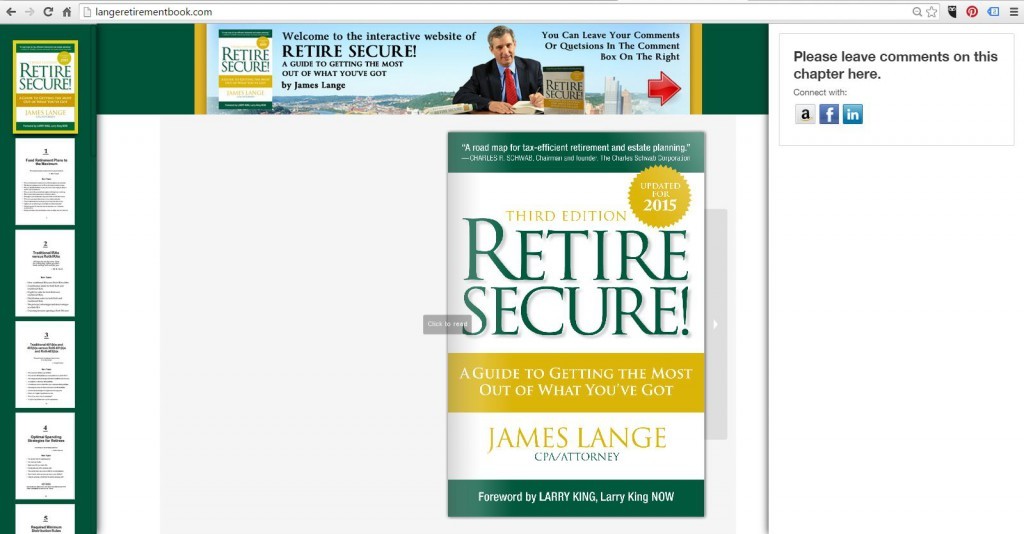
Reason #1 – The entire book is on this website. Yes, all 420 pages of the book, including the front and back covers, all about the best strategies for retirement and estate planning.

Lange-Retirement-Book-Wesbite1

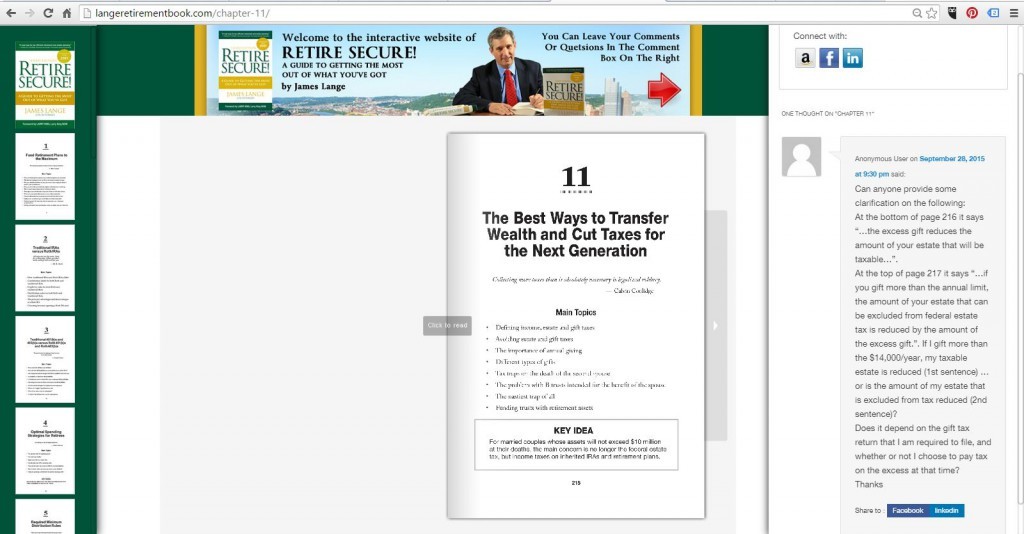
Reason #2 – The book is divided into chapters for ease of reading. Meaning, you don’t have to flip through 400-some pages to get to Chapter 11 – The Best Ways to Transfer Wealth and Cut Taxes for the Next Generation.

Lange-Retirement-Book-Wesbite-2

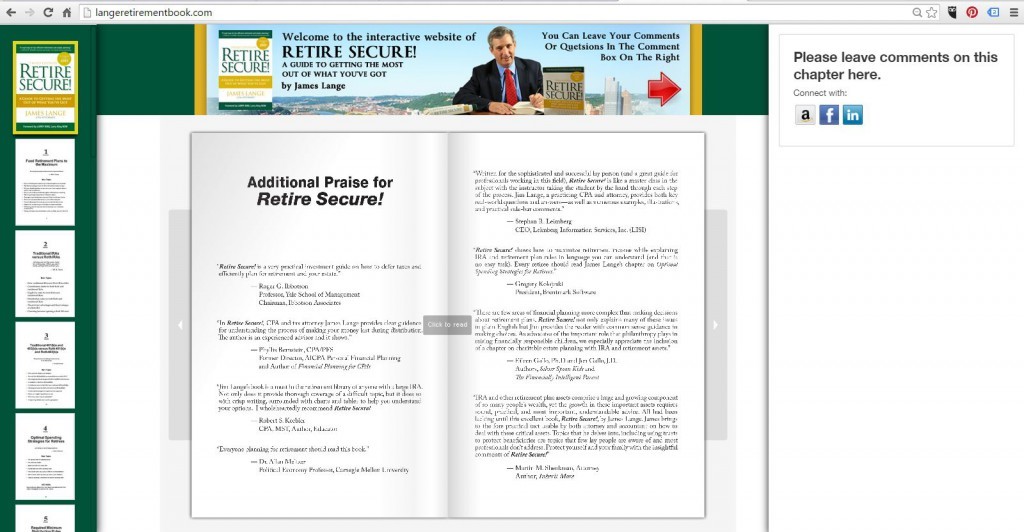
Reason #3 – We honestly haven’t seen anything like this before. Granted, I’ve read magazines on viewers where you can flip the pages as you read. But not a website for a book that includes a viewer, as well as a forum where readers can engage with each other.

The comments are moderated by the Lange Financial Group, LLC staff and myself. One of us will reply to your comment as soon as we can. To leave a comment, all you need to do is connect with your Amazon, Facebook, or LinkedIn account. This measure is for your protection, as well as ours. We don’t want spammers posting comments or incorrect information about such an important topic.

Lange-Retirement-Book-Wesbite-3

Reason #4 – We are hoping this interactive website encourages you to purchase the book! Retire Secure! is available from Amazon and JamesLange.com. Once you’ve read the book, feel free to return to LangeRetirementBook.com to ask questions, as well as Amazon and Goodreads to review the book for the benefit of others.

Save

The Third Edition of Retire Secure has Finally Arrived!

The new edition of Retire Secure! A Guide to Getting The Most out Of What You’ve Got is the distilled and concentrated version of the recommendations we have developed over 30 years. It is particularly useful for IRA and retirement plan owners.

We will soon be sending our clients a copy with a personalized note directing you to what we think will be the most relevant sections for you to read. This personalization has been a huge project, but it’s something that I think will be enormously helpful to you.

Retire Secure! will be available for purchase in bookstores and on Amazon in October. However, if you absolutely cannot wait, the book is available for Kindle and Amazon pre-order here.

Amazon Kindle Pre-Order Retire Secure! James Lange

The core concepts of the current edition are similar to the two previous editions (Wiley, 2006 and 2009). Recent legislative changes, however, have led to important strategy adjustments that are incorporated in the latest edition.

  • In Part 1, The Accumulation Years, we include some new strategies that were not available in 2009.
  • In Part 2, The Distribution Years, we cover how to spend down retirement funds in the right order to manage your assets wisely, but that area is more complicated than ever because of some of the new tax laws. We have also updated recommendations for Roth conversions, and the impact of a potential new law for IRA and retirement plan owners and their families — the death of the stretch IRA. It could be devastating for your children. Though there is no perfect answer, I do address some of the best strategies I know to reduce the pain of the likely changes in the IRA law.
  • In Part 3, we’ve updated the Eddie and Emily Estate Planning case study. Essentially, it incorporates the updated Lange’s Cascading Beneficiary Plan, which many of you already have in your wills and trusts.

If you’ve read previous versions of Retire Secure!, I hope you’ll find the updates and changes enlightening. To make the new material easier to find, I have included a section that highlights the changes. And if you’re new to the book, I hope you’ll take this as an opportunity to really educate yourself on these principles and sound practices. There’s mathematical proof that optimizing the strategies you use to approach saving, investing, estate planning, and distributing assets could mean a dierence of millions of dollars over your lifetime and for your heirs.

It’s my fervent wish that Retire Secure! will help you live a happier, healthier, and more secure life!

Jim

How Advisors Should Handle the IRA and Retirement Plan Beneficiary Form

retirement-plan-beneficiary-form-trusts-the-roth-revolution-james-langeThe ability to know what to do with an IRA or retirement plan beneficiary form can often be detrimental.

First, know we are on shaky ground. The conservative and proper legal advice is to request the client have their estate attorney fill out the beneficiary designation forms.

There are several advantages of having an estate attorney fill out the forms

  • Eliminates or drastically reduces your exposure for not filling out the form correctly and consistent with the clients’ wishes
  • Presumably, the estate attorney has a “big picture” of how the estate will be distributed and the IRA and retirement plan beneficiary designation is an important piece to that entire puzzle

For most traditional clients, I prefer the plan described in chapter 12 of Retire Secure! (Wiley, 2006). The chapter, “The Ideal Beneficiary Designation of Your Retirement Plan” describes what I consider the “master plan”.

Assume that you have a traditional family with children and grandchildren or even the potential to have grandchildren in the future. Let’s also assume that your client and their spouses trust each other completely and the client’s children are by now responsible adults (if not, see the discussion about trusts below).

Primary Beneficiary:

My spouse __________________

Contingent beneficiary

My children______________, ___________, and __________equally, per stirpes

Per stirpes is Latin for by representation. Adding per stirpes is critical. Let’s assume one of your client’s children either predeceases your client or your client’s child wants to disclaim a portion of the inherited IRA to their children, i.e. your client’s grandchildren. Without the words per stirpes, (assuming that the form does not have a box to check to indicate a per stirpes designation), the share of the predeceased or disclaiming child would not go to their children, but rather to their siblings, because the majority of beneficiary forms do not assume a per stirpes distribution unless you specifically state per stirpes in the designation. Presumably, most of your clients do not want to disinherit their grandchildren. Without per stirpes, you could have a grandchild that not only lost their parent, but also lost any inheritance they may have used for support, education, etc.

I also recommend putting current addresses and social security numbers on the IRA or retirement plan beneficiary designation.

Please note, however, that even this solution is only a partial and temporary solution. This solution still allows the possibility of having your client’s grandchild (or child if they are young) drinking $1,000 per bottle champagne to celebrate their purchase of a new Hummer on their 21st birthday.

So, to do the job right, you should name a well drafted trust, either a dedicated trust or a trust that is currently part of the client’s will or living trust, for the benefit of grandchildren (or children if client’s children are young and/or not sufficiently mature to handle an inheritance). In addition, you need at least one trust for each set of your client’s children’s children. There are lots of variations on these trusts, but for the IRA beneficiary purposes, they must meet 6 specific conditions in order to preserve the “stretch IRA” for the grandchildren.

Therefore, what will be a combination of practical, yet also proper advice is to fill out the forms the way I have suggested and recommend both orally and in writing that your client see a qualified estate planning attorney to properly fill out the IRA and retirement plan beneficiary forms.

-Jim

Jim Lange, Retirement and Estate Planning A nationally recognized IRA, Roth IRA conversion, and 401(k) expert, he is a regular speaker to both consumers and professional organizations. Jim is the creator of the Lange Cascading Beneficiary Plan™, a benchmark in retirement planning with the flexibility and control it offers the surviving spouse, and the founder of The Roth IRA Institute, created to train and educate financial advisors.

Jim’s strategies have been endorsed by The Wall Street Journal (33 times), Newsweek, Money Magazine, Smart Money, Reader’s Digest, Bottom Line, and Kiplinger’s. His articles have appeared in Bottom Line, Trusts and Estates Magazine, Financial Planning, The Tax Adviser, Journal of Retirement Planning, and The Pennsylvania Lawyer magazine.

Jim is the best-selling author of Retire Secure! (Wiley, 2006 and 2009), endorsed by Charles Schwab, Larry King, Ed Slott, Jane Bryant Quinn, Roger Ibbotson and The Roth Revolution, Pay Taxes Once and Never Again endorsed by Ed Slott, Natalie Choate and Bob Keebler.

If you’d like to be reminded as to when the book is coming out please fill out the form below.

Thank you.

Save

Save

It’s the 2nd Annual National my Social Security Week!

National-My-Social-Security-Week-The-Roth-Revoluton-BlogIt’s the 2nd annual National my Social Security Week!

We encourage you to go to www.socialsecurity.gov and sign up for an account, if you haven’t already. With my account, you can verify your earnings record and get estimates of your future benefits to help you make important financial decisions. If you are already receiving benefits you can get a benefit verification letter, check your benefit options and payment information, change you address or direct deposit information, and get a replacement Medicare card or SSA-1099 for tax season!

It is a great financial planning and benefit management tool which is secure, convenient, and FREE!

Learn all about the service and sign up for free at www.socialsecurity.gov/myaccount.

It’s never too early or too late to plan for retirement!

Donations to Charity: Is There Still a Tax Benefit if I Donate?

donations-to-charity-james-lange-the-roth-revolution-blogImagine 100 years in to the future: Two people are playing a word association game. One player gives the clue, “Bill Gates.” Today, you’d probably say, “The founder of Microsoft,” right? Well, I’m going to go out on a limb and suggest that, 100 years from now, Microsoft’s importance will have faded because of ever-evolving technology and many people will not recognize the company name, much less know who its founder was. However, I’m confident that Bill Gates will still be a household name. Why? It is because Bill and his wife Melinda have donated, and continue to donate, the vast majority of their immense wealth to charity. The impact of their generosity is astonishing. Thanks to their largesse, it is possible – maybe even likely – that diseases such as malaria will be eradicated within our lifetimes. Certainly, their philanthropy will save millions of lives, and improve the lives of virtually everyone on the planet. My own charitable gifting is nowhere near the scale of Bill and Melinda’s, but, even so, I can see how my donations benefit others. And it makes me happy to think that I can make someone else’s life better, even in my own small way.

The American Taxpayer Relief Act of 2012 reinstated a phase-out of itemized deductions for high income taxpayers. For those individuals, it meant that they were unable to receive the full benefit of their charitable contributions on their tax returns, and they were very unhappy. A few taxpayers didn’t care. I have a client who donates an unusually significant amount of her annual income to charity every year, and who steadfastly refused to give me a list of the donations so that I could deduct them on her tax return. She felt that it was morally wrong for her to receive any benefit from them. It was an admirable position, to be sure, but then I pointed out that the government does not do a very good job of dealing with social problems in this country. I told her that I believe that the reason charities don’t have to pay taxes is because they do a much more efficient job of distributing money and services to the needy than our government does. Under those circumstances, it seemed wasteful to me to not deduct the donations. She listened to me, and the following year presented me with hundreds of donation receipts, which I deducted on her return. She received a significant tax refund, which she promptly used to donate even more to charity!

If donating to charity is important to you, you may find it worthwhile to review the ideas discussed in Chapter 18. Many readers will be surprised to learn that there are strategies available that can give them far more bang for their charitable buck than they may have thought possible. Charitable gifting does not necessarily have to come at the expense of family members either, and in some instances it may even benefit them! Your distant dreams of establishing a scholarship fund, building a bicycle trail, or providing ongoing medical care to people in need are more achievable than you may realize. The secret is to take advantage of all of the gifting strategies that are available to you.

See you soon!

Jim

Jim Lange, Retirement and Estate Planning A nationally recognized IRA, Roth IRA conversion, and 401(k) expert, he is a regular speaker to both consumers and professional organizations. Jim is the creator of the Lange Cascading Beneficiary Plan™, a benchmark in retirement planning with the flexibility and control it offers the surviving spouse, and the founder of The Roth IRA Institute, created to train and educate financial advisors.

Jim’s strategies have been endorsed by The Wall Street Journal (33 times), Newsweek, Money Magazine, Smart Money, Reader’s Digest, Bottom Line, and Kiplinger’s. His articles have appeared in Bottom Line, Trusts and Estates Magazine, Financial Planning, The Tax Adviser, Journal of Retirement Planning, and The Pennsylvania Lawyer magazine.

Jim is the best-selling author of Retire Secure! (Wiley, 2006 and 2009), endorsed by Charles Schwab, Larry King, Ed Slott, Jane Bryant Quinn, Roger Ibbotson and The Roth Revolution, Pay Taxes Once and Never Again endorsed by Ed Slott, Natalie Choate and Bob Keebler.

If you’d like to be reminded as to when the book is coming out please fill out the form below.

Thank you.

Save

Trusts as Beneficiaries of Retirement Plans: A Possible Alternative to the Stretch IRA?

trusts james langeIf you’ve read my earlier posts, you know that much of the new edition of Retire Secure! addresses the ramifications of the legislation that, if passed, will kill the Stretch IRA. If this potential change is a concern for your family, then Chapter 17 is a “must-read” for you because it offers a possible alternative that will allow them to continue the tax deferral of your retirement plan for many years.

Trusts may be appropriate in many situations. We use them for young beneficiaries who, by law, cannot inherit money, and for older beneficiaries who can’t be trusted with money. Trusts can also be used to help minimize taxes at death (although this is not as common as in previous years). With more frequency, though, our office is using trusts to replace the benefits of the Stretch IRA. This application started when all of these campaigns to kill the Stretch IRA began, and we began to seek alternatives for our clients. Chapter 17 compares the value of an IRA assuming that the non-spouse beneficiary must withdraw the proceeds within 5 years, to the value of an IRA when it is protected by a specific type of trust. I think you will find the results very surprising.

The rules governing trusts are very complex, and, if you are interested in incorporating them in to your own estate plan, you will need the assistance of a competent professional.

Do you donate to charity? If so, my next post will cover the changes in the laws that affect charitable contributions.

All the best,

Jim

Jim Lange, Retirement and Estate Planning A nationally recognized IRA, Roth IRA conversion, and 401(k) expert, he is a regular speaker to both consumers and professional organizations. Jim is the creator of the Lange Cascading Beneficiary Plan™, a benchmark in retirement planning with the flexibility and control it offers the surviving spouse, and the founder of The Roth IRA Institute, created to train and educate financial advisors.

Jim’s strategies have been endorsed by The Wall Street Journal (33 times), Newsweek, Money Magazine, Smart Money, Reader’s Digest, Bottom Line, and Kiplinger’s. His articles have appeared in Bottom Line, Trusts and Estates Magazine, Financial Planning, The Tax Adviser, Journal of Retirement Planning, and The Pennsylvania Lawyer magazine.

Jim is the best-selling author of Retire Secure! (Wiley, 2006 and 2009), endorsed by Charles Schwab, Larry King, Ed Slott, Jane Bryant Quinn, Roger Ibbotson and The Roth Revolution, Pay Taxes Once and Never Again endorsed by Ed Slott, Natalie Choate and Bob Keebler.

If you’d like to be reminded as to when the book is coming out please fill out the form below.

Save

Changing Beneficiary Designations for Retirement Plans: Why A One-size-fits-all Approach is Definitely Not Appropriate

retirement-plans-james-lange-pittsburgh-paI had some reservations about writing Chapter 16. Chapter 15 discusses the perils of filling out your own beneficiary forms, and Chapter 16 talks about filling out beneficiary forms. It sounds counter-intuitive, but there is a method to my madness!

The reason I wrote Chapter 16 was because I thought that my readers probably wouldn’t find it very helpful to have me tell them, “Don’t do the wrong thing!” without also offering a very clear explanation of what the wrong thing is. Some folks might be disappointed that Chapter 16 is not a step-by-step guide about the “right” way to prepare your beneficiary designations. Unfortunately, that would have been an impossible task because it is one area of estate planning where a one-size-fits-all approach is definitely not appropriate. Chapter 16 is intended to offer general guidance only, and I hope you’ll consult with a professional about your own situation.

As it is becoming more common to see trusts as part of estate plans, I thought it would be helpful to go over some of the finer points of naming trusts as beneficiaries of your IRA or retirement plans. Frequently, trusts are used to “protect” assets – whether it be from taxes, creditors, or whatever the case may be. If the beneficiary designations of your trust are not precisely accurate, the trust cannot be funded. That means that the money will stay in the retirement plan, and not go in to the trust. Your heirs can try to explain to the IRS that you made a minor mistake when filling out your beneficiary form, and your intentions were really something other than what you wrote. The cost of asking the IRS to agree to your executor’s interpretation of what a beneficiary designation was supposed to be (also called a private letter ruling) is, as of this writing, about $18,000 – and there’s no guarantee that they’re going to agree with your executor anyway. If they don’t agree, then all of the work you went through to establish the trust was for nothing. So why risk the protection that you had hoped to offer by setting up the trust? Please consider using a competent professional to help you with your beneficiary forms!

Chapter 17 continues this discussion by reviewing the different types of trusts you can use as a beneficiary of your retirement plan. Check back soon!

-Jim

Jim Lange, Retirement and Estate Planning A nationally recognized IRA, Roth IRA conversion, and 401(k) expert, he is a regular speaker to both consumers and professional organizations. Jim is the creator of the Lange Cascading Beneficiary Plan™, a benchmark in retirement planning with the flexibility and control it offers the surviving spouse, and the founder of The Roth IRA Institute, created to train and educate financial advisors.

Jim’s strategies have been endorsed by The Wall Street Journal (33 times), Newsweek, Money Magazine, Smart Money, Reader’s Digest, Bottom Line, and Kiplinger’s. His articles have appeared in Bottom Line, Trusts and Estates Magazine, Financial Planning, The Tax Adviser, Journal of Retirement Planning, and The Pennsylvania Lawyer magazine.

Jim is the best-selling author of Retire Secure! (Wiley, 2006 and 2009), endorsed by Charles Schwab, Larry King, Ed Slott, Jane Bryant Quinn, Roger Ibbotson and The Roth Revolution, Pay Taxes Once and Never Again endorsed by Ed Slott, Natalie Choate and Bob Keebler.

If you’d like to be reminded as to when the book is coming out please fill out the form below.

Thank you.

Save