 Earlier this year, President Obama announced that he wants to create new rules that give financial advisors a “fiduciary” status under the law. I welcome this wholeheartedly because a fiduciary is required to always put his clients’ interests ahead of his own. This means that a financial advisor cannot make investment recommendations based on the commission they would receive from the investment, and that they must first consider the benefits that would be received by their client. As a fee-based advisor I have always served as a fiduciary to my clients and believe that it is an immensely important role.
I find it sad that we have to pass laws to make sure that the client’s interests are protected, but think that the President is on the right track with this one. More often than not, I hear of financial advisors who are only looking for a commission telling retirees that there’s no reason to not roll their old retirement plans to an IRA. That is simply not true and, in fact, there are circumstances where a retiree will be well served by keeping all or part of his or her retirement money in the original work plan.
These scenariosare discussed in detail in Chapter 6 of the new edition of Retire Secure! If you’ve wondered if rollingyour old 401(k) to an IRA is a good idea, you may very well find that you could save yourself from making a terrible financial decision by weighing all the potential advantages and disadvantages.
Many work plans give employees the opportunity to contribute to both pre-tax and after-tax accounts. If you ultimately decide that rolling your 401(k) to an IRA is the best course of action, you should make sure that you read Chapter 6 to educate yourself about the brand new IRS ruling that applies to your after-tax contributions. This ruling gives retirees an unprecedented opportunity to roll part of your 401(k) to a Roth IRA and, if done properly, the transaction will be completely tax free.
Check back soon for the latest information on Roth conversions!
Thanks for Reading!
Jim
 A nationally recognized IRA, Roth IRA conversion, and 401(k) expert, he is a regular speaker to both consumers and professional organizations. Jim is the creator of the Lange Cascading Beneficiary Plan™, a benchmark in retirement planning with the flexibility and control it offers the surviving spouse, and the founder of The Roth IRA Institute, created to train and educate financial advisors.
Jim’s strategies have been endorsed by The Wall Street Journal (33 times), Newsweek, Money Magazine, Smart Money, Reader’s Digest, Bottom Line, and Kiplinger’s. His articles have appeared in Bottom Line, Trusts and Estates Magazine, Financial Planning, The Tax Adviser, Journal of Retirement Planning, and The Pennsylvania Lawyer magazine.
Jim is the best-selling author of Retire Secure! (Wiley, 2006 and 2009), endorsed by Charles Schwab, Larry King, Ed Slott, Jane Bryant Quinn, Roger Ibbotson and The Roth Revolution, Pay Taxes Once and Never Again endorsed by Ed Slott, Natalie Choate and Bob Keebler.
If you’d like to be reminded as to when the book is coming out please fill out the form below.
Thank you.
 Those of you who have attended my workshops or read the previous editions of my book may remember a rule of thumb I used to use that said, “Spend your after-tax dollars first, tax-deferred dollars second, and then your Roth IRA”. Well, guess what? The changes in the tax laws now mean that there are no more rules of thumb! My new advice is, “Spend your after-tax dollars first, and then withdraw traditional IRA and Roth IRA dollars strategically to optimize tax results.”
 Over the years, I’ve met with many clients who have managed to accumulate small fortunes over the course of their working careers – even though their incomes were never even high enough to put them in the top two or three tax brackets. I call these clients my “savers.” These individuals seem to share one trait – mainly that they simply don’t feel the need to spend money if they don’t have to. Instead, they set the money aside for the times when they absolutely must spend and, more often than not, they spend far less than what they could.

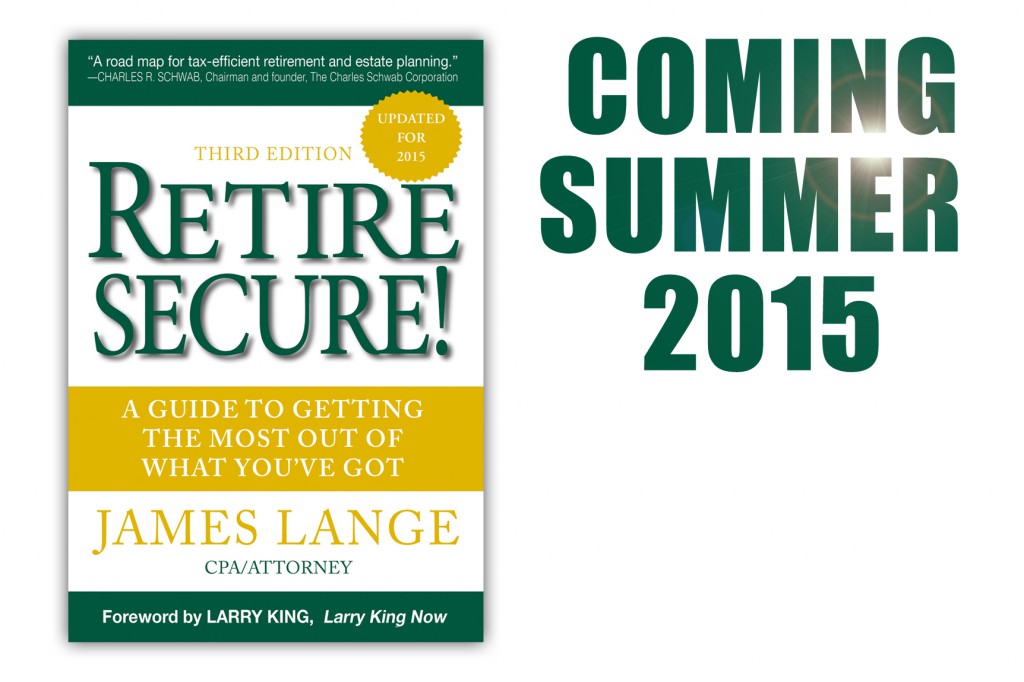
 Jim was recently quoted in the Wall Street Journal (for the 35th time) by Jonathan Clements, a long-respected personal finance journalist. They discussed several topics including many that Jim has included in his new book due out in summer 2015, Retire Secure: A Guide to Getting the Most out of What You’ve Got.
 Over the years, I’ve been challenged by clients who present me with questions that even King Solomon in his infinite wisdom couldn’t answer. Other questions, complicated though they might be, are much easier to manage because they can be solved by running the numbers.

 The third edition of Retire Secure! has been completed and will be going to the printer shortly. Some of you may be thinking, “So what? I already read that book.” Since the second edition of Retire Secure! was published in 2009, there have been two major revisions to the tax code and several landmark court decisions that have significantly changed the way we approach the cases we handle in our office. We try to keep you informed of these changes through our newsletters. If you’re a client, we also meet with you at least once a year to review your situation and, if needed, we help you make changes so that you can achieve the best results possible based on the current laws.
 The Third Edition of Retire Secure! is almost complete!