

Ways to Cut Taxes for the Next Generation – Consider Gifting Money to Children

gifting money to children lange financial groupIn January of 2015, President Obama proposed eliminating the tax-free benefits of Section 529 college savings plans. Under his proposal, savings would grow tax-deferred, but withdrawals would be taxed as income to the beneficiary (usually the student). His belief was that taxpayers who save in 529 plans are families who can better afford the cost of college than everyone else. In reality, it is estimated that close to ten percent of 529 accounts are owned by households having income below $50,000, and over 70 percent are owned by households with income below $150,000. What isn’t surprising, though, is that the tax revenue realized by this action would have been significant, because as of the end of the 4th quarter of 2014, the assets held in 529 and other college savings plans reached almost a quarter of a trillion dollars. How many students would have been forced to apply for loans if they had been required to pay tax on withdrawals from their college savings plans? Fortunately, the House of Representatives thought differently than the President and, in February of 2015, they passed HR 529. This bill not only maintains the tax-free status of 529 plans, but also makes them more flexible and easier to use. Hopefully the Senate will follow the House’s lead and pass a companion bill with similar provisions.

Do you have college savings plans established for your children or grandchildren and, if so, were you aware of this attack on their tax-free status?

Gifting money to children

Contributing to college savings plans for children and grandchildren is a form of gifting, which is a topic that I discuss in detail in Chapter 11 of Retire Secure!. Gifting money to children is an excellent way to minimize taxes at your death, and, depending on the amount gifted, can also provide the recipient with tax-free income. Unfortunately, strategies that reduce taxes frequently come under fire and it is critical that you stay on top of the rules. Also discussed in this chapter are the perils of gifting to relatives in an attempt to avoid seizure of your to pay for nursing home care. It’s a bad idea – don’t even think about it – but it is still beneficial to understand the laws on this subject.

Many couples are not aware that the American Taxpayer Relief Act of 2012 introduced a concept called portability that makes estate taxes less of a concern for many individuals than in the past. If you have not had your estate plan reviewed since 2012, you should read Chapter 11 to learn about the potential pitfalls of what I call “The Cruelest Trap of All”. Since the passage of this act, many estate plans are outdated and could cause the surviving spouse to be disinherited at the first spouse’s death.

Gifting money to children strategies, and the tax implications of gifting, should be a critical part of every estate plan. Changes in legislation that were not anticipated at the time the plan was established, though, can make your plan ineffective and in some cases disastrous. As much has changed in this area; please read Chapter 11 thoroughly to see how you might be affected.

Stop back soon!

Jim

Jim Lange, Retirement and Estate Planning A nationally recognized IRA, Roth IRA conversion, and 401(k) expert, he is a regular speaker to both consumers and professional organizations. Jim is the creator of the Lange Cascading Beneficiary Plan™, a benchmark in retirement planning with the flexibility and control it offers the surviving spouse, and the founder of The Roth IRA Institute, created to train and educate financial advisors.

Jim’s strategies have been endorsed by The Wall Street Journal (33 times), Newsweek, Money Magazine, Smart Money, Reader’s Digest, Bottom Line, and Kiplinger’s. His articles have appeared in Bottom Line, Trusts and Estates Magazine, Financial Planning, The Tax Adviser, Journal of Retirement Planning, and The Pennsylvania Lawyer magazine.

Jim is the best-selling author of Retire Secure! (Wiley, 2006 and 2009), endorsed by Charles Schwab, Larry King, Ed Slott, Jane Bryant Quinn, Roger Ibbotson and The Roth Revolution, Pay Taxes Once and Never Again endorsed by Ed Slott, Natalie Choate and Bob Keebler.

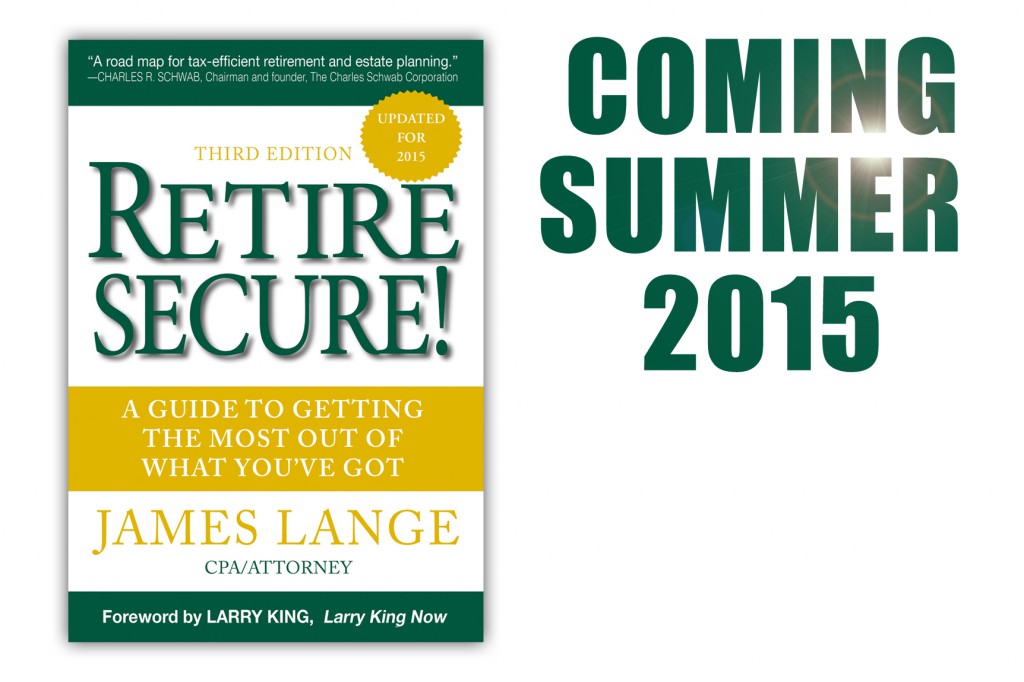
If you’d like to be reminded as to when the book is coming out please fill out the form below.

Thank you.

Save

Save

Save

Retirement and Estate Planning Case Study: Plan with the Big Picture in Mind

Knowing that many people aren’t as enthusiastic as I am about topics like taxes, interest rates and so on, I tried to make Retire Secure! as reader friendly as possible.  Even so, I know there are still folks out there who find it difficult to apply the concepts outlined in the book to their own personal situations.  It’s for those people that I wrote Chapter 10, a Retirement and Estate Planning Case Study on Eddie & Emily.  It is a real life retirement story loosely based on an actual client who came to me with some concerns.

Chapter 10 is written from this couple’s point of view.  It walks the reader through the thought process that these clients went through as they entered retirement, and how we helped them achieve peace of mind about their concerns.  Every client’s situation is different, so it would wrong to imply that one course of action is always better than another.  Since we helped them plan with the big picture in mind, though, they were confident that the decisions that they made were the best possible for themselves and their children.

Stop back soon for a peek at Chapter 11.  It’s a lot more technical than Chapter 10, but contains important information on the best ways to transfer wealth to your heirs.

See you soon!

Jim

Jim Lange, Retirement and Estate Planning A nationally recognized IRA, Roth IRA conversion, and 401(k) expert, he is a regular speaker to both consumers and professional organizations. Jim is the creator of the Lange Cascading Beneficiary Plan™, a benchmark in retirement planning with the flexibility and control it offers the surviving spouse, and the founder of The Roth IRA Institute, created to train and educate financial advisors.

Jim’s strategies have been endorsed by The Wall Street Journal (33 times), Newsweek, Money Magazine, Smart Money, Reader’s Digest, Bottom Line, and Kiplinger’s. His articles have appeared in Bottom Line, Trusts and Estates Magazine, Financial Planning, The Tax Adviser, Journal of Retirement Planning, and The Pennsylvania Lawyer magazine.

Jim is the best-selling author of Retire Secure! (Wiley, 2006 and 2009), endorsed by Charles Schwab, Larry King, Ed Slott, Jane Bryant Quinn, Roger Ibbotson and The Roth Revolution, Pay Taxes Once and Never Again endorsed by Ed Slott, Natalie Choate and Bob Keebler.

If you’d like to be reminded as to when the book is coming out please fill out the form below.

Save

Net Unrealized Appreciation (NUA): Don’t Pay More Taxes Than You Need To

Net Unrealized Appreciation (NUA) Don’t Pay More Taxes Than You Need To, James LangeSome employees have Stock Options, or the option to buy the stock of the company that they work for within their retirement plans. A unanimous Supreme Court decision in 2014 might discourage employers from offering their employees a stake in the business in future years, because they can now be held liable if the value of the stock drops. Employers can now also be held liable under insider trading laws for certain actions they make within the retirement plan, with respects to company stock.

But what if you do happen to have some company stock in your retirement plan? If you do, be sure to read Chapter 9 for some very important tax planning tips! When you retire and take a lump sum distribution from your retirement plan, the distribution may include employer stock that is (hopefully) worth more than the fair market value at the time it was purchased in your plan. The difference between the value of the company stock at the time you take your lump sum distribution and its value at the time it was purchased is called Net Unrealized Appreciation (NUA).

If you own company stock within your retirement plans, you should make sure that you understand Net Unrealized Appreciation (NUA) rules outlined in Chapter 9 before you roll over or take distributions from the plan. Many financial advisors don’t understand these rules and, if you don’t, you could end up paying significantly more in taxes than you need to. This is especially true if the company stock in your 401(k) has increased in value!

Stay tuned for an update on our classic case study of Eddie & Emily from Chapter 10!

– Jim

Jim Lange A nationally recognized IRA, Roth IRA conversion, and 401(k) expert, he is a regular speaker to both consumers and professional organizations. Jim is the creator of the Lange Cascading Beneficiary Plan™, a benchmark in retirement planning with the flexibility and control it offers the surviving spouse, and the founder of The Roth IRA Institute, created to train and educate financial advisors.

Jim’s strategies have been endorsed by The Wall Street Journal (33 times), Newsweek, Money Magazine, Smart Money, Reader’s Digest, Bottom Line, and Kiplinger’s. His articles have appeared in Bottom Line, Trusts and Estates Magazine, Financial Planning, The Tax Adviser, Journal of Retirement Planning, and The Pennsylvania Lawyer magazine.

Jim is the best-selling author of Retire Secure! (Wiley, 2006 and 2009), endorsed by Charles Schwab, Larry King, Ed Slott, Jane Bryant Quinn, Roger Ibbotson and The Roth Revolution, Pay Taxes Once and Never Again endorsed by Ed Slott, Natalie Choate and Bob Keebler.

If you’d like to be reminded as to when the book is coming out please fill out the form below.

Save

Annuities: Good or Bad?

Annuities, Retirement Planning, Pittsburgh Pennsylvania, James LangeThe Center for Disease Control annually publishes a document called the National Vital Statistics Report. This report estimates the life expectancy of men and women in the United States. At birth, the life expectancy for a male is 76.7 years and, for a female, 81.4 years. What is interesting about the report, however, is that it shows that, the longer you do live, the more your life expectancy increases. If you’ve already made it to age 65 and are male, you are likely to continue to live until age 83. If you’re a 65-year old female, you can be expected to live until age 85.5. If you’re a male and you’ve already made it to age 80, you can expect to live until age 88.3; an 80-year old female can expect to live until age 89.7. When your life expectancy continues to increase, how can you possibly make sure that the money you’ve saved for retirement lasts for your entire life?

Financial professionals are sharply divided on the topic of annuities. Some love them, and some hate them.  My goal in the Third Edition of Retire Secure! is to point out the advantages and disadvantages of annuities, and let you make up your own mind as to whether they would be good or bad for your own retirement. There are many different kinds of annuities, but most can be used to provide a guaranteed lifetime income for both you and your spouse. This can provide peace of mind to individuals who are concerned that the Social Security system might go bankrupt after they retire and are no longer able to earn income. As of June 2014, employees are permitted to buy a specific type of annuity called a qualified longevity annuity contract (or QLAC) within their retirement plan. While you can’t avoid taking Required Minimum Distributions completely, this type of annuity allows owners to defer retirement distributions until age 85. This means that owners would receive the maximum pension benefit possible for the rest of their lives. Once distributions are started, the owner receives a guaranteed income for the rest of his or her life. Being able to exempt a portion of retirement income from minimum required distributions from age 70 ½ to age 85 can be a powerful estate planning tool, however, there are rules you have to follow. Those rules are covered in Chapter 8.

Annuities are also playing a growing role in estate planning for adult children. Many retirees have adult children who have been financially devastated because they were not adequately prepared for the cost of sending their own children to college. Others simply live beyond their means and believe that balancing their budget means robbing Peter to pay Paul. For some, the unexpected loss of a steady income from a job can spell financial disaster. Chapter 8 contains some tips on how you can use annuities to put your spendthrift children on a budget or, if necessary, even protect them from their creditors.   In some cases, annuities can offer the means to provide your children with the highest possible degree of financial security.

Check back soon for a tip on how to avoid a common and expensive mistake when taking distributions from a retirement plan that includes company stock!

– Jim

Jim Lange A nationally recognized IRA, Roth IRA conversion, and 401(k) expert, he is a regular speaker to both consumers and professional organizations. Jim is the creator of the Lange Cascading Beneficiary Plan™, a benchmark in retirement planning with the flexibility and control it offers the surviving spouse, and the founder of The Roth IRA Institute, created to train and educate financial advisors.

Jim’s strategies have been endorsed by The Wall Street Journal (33 times), Newsweek, Money Magazine, Smart Money, Reader’s Digest, Bottom Line, and Kiplinger’s. His articles have appeared in Bottom Line, Trusts and Estates Magazine, Financial Planning, The Tax Adviser, Journal of Retirement Planning, and The Pennsylvania Lawyer magazine.

Jim is the best-selling author of Retire Secure! (Wiley, 2006 and 2009), endorsed by Charles Schwab, Larry King, Ed Slott, Jane Bryant Quinn, Roger Ibbotson and The Roth Revolution, Pay Taxes Once and Never Again endorsed by Ed Slott, Natalie Choate and Bob Keebler.

If you’d like to be reminded as to when the book is coming out please fill out the form below.

Thank you.

Save

Is It a Good Idea to Roll Over Your 401K to a Traditional or Roth IRA?

Earlier this year, President Obama announced that he wants to create new rules that give financial advisors a “fiduciary” status under the law. I welcome this wholeheartedly because a fiduciary is required to always put his clients’ interests ahead of his own. This means that a financial advisor cannot make investment recommendations based on the commission they would receive from the investment, and that they must first consider the benefits that would be received by their client. As a fee-based advisor I have always served as a fiduciary to my clients and believe that it is an immensely important role.

I find it sad that we have to pass laws to make sure that the client’s interests are protected, but think that the President is on the right track with this one. More often than not, I hear of financial advisors who are only looking for a commission telling retirees that there’s no reason to not roll their old retirement plans to an IRA. That is simply not true and, in fact, there are circumstances where a retiree will be well served by keeping all or part of his or her retirement money in the original work plan.

These scenariosare discussed in detail in Chapter 6 of the new edition of Retire Secure! If you’ve wondered if rollingyour old 401(k) to an IRA is a good idea, you may very well find that you could save yourself from making a terrible financial decision by weighing all the potential advantages and disadvantages.

Many work plans give employees the opportunity to contribute to both pre-tax and after-tax accounts. If you ultimately decide that rolling your 401(k) to an IRA is the best course of action, you should make sure that you read Chapter 6 to educate yourself about the brand new IRS ruling that applies to your after-tax contributions. This ruling gives retirees an unprecedented opportunity to roll part of your 401(k) to a Roth IRA and, if done properly, the transaction will be completely tax free.

Check back soon for the latest information on Roth conversions!

Thanks for Reading!

Jim

Jim Lange A nationally recognized IRA, Roth IRA conversion, and 401(k) expert, he is a regular speaker to both consumers and professional organizations. Jim is the creator of the Lange Cascading Beneficiary Plan™, a benchmark in retirement planning with the flexibility and control it offers the surviving spouse, and the founder of The Roth IRA Institute, created to train and educate financial advisors.

Jim’s strategies have been endorsed by The Wall Street Journal (33 times), Newsweek, Money Magazine, Smart Money, Reader’s Digest, Bottom Line, and Kiplinger’s. His articles have appeared in Bottom Line, Trusts and Estates Magazine, Financial Planning, The Tax Adviser, Journal of Retirement Planning, and The Pennsylvania Lawyer magazine.

Jim is the best-selling author of Retire Secure! (Wiley, 2006 and 2009), endorsed by Charles Schwab, Larry King, Ed Slott, Jane Bryant Quinn, Roger Ibbotson and The Roth Revolution, Pay Taxes Once and Never Again endorsed by Ed Slott, Natalie Choate and Bob Keebler.

If you’d like to be reminded as to when the book is coming out please fill out the form below.

Thank you.

Save

Save

The Optimal Order for Spending Assets: Roth IRA or Traditional IRA First?

Roth IRA, James Lange, Retire Secure A Guide to Getting the Most Out of What You've GotThose of you who have attended my workshops or read the previous editions of my book may remember a rule of thumb I used to use that said, “Spend your after-tax dollars first, tax-deferred dollars second, and then your Roth IRA”. Well, guess what? The changes in the tax laws now mean that there are no more rules of thumb! My new advice is, “Spend your after-tax dollars first, and then withdraw traditional IRA and Roth IRA dollars strategically to optimize tax results.”

Changes in the tax law that affect capital gains and individual tax brackets, as well as new taxes that are aimed specifically at high income taxpayers mean that the advice I used to give in the past is now far too simplistic. Chapter 4 presents detailed information on how capital gains and other taxes should affect your decision to withdraw money from a traditional versus a Roth IRA account. Would you have thought that your marital status could affect your decision too? Is it possible to minimize the tax on your IRA withdrawals? (Hint: oh, yes!) If you have IRA and Roth IRA money left over when you die, is it better to leave one type of account over another to a child at your death?

Chapter 4 covers many new issues that you did not have to worry about in the past, which should certainly affect these decisions. I’d like to give you one word of caution, though. Each of the scenarios presented in this chapter is based on a specific set of variables. In one scenario, I changed only the account from which the taxpayer made the withdrawal, and the outcome is significantly different. Please don’t assume that your personal circumstances will result in the same outcome shown in these scenarios. Ask us to run the numbers for you!

Be sure to stop back for my next post, which will cover some ideas for managing your Required Minimum Distributions!

Thanks,

Jim

Jim Lange A nationally recognized IRA, Roth IRA conversion, and 401(k) expert, he is a regular speaker to both consumers and professional organizations. Jim is the creator of the Lange Cascading Beneficiary Plan™, a benchmark in retirement planning with the flexibility and control it offers the surviving spouse, and the founder of The Roth IRA Institute, created to train and educate financial advisors.

Jim’s strategies have been endorsed by The Wall Street Journal (33 times), Newsweek, Money Magazine, Smart Money, Reader’s Digest, Bottom Line, and Kiplinger’s. His articles have appeared in Bottom Line, Trusts and Estates Magazine, Financial Planning, The Tax Adviser, Journal of Retirement Planning, and The Pennsylvania Lawyer magazine.

Jim is the best-selling author of Retire Secure! (Wiley, 2006 and 2009), endorsed by Charles Schwab, Larry King, Ed Slott, Jane Bryant Quinn, Roger Ibbotson and The Roth Revolution, Pay Taxes Once and Never Again endorsed by Ed Slott, Natalie Choate and Bob Keebler.

If you’d like to be reminded as to when the book is coming out please fill out the form below.

Save

Save

Save

Save

Required Minimum Distributions: The Government Wants Their Money!

Required Minimum Distributions, The Government Wants Their Money, James Lange - The Roth Revolution BlogOver the years, I’ve met with many clients who have managed to accumulate small fortunes over the course of their working careers – even though their incomes were never even high enough to put them in the top two or three tax brackets. I call these clients my “savers.” These individuals seem to share one trait – mainly that they simply don’t feel the need to spend money if they don’t have to. Instead, they set the money aside for the times when they absolutely must spend and, more often than not, they spend far less than what they could.

It’s these clients who seem to suffer the greatest shock when they turn 70 ½ and are required to start withdrawing money from their qualified retirement plans. They object, “But I don’t need the money! I just want to leave it sit there in case I need it some day!” And I have to tell them that it doesn’t matter if they need the money or not. The money that they squirreled away in their retirement plans for a rainy day has grown all these years without being taxed, and now the government wants their tax money!

There’s no avoiding the Required Minimum Distribution rules on traditional retirement plans. Failure to take a distribution when required, in fact, will cost you a penaly tax of 50% on the amount not withdrawn. Individuals who hate the RMD rules and have a spiteful streak might enjoy an interesting (and legal) tip presented in Chapter 5 that allows them to take advantage of the withholdings on the distribution to wait until the very last minute to pay the IRS their due, while also avoiding a late payment penalty. They can also learn of a possible way to completely avoid tax on their Required Minimum Distributions – and also a general increase in their tax bracket – by sending their RMD direct to a charity. I encourage everyone, though, to read Chapter 5 so that you have a good understanding of the RMD rules. Later chapters address proposed legislative changes to the rules that may not strike you as being significant, and unless you have a good understanding of how they currently work.

My next post will talk about rolling your old retirement plan to an IRA. There have been a lot of changes in the laws about this, so I hope you will stop back to get a summary of what you can expect.

Happy Reading!

Jim

Jim Lange A nationally recognized IRA, Roth IRA conversion, and 401(k) expert, he is a regular speaker to both consumers and professional organizations. Jim is the creator of the Lange Cascading Beneficiary Plan™, a benchmark in retirement planning with the flexibility and control it offers the surviving spouse, and the founder of The Roth IRA Institute, created to train and educate financial advisors.

Jim’s strategies have been endorsed by The Wall Street Journal (33 times), Newsweek, Money Magazine, Smart Money, Reader’s Digest, Bottom Line, and Kiplinger’s. His articles have appeared in Bottom Line, Trusts and Estates Magazine, Financial Planning, The Tax Adviser, Journal of Retirement Planning, and The Pennsylvania Lawyer magazine.

Jim is the best-selling author of Retire Secure! (Wiley, 2006 and 2009), endorsed by Charles Schwab, Larry King, Ed Slott, Jane Bryant Quinn, Roger Ibbotson and The Roth Revolution, Pay Taxes Once and Never Again endorsed by Ed Slott, Natalie Choate and Bob Keebler.

If you’d like to be reminded as to when the book is coming out please fill out the form below.

Save

IRA Withdrawals: Should you withdraw from your Roth or traditional IRA first?

IRA Withdrawal
Those of you who have attended my workshops or read the previous editions of my book may remember a rule of thumb I used to use that said, “Spend your after-tax dollars first, use traditional IRA withdrawals second, and then withdraw your Roth”. Well, guess what? The changes in the tax laws now mean that there are no more rules of thumb! My new advice is, “Spend your after-tax dollars first, and then withdraw traditional and Roth IRA dollars strategically to optimize tax results”.

Changes in the tax law that affect capital gains and individual tax brackets, as well as new taxes that are aimed specifically at high income taxpayers mean that the advice I used to give in the past is now far too simplistic. Chapter 4 presents detailed information on how capital gains and other taxes should affect your decision to withdraw money from a traditional versus a Roth account. Would you have thought that your marital status could affect your decision too? Is it possible to minimize the tax on your IRA withdrawals? (Hint: oh, yes.) If you have IRA and Roth money left over when you die, is it better to leave one type of account over another to a child at your death?

Chapter 4 covers many new rules that you did not have to worry about in the past, which should certainly affect these decisions. I’d like to give you one word of caution, though. Each of the scenarios presented in this chapter is based on a specific set of variables. In one scenario, I changed only the account from which the taxpayer made the withdrawal, and the outcome is significantly different. Please don’t assume that your personal circumstances will result in the same outcome shown in these scenarios, but ask us to run the numbers for you!

Be sure to stop back for my next post, which will cover some ideas for managing your Required Minimum Distributions!

Save

Save

More on The Traditional IRA vs Roth IRA

Retire Secure A Guide to Getting the Most Out of What You've Got, James Lange 2015Over the years, I’ve been challenged by clients who present me with questions that even King Solomon in his infinite wisdom couldn’t answer. Other questions, complicated though they might be, are much easier to manage because they can be solved by running the numbers.

Chapter 3 of the new edition of Retire Secure! quantifies a number of “what if” scenarios that are frequently presented to me by my clients. What if I’m in an average tax bracket, and I need to cash in my retirement account? What if I’m in the highest tax bracket, and I need to withdraw all or part of my retirement account? What if I’m in a high tax bracket now, but am in a lower tax bracket when I need to withdraw all or part of my retirement account? What happens if I’m in a high tax bracket now, but I lose my job and am in a very low tax bracket when I need to withdraw all or part of my retirement account? What happens if I’m in a high tax bracket, but my heir is in a low tax bracket? All of these are very significant considerations if you have to choose between a Traditional IRA vs a Roth IRA.

Questions like these can be accurately answered by using quantitative analysis. Chapter 3 presents a series of hypothetical scenarios which prove that certain tax situations definitely do favor the use of one type of account over another. In some situations, the Traditional IRA is better, and in others, the Roth IRA is better. If your choice is Traditional IRA vs Roth IRA, you may find some of these scenarios thought-provoking. As with the previous chapters, the assumed rate of return has been reduced to a conservative 6%, so the differences in the illustrations will be even more pronounced if you earn a higher rate of return on your own investments. The illustrations should only be used as a general guide. In order to get the most accurate answer for your specific situation, please consider asking us to run the numbers for you.

All this discussion about the Traditional IRA vs Roth IRA debate reminds me: you really should take a look at my next post about Chapter 4. It delves into some surprising new details about spending retirement accounts!

Jim

Jim Lange A nationally recognized IRA, Roth IRA conversion, and 401(k) expert, he is a regular speaker to both consumers and professional organizations. Jim is the creator of the Lange Cascading Beneficiary Plan™, a benchmark in retirement planning with the flexibility and control it offers the surviving spouse, and the founder of The Roth IRA Institute, created to train and educate financial advisors.

Jim’s strategies have been endorsed by The Wall Street Journal (33 times), Newsweek, Money Magazine, Smart Money, Reader’s Digest, Bottom Line, and Kiplinger’s. His articles have appeared in Bottom Line, Trusts and Estates Magazine, Financial Planning, The Tax Adviser, Journal of Retirement Planning, and The Pennsylvania Lawyer magazine.

Jim is the best-selling author of Retire Secure! (Wiley, 2006 and 2009), endorsed by Charles Schwab, Larry King, Ed Slott, Jane Bryant Quinn, Roger Ibbotson and The Roth Revolution, Pay Taxes Once and Never Again endorsed by Ed Slott, Natalie Choate and Bob Keebler.

If you’d like to be reminded as to when the book is coming out please fill out the form below.

Which Is Better the Traditional or the Roth IRA

Retire Secure! Third Edition, A Guide To Making The Most Out Of What You've Got, James Lange
A theme which appears consistently throughout the third edition of Retire Secure! is the question of which is better – the traditional or Roth IRA. Changes in the law since Edition Two was written, as well as additional changes that our current administration is pressing for, make it the million dollar question.

In order to answer the question, we dedicated Chapter 2 to comparing the pros and cons of each type of account as they exist under the current law. If you are not familiar with the rules of each IRA account, it is probably worth your time to read this chapter. Subsequent chapters address the proposed changes to the rules, and how they might affect your decision when reviewing your retirement plan options. And, due to popular demand, I’ve added a section about the IRS ordering rules, which explains how to avoid tax and penalty if you need to withdraw money from a Roth account before five years has passed.

The IRA illustrations were calculated using a 6% rate of return, and the maximum contribution amount as established by the IRS. We also ran an illustration that shows, for those who don’t have a lot of time left to save, the difference in the accounts when contributions are made for a very limited number of years.

A final note about tax brackets: when Edition Two was written, the maximum tax rate was 35%. Subsequent changes in the tax laws increased the maximum rate to 39.6%. This difference of almost 5% is more significant than you might think. The impact of the increased tax brackets is discussed in detail in subsequent chapters, but the concept is first introduced in Chapter 2.

Check back soon for an update on Chapter 3!

Jim

Jim Lange A nationally recognized IRA, Roth IRA conversion, and 401(k) expert, he is a regular speaker to both consumers and professional organizations. Jim is the creator of the Lange Cascading Beneficiary Plan™, a benchmark in retirement planning with the flexibility and control it offers the surviving spouse, and the founder of The Roth IRA Institute, created to train and educate financial advisors.

Jim’s strategies have been endorsed by The Wall Street Journal (33 times), Newsweek, Money Magazine, Smart Money, Reader’s Digest, Bottom Line, and Kiplinger’s. His articles have appeared in Bottom Line, Trusts and Estates Magazine, Financial Planning, The Tax Adviser, Journal of Retirement Planning, and The Pennsylvania Lawyer magazine.

Jim is the best-selling author of Retire Secure! (Wiley, 2006 and 2009), endorsed by Charles Schwab, Larry King, Ed Slott, Jane Bryant Quinn, Roger Ibbotson and The Roth Revolution, Pay Taxes Once and Never Again endorsed by Ed Slott, Natalie Choate and Bob Keebler.

If you’d like to be reminded as to when the book is coming out please fill out the form below.

Save