
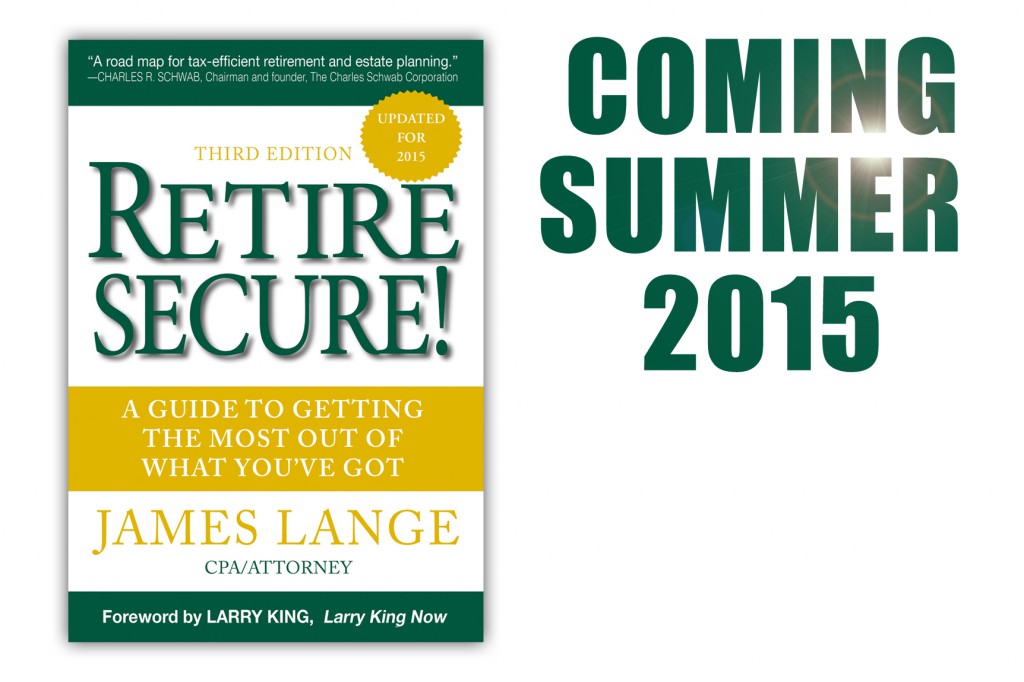
Retire Secure! Third Edition: The Rate of Return You Earn Makes a Big Difference

Retire Secure A Guide to Getting the Most Out of What You've Got, James Lange 2015

I love it when clients give me feedback, good or otherwise. When I wrote the second edition of Retire Secure!, I got a lot of complaints about the fact that our calculations assumed an investment rate of return of 8%. Our more conservative clients told me that 8% was just not realistic for them, and that our numbers must therefore be inaccurate.

Chapter 1 compares the difference between saving in pre-tax and after-tax accounts, but in order to keep those conservative clients happy, the assumed rate of return has been lowered to 6%. As expected, the difference in the two accounts was not quite as dramatic as when we used an 8% rate of return, but the results showed that it is still better to save using a pre-tax account. Then we looked at the significant reduction in the wealth accumulated by both savers and, being the number crunchers that we are, we said, “What do they have to do in order to get that wealth back?” The answer was to increase the amount contributed to the account each year and the rate of return you earn makes a big difference over the long term.

Do you want to teach your children and grandchildren the benefits of starting to save early in their lives? We introduce two new types of retirement savings plans that make it possible for low-income taxpayers such as students to contribute to a retirement account that has no fees and very low minimum contributions. There is also a new section devoted to a discussion on the growing trend of using loans against retirement plans to pay for expenses such as college education. It must be okay because it’s your own money, right? Read Chapter 1 to learn the pros and cons of this strategy.

Have you been seeing the term “underfunded pension plan” a lot lately? If you haven’t, you might want to Google that term and look at what comes up. The number of underfunded pension plans in this country has reached an alarming level, and, even if you are eligible for benefits under such a plan, you might want to consider establishing a back-up plan. Chapter 1 addresses this problem.

Check back soon, and I’ll give you can idea of what you can expect in Chapter 2!

Thanks,

Jim

Jim Lange A nationally recognized IRA, Roth IRA conversion, and 401(k) expert, he is a regular speaker to both consumers and professional organizations. Jim is the creator of the Lange Cascading Beneficiary Plan™, a benchmark in retirement planning with the flexibility and control it offers the surviving spouse, and the founder of The Roth IRA Institute, created to train and educate financial advisors.

Jim’s strategies have been endorsed by The Wall Street Journal (33 times), Newsweek, Money Magazine, Smart Money, Reader’s Digest, Bottom Line, and Kiplinger’s. His articles have appeared in Bottom Line, Trusts and Estates Magazine, Financial Planning, The Tax Adviser, Journal of Retirement Planning, and The Pennsylvania Lawyer magazine.

Jim is the best-selling author of Retire Secure! (Wiley, 2006 and 2009), endorsed by Charles Schwab, Larry King, Ed Slott, Jane Bryant Quinn, Roger Ibbotson and The Roth Revolution, Pay Taxes Once and Never Again endorsed by Ed Slott, Natalie Choate and Bob Keebler.

If you’d like to be reminded as to when the book is coming out please fill out the form below.

Save

Save

What the Scaife Case Teaches Us: Using a Bank or a Lawyer as a Trustee doesn’t Guarantee Proper Fiduciary Care

5MU0KKFTThe late Richard Mellon Scaife. The trust at the center of the litigation was created in 1935 by his mother, Sarah Mellon Scaife. (Photo Courtesy of Tony Tye/Post-Gazette)

http://www.post-gazette.com/local/2015/01/15/Scaife-children/stories/201501150289

On January 15, 2015 the Pittsburgh Post-Gazette ran an article (Scaife children seek details on drained trust) outlining an ongoing court case between the children of Richard Mellon Scaife and the trustees of their grandmother’s trust. The trust was set up in 1935 by the children’s grandmother for the benefit of Richard Mellon Scaife, but apparently language in the document also suggested that some of the principal should be saved for R.M. Scaife’s children. When Mr. Scaife died in July of 2014, Jeannie Scaife and David N. Scaife found that the fund that had contained $210 million dollars in 2005 was now completely drained. They allege that the trustees for the account allowed and even encouraged inappropriate spending from the fund by the late Mr. Scaife.

This case offers a vivid illustration of a point that Pittsburgh CPA, James Lange, has been sharing with his clients for more than 30 years: Trusts are wonderful vehicles to protect and provide for your family for generations, but choosing the right trustees makes all the difference. Creating trusts with banks and lawyers as trustees, even after paying the enormous fees, doesn’t guarantee appropriate fiduciary care.

Lange insists that the moral of the story, no matter how the case turns out, is that most people, even billionaires, will usually be better off with reliable family members as trustees. The family members can hire accountants, attorneys, and money managers to help them manage and maintain the trust. If those people aren’t appropriate or fulfilling their duties properly they can be fired, but control is retained by the family instead of bankers and lawyers whose first duty might not be to your family’s legacy.

If you need help with your financial planning contact us at (800) 387-1129 or (412) 521-2732.

Save

More on Retire Secure! Third Edition…Coming Soon!

Retire Secure! Third Edition, A Guide To Making The Most Out Of What You've Got, James LangeThe third edition of Retire Secure!, Retire Secure! A Guide to Making the Most Out of What You’ve Got is set to be released in the coming months, (stay tuned for exact date). This revised Third Edition of Retire Secure! covers how to develop an estate plan that, among other goals, seeks to continue the tax-favored status of your retirement plans or IRAs long after your death using the stretch or inherited IRA—a strategy that has been, and continues to be, threatened by congress. Lange has a history of staying ahead of the curve, seeing trends and changes in the tax laws and developing strategies for his clients in advance to keep them on the right path toward their financial goals. He was among the first to predict the coming changes to the tax law on Roth IRAs and wrote a peer-reviewed article for The Tax Advisor (official journal of the AICPA) that would go on to win article of the year in 1998. He is continuing this trend in this Third Edition by laying out the possibility of the death of the stretch or inherited IRA as we know it, and providing avenues to reach the same or better outcomes for your family including the use of charitable remainder unitrusts, or CRUTS and life insurance.

Lange offers up plenty of new content in this Third Edition including cutting edge analysis on the unique synergy between Roth IRA conversions and Social Security Maximization that his office has been developing. Using Social Security maximization techniques including spousal benefits like “Apply & Suspend,” and timing small appropriate Roth IRA conversions to take advantage of lower tax brackets in retirement can make hundreds of thousands of dollars of difference in your retirement portfolio… and he’s got the study to prove it.

Virtually every chapter of Retire Secure! contains recommendations, analysis, and case studies that have come from a deep understanding of tax law, estate planning, investing, and “running the numbers” and are proven to work.

Read this upcoming book and make the most out of what you’ve got for your retirement and your family’s future security.

Jim LangeA nationally recognized IRA, Roth IRA conversion, and 401(k) expert, he is a regular speaker to both consumers and professional organizations. Jim is the creator of the Lange Cascading Beneficiary Plan™, a benchmark in retirement planning with the flexibility and control it offers the surviving spouse, and the founder of The Roth IRA Institute, created to train ad educate financial advisors.

Jim’s strategies have been endorsed by The Wall Street Journal (33 times), Newsweek, Money Magazine, Smart Money, Reader’s Digest, Bottom Line, and Kiplinger’s. His articles have appeared in Bottom Line, Trusts and Estates Magazine, Financial Planning, The Tax Adviser, Journal of Retirement Planning, and The Pennsylvania Lawyer magazine.

Jim is the best-selling author of Retire Secure! (Wiley, 2006 and 2009), endorsed by Charles Schwab, Larry King, Ed Slott, Jane Bryant Quinn, Roger Ibbotson and The Roth Revolution, Pay Taxes Once and Never Again endorsed by Ed Slott, Natalie Choate and Bob Keebler.

Please complete the form below to receive reminders about the upcoming release of Retire Secure! Third Edition

Save

More on Retire Secure! Third Edition… Coming Soon!

Retire Secure! Third Edition, A Guide To Making The Most Out Of What You've Got, James LangeThe third edition of Retire Secure!, Retire Secure! A Guide to Making the Most Out of What You’ve Got is set to be released in the coming months, (stay tuned for exact date). This revised Third Edition of Retire Secure! covers how to develop an estate plan that, among other goals, seeks to continue the tax-favored status of your retirement plans or IRAs long after your death using the stretch or inherited IRA—a strategy that has been, and continues to be, threatened by congress. Lange has a history of staying ahead of the curve, seeing trends and changes in the tax laws and developing strategies for his clients in advance to keep them on the right path toward their financial goals. He was among the first to predict the coming changes to the tax law on Roth IRAs and wrote a peer-reviewed article for The Tax Advisor (official journal of the AICPA) that would go on to win article of the year in 1998. He is continuing this trend in this Third Edition by laying out the possibility of the death of the stretch or inherited IRA as we know it, and providing avenues to reach the same or better outcomes for your family including the use of charitable remainder unitrusts, or CRUTS and life insurance.

Lange offers up plenty of new content in this Third Edition including cutting edge analysis on the unique synergy between Roth IRA conversions and Social Security Maximization that his office has been developing. Using Social Security maximization techniques including spousal benefits like “Apply & Suspend,” and timing small appropriate Roth IRA conversions to take advantage of lower tax brackets in retirement can make hundreds of thousands of dollars of difference in your retirement portfolio… and he’s got the study to prove it.

Virtually every chapter of Retire Secure! contains recommendations, analysis, and case studies that have come from a deep understanding of tax law, estate planning, investing, and “running the numbers” and are proven to work.

Read this upcoming book and make the most out of what you’ve got for your retirement and your family’s future security.

Jim LangeA nationally recognized IRA, Roth IRA conversion, and 401(k) expert, he is a regular speaker to both consumers and professional organizations. Jim is the creator of the Lange Cascading Beneficiary Plan™, a benchmark in retirement planning with the flexibility and control it offers the surviving spouse, and the founder of The Roth IRA Institute, created to train ad educate financial advisors.

Jim’s strategies have been endorsed by The Wall Street Journal (33 times), Newsweek, Money Magazine, Smart Money, Reader’s Digest, Bottom Line, and Kiplinger’s. His articles have appeared in Bottom Line, Trusts and Estates Magazine, Financial Planning, The Tax Adviser, Journal of Retirement Planning, and The Pennsylvania Lawyer magazine.

Jim is the best-selling author of Retire Secure! (Wiley, 2006 and 2009), endorsed by Charles Schwab, Larry King, Ed Slott, Jane Bryant Quinn, Roger Ibbotson and The Roth Revolution, Pay Taxes Once and Never Again endorsed by Ed Slott, Natalie Choate and Bob Keebler.

Please complete the form below to receive reminders about the upcoming release of Retire Secure! Third Edition

Save

Back Door IRA, The Conclusion

Roth-IRA-conversions,James-LangeRecharacterizations

Disclaimer: Please note that the Tax Cuts and Jobs Act of 2017 removed the ability for taxpayers to do any “recharacterizations” of Roth IRA conversions after 12/31/2017. The material below was created and published prior the passage of the Tax Cuts and Jobs Act of 2017. 

Converting to a Roth IRA also comes with another very unique advantage. The IRS allows you a one-time opportunity to recharacterize or “undo” this conversion by October 15th of the following tax year. IRS publication 590 states that, “a recharacterization allows you to ‘undo’ or ‘reverse’ a rollover or conversion to a Roth IRA. To recharacterize, you generally instruct the trustee of the financial institution holding your Roth IRA to transfer the amount back to a traditional IRA (in a trustee-to-trustee or within the same trustee). If you do this by the due date for your tax return (including extensions), you can treat the contribution as made to the traditional IRA for that year (effectively ignoring the Roth IRA contribution)”. In the case of a Backdoor Roth IRA, you probably won’t think about recharacterizing. However, if you want to explore this option, we are here to help assist you, because like many of the other rules involved this can be complicated.

Conclusion

While Backdoor Roth IRAs can be beneficial to many investors, they aren’t for everyone. They come with their limitations and complications. There are precautions that need to be taken to reap the full benefits of any financial decision. This is an area where a highly informed financial advisor can help you make an educated and calculated decision. You should always consult with your financial advisor and tax professional to help avoid tax ramifications.

As always, we are here to help and can look at your specific financial situation and chart the right path for you. If you are interested in learning more about whether or not a Backdoor Roth would be right for you and your specific situation, please call us and we would be happy to discuss this with you. As always, we enjoy the opportunity to assist you in addressing your financial matters.

Financial Check-Up


Complimentary Financial Check-up

If you are currently not a client of The Lange Financial Group, we would like to offer you a complimentary, one-hour, private consultation with one of our professionals at absolutely no cost or obligation to you.

To schedule your financial check-up, please call 412-521-2732 or fill out our Pre-Qualification Form here.

Thank you,
James Lange


This article is for informational purposes only. This information is not intended to be a substitute for specific individualized tax, legal or investment planning advice as individual situations will vary. For specific advice about your situation, please consult with a lawyer or financial professional.

The Roth IRA offers tax deferral on any earnings in the account. Withdrawals from the account may be tax free, as long as they are considered qualified. Limitations and restrictions may apply. Withdrawals prior to age 59 ½ may result in a 10% IRS penalty tax. Future tax laws can change at any time and may impact the benefits of Roth IRAs. Their tax treatment may change.

Roth IRA account owners should consider the potential tax ramifications, age and contribution deductibility limits in regard to executing a re-characterization of a Roth IRA to a Traditional IRA.

The views stated in this letter are not necessarily the opinion of The Lange Financial Group, LLC, and should not be construed, directly or indirectly, as an offer to buy or sell any securities mentioned herein. Investors should be aware that there are risks inherent in all investments, such as fluctuations in investment principal. With any investment vehicle, past performance is not a guarantee of future results. Material discussed herewith is meant for general illustration and/or informational purposes only, please note that individual situations can vary. Therefore, the information should be relied upon when coordinated with individual professional advice. This material contains forward looking statements and projections. There are no guarantees that these results will be achieved. © Academy of Preferred Financial Advisors, 2014


The Hazards of Naming Different Beneficiaries for Different Accounts

It is quite common in my practice for clients to say they want one particular account to go to one beneficiary and a different account to another beneficiary. The accounts might reflect the relative proportionate value that the client wants each of the different beneficiaries to receive, but I think this can turn into a nightmare.

• You will have a terrible time trying to keep track of the different
distribution schedules.

• As the different investments go up or down, the amount going to the different heirs would also go up and down, which is probably not the intent.

• A beneficiary designation may say, “ I leave my Vanguard account to beneficiary B and my Schwab account to beneficiary A. ” If during your lifetime you switch or transfer money from Vanguard to Schwab, you have, in effect, changed who is going to get what, and that may not be your intention.

In general, I prefer one master beneficiary designation for all IRAs, retirement plans, 403(b)s, 401(k)s, and the like. In it I describe distributions as I would in a will or irrevocable or revocable trust. That way, we can avoid mistakes and simplify estate administration after the retirement plan owner dies.

I recognize that, for investment purposes, people use different accounts for different beneficiaries. For example, you might treat the investments of a grandchild beneficiary differently from those of a child or spouse. Under those circumstances I would be willing to bend and accept different beneficiaries for different accounts.

The one area where it might make sense to direct certain money to particular beneficiaries is FDIC insured deposits. At press time, the amount that the FDIC would insure rose from $ 100,000 to $ 250,000 through 2009. Assuming the money is outside the IRA (there are different protections for IRAs) one way to get more FDIC insurance is to have different beneficiaries with different paid on death designations. If you are a parent with four kids and you have four $ 250,000 CDs, you can do a pod account for each child and have the entire amount federally guaranteed. If the money was in an IRA, you are also insured up to $ 250,000 but you can ’ t get additional coverage by naming additional beneficiaries.

Retire Secure! Pay Taxes Later – The Key to Making Your Money Last, 2nd Edition, James Lange, page. 271-272 https://www.paytaxeslater.com/