
How Grandparents Can Best Provide for Their Grandchild with a Disability

forbes.com (1)

How Grandparents Can Best Provide
for Their Grandchild with a Disability

by James Lange, CPA/Attorney

Reprinted with permission of Forbes.com where Jim is a paid contributor.

I helped implement a tax saving strategy for my recently deceased father-in-law that, given reasonable assumptions, will save our family $1,178,397 in taxes over our daughter’s lifetime. To oversimplify, I redirected what would have been my wife’s $500,000 inherited IRA to our daughter's Special Needs Trust (SNT).

Many grandparents of children with disabilities can take the same tax-cutting steps we did to help protect their grandchild’s long-term financial security and independence.

Please note this strategy could also have significant benefits to grandparents who don’t have a grandchild with a disability. Grandparents with children, who are in a substantially higher tax bracket than their grandchildren, can take similar tax-cutting steps.

If you are skeptical, please note that this strategy was published and attributed to me in The Wall Street Journal on December 22, 2025 in an article by Ashlea Ebeling.

The Common Default

Most grandparents with traditional families name their spouse as the primary beneficiary of their IRA and other retirement plans. Then, typically, they name their children equally as the contingent beneficiaries of their IRAs. That means if their spouse predeceases them, their children inherit the IRAs equally. You may also see the words "per stirpes" on the beneficiary form to indicate that if one of the children predecease their parents, then the share of the predeceased child goes to the child or children of the predeceased child.

The Improvement in the Common Default

I suggest adding flexibility to the documents by including “disclaimers” (see below) and in the case of a grandchild with a disability to allow a child to “disclaim” to a SNT.

Some estate attorneys have been using variations of this disclaimer strategy for more than 30 years. The objective has always been to allow grandparents to set up a flexible estate plan that could direct at least a portion of their IRA to a grandchild or to a trust for one or more grandchildren. Over that time many IRAs were directed or disclaimed to grandchildren, saving hundreds of thousands of dollars or more in taxes.

Disclaimer Planning to a SNT

A disclaimer is a legal way to refuse an inherited IRA (or a portion of an IRA or any other asset) so it passes automatically to the next contingent beneficiary named in the beneficiary designation. You aren’t changing the beneficiary form after death, just allowing a named beneficiary to step aside in favor of a contingent beneficiary. For most traditional families, I often prefer estate plans that have a series of disclaimers built in on several levels.

Specifically in the context of this article, I am recommending you consider giving your child the choice of accepting their share of their inherited IRA or disclaiming it into the SNT for their child.

Why IRAs and Retirement Accounts Are Especially Well-Suited for a SNT

IRAs and retirement accounts are fully taxable when distributed. Under the current law known as the SECURE Act, for deaths after December 31, 2019, subject to exception, inherited IRAs must be distributed and taxed within ten years after the death of the IRA owner. This often results in massive income tax acceleration for grown children who may already be in high-income tax brackets.

However, when an inherited IRA passes directly or via disclaimer to a SNT for a beneficiary with a disability who qualifies as an Eligible Designated Beneficiary (EDB), the beneficiary can "stretch" distributions—deferring taxes—over their actuarial life expectancy. For a child who likely will need lifetime support, this difference can be life changing.

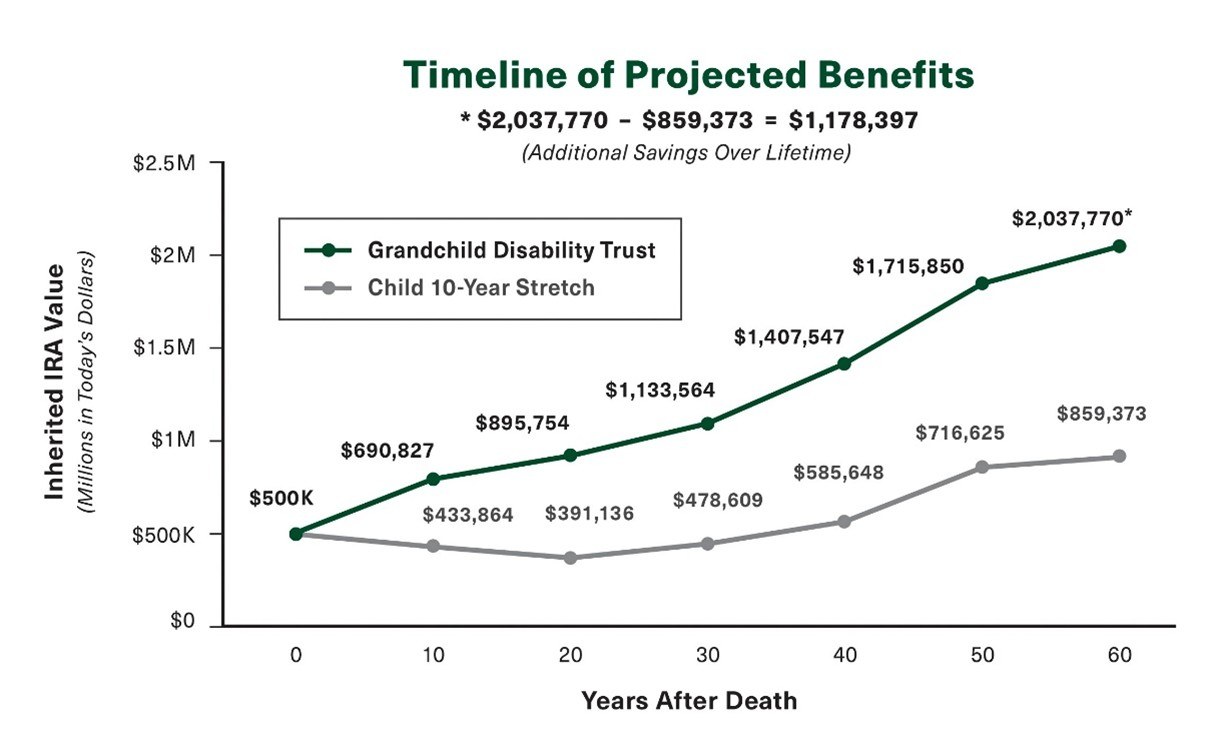
In our family's case, we benefited in two ways. First, we avoided the standard ten-year distribution of the inherited IRA rule that would have forced my wife to pay income taxes on her portion of her dad's IRA over ten years. Instead, our daughter’s trust will enjoy a 50-plus-year “stretch” based on our daughter's life expectancy. In addition, our daughter, who will receive taxable distributions from the trust will be in a lower income tax bracket than my wife and I. Combining both tax benefits with reasonable assumptions*, our daughter will enjoy $1,178,397 in additional savings over her lifetime. (Please see the graph below for a timeline of the projected benefit of the strategy we recommend.)
James Lange How Grandparents Can Best Provide for Their Grandchild with a Disabilty

*Assumptions

  • $500,000 inherited IRA with a 10-year stretch vs. 60-year lifetime stretch
  • 6% rate of return, 3% inflation rate (net rate of return of 3% more than inflation)
  • Parent vs. grandchild annual income = $150,000 vs. $18,000 SSDI (assume all after-tax income is spent by both parent and grandchild except for IRA distributions)
  • Current income tax rates for federal tax purposes
  • 15% tax rate on portfolio income for both parent and grandchild
  • No inheritance, estate, or state income tax are included in the analysis

Note: No information provided should be construed as tax, legal or investment advice. Speak with a qualified professional prior to implementation.

This plan doesn't work nearly as well today if the grandchild doesn't have a disability, however, there is still an opportunity to use trusts to save taxes when the grandchild is not disabled but their tax rate is considerably lower than their parents’.

My strong recommendation for grandparents of a grandchild with a disability is to consider naming a properly drafted SNT as a contingent beneficiary of their IRA or retirement plan. If the grandchild doesn’t have a disability, then consider including disclaimer provisions either to a grandchild directly or a standard minor’s trust to take advantage of the grandchild’s lower tax bracket.

What Our Family Actually Did

I requested my father-in-law add a SNT for the benefit of our daughter who has a disability as the contingent beneficiary of my wife’s share of the inherited IRA. He did that. After he passed, my wife disclaimed her share of his IRA to the SNT.

With or without disclaimers, if you want to benefit a grandchild with a disability, you usually need a SNT. The SNT can offer protection when an outright inheritance to a grandchild with a disability could threaten eligibility for means-tested benefits like Supplemental Security Income (SSI) and Medicaid. In addition, it can unnecessarily cause a massive income tax acceleration.

How to Enhance This Strategy

What is better than long-term income-tax deferred investments? Long-term tax-free investments. If grandpa or grandma converts some of their IRA to a Roth and that Roth can eventually go to a SNT, the SNT will have the same “stretch” distribution pattern as a traditional IRA, but all the qualifying distributions will be tax-free.

My wife and I made a $250,000 Roth conversion in 1998. That Roth, including the growth from the time that we converted it until our death which will hopefully be a 50-year period, will eventually pass to our daughter, who will stretch that inherited Roth IRA over her lifetime. Our family might get over 90 years of tax-free growth on that Roth conversion. That Roth conversion story, which also created a million dollar plus benefit for our daughter, along with other benefits of Roth conversion planning, was published in Forbes magazine in the February 28, 2019 edition.

Warning

Drafting the trusts, implementing the disclaimers, and taking all the necessary steps to achieve the goals of this article is a minefield where one misstep can cause a massive income tax acceleration. Those considering this strategy are advised to work with a qualified estate attorney and advisor to avoid mistakes.

Furthermore, there is no rush to do anything with the inherited IRA immediately after a death. You have nine months to make a disclaimer. Don’t let the executor, the trustee, the beneficiary, or the financial institution where the money is invested do anything until you have all your ducks in a row, that is, when the strategy and the mechanics of what to do are clearly defined. I have seen a lot of wonderful disclaimer opportunities ruined because someone did something they should not have done after death.

The banker we dealt with would have made a deadly mistake that would have killed the “stretch” for our daughter had I not been so diligent to make sure everything was done right.

The Takeaway

If a family includes a grandchild with a disability, naming a SNT as a contingent beneficiary of an IRA either directly or through a disclaimer is one of the highest impact planning moves available. Converting part of that IRA to a Roth is like adding the cherry on top.

Directing IRAs or retirement accounts—or better yet Roth IRAs—to a SNT can easily save families with a $500,000 IRA or more hundreds of thousands of dollars per beneficiary (sometimes well over $1M in taxes) and provide lifetime support for a grandchild with a disability. The evidence is in the track record of families who got it right, including mine.

How can I leave my IRA to a grandchild with a disability without disqualifying them from SSI or Medicaid?

What is a disclaimer in estate planning, and how can it help my family save on taxes?

Can an inherited IRA be stretched over a lifetime if the beneficiary has a disability?

Why are IRAs and retirement accounts especially well-suited for funding a Special Needs Trust (SNT)?

How can Roth IRA conversions benefit a grandchild with a disability?

About Your Presenter: James Lange, CPA/Attorney

James-Lange

Jim is the author of 10 best-selling financial books and has been quoted 37 times in The Wall Street Journal. He has published 21 articles for Forbes.com.
Bill Bengen’s New 30-Year Safe Withdrawal Rate: A 17.5% Raise for Retirees

Bill Bengen’s research on retirement withdrawals has shaped financial planning for decades. He is widely recognized as the originator of the “4% rule,” a guideline that has been referenced in countless academic papers, financial planning articles, and media discussions about how retirees can safely draw income from their portfolios.

In his latest research, Bill unveils an updated safe withdrawal rate for a traditional 30-year retirement horizon—raising it from 4.0% to 4.7%. This increase effectively represents a 17.5% raise for retirees who follow the framework. The updated guidance is explained in detail in his book A Richer Retirement: Supercharging the 4% Rule to Spend More and Enjoy More.

This article draws heavily on Bill Bengen’s groundbreaking research and recent updates. Bill was kind enough to review this article, and his insights are incorporated throughout.

The Math Behind the Change from 4.0% to 4.7% — A 17.5% Raise

The increase from 4.0% to 4.7% stems primarily from updated assumptions. In the past, Bill based his calculations on a simple 50/50 portfolio of U.S. stocks and bonds. His new model assumes a well-diversified portfolio consisting of multiple asset classes.

For retirees, the impact can be meaningful. In the first year of retirement, a retiree with $1 million in savings could withdraw $47,000 instead of $40,000. That $7,000 increase represents a 17.5% raise in spending power.

Reminder of How Bill’s Safe Withdrawal Rate Works

The method begins by withdrawing 4.7% from your retirement portfolio during the first year. In each following year, you increase that initial withdrawal amount by the annual inflation rate—regardless of how the market performs.

For example, if you withdraw $47,000 in year one and the portfolio declines to $850,000 by the end of that year while inflation runs at 3%, your year-two withdrawal would still be based on the first-year withdrawal amount. In this case, you would increase the $47,000 by 3%, resulting in a withdrawal of $48,410 in year two.

Why Investment Horizons Matter

Few retirees have a perfectly defined 30-year investment horizon. Some individuals will need retirement income for only a few years, while others may require income for forty or even fifty years.

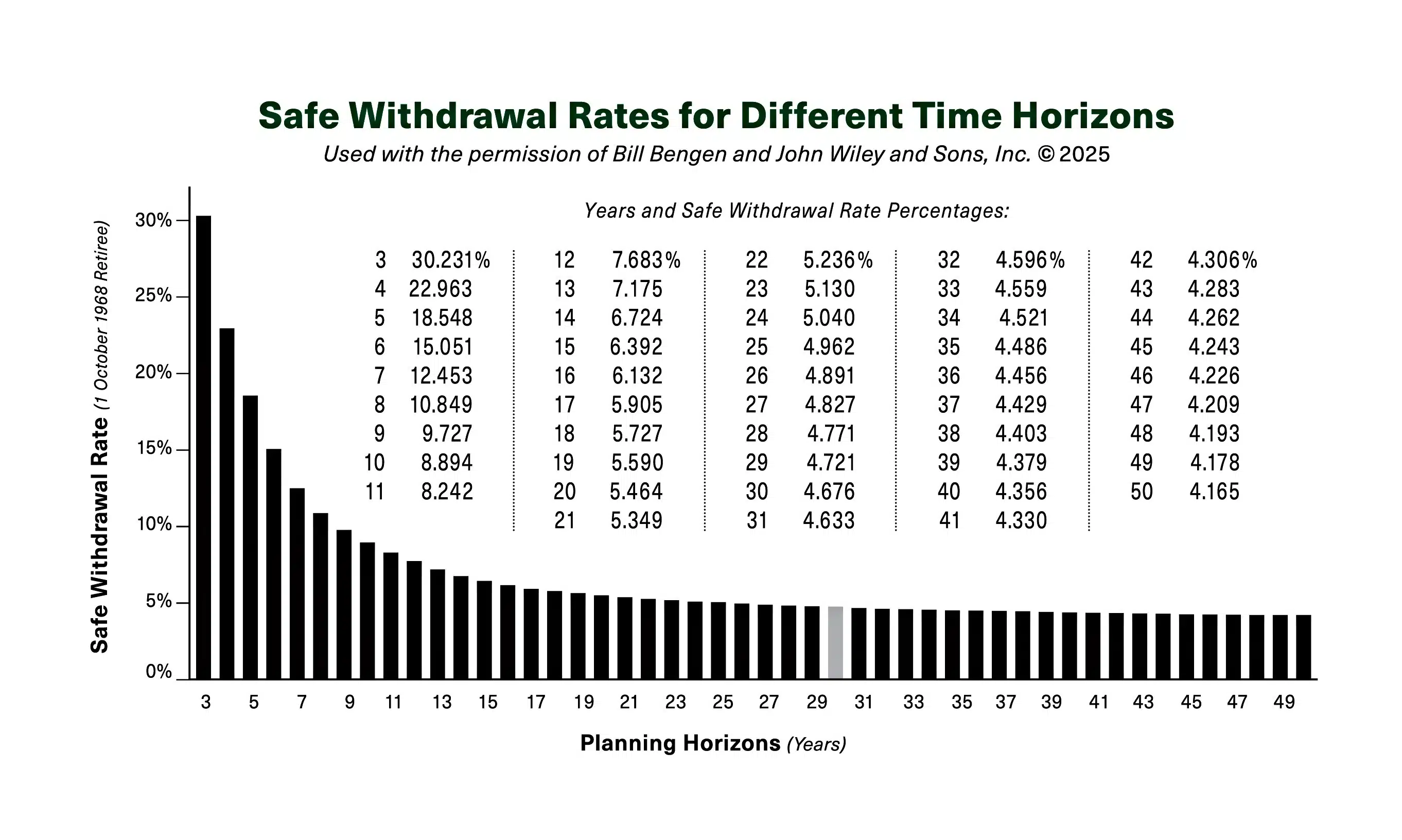
Bill’s updated research includes a chart showing safe withdrawal rates for investment horizons ranging from 3 to 50 years. The chart, reproduced from page 81 of his book, provides a practical roadmap for retirees who want to match their withdrawal strategy to their own realistic planning horizon rather than relying on a one-size-fits-all rule.

For example, someone with a ten-year investment horizon could safely withdraw about 8.894%, while someone planning for twenty years could withdraw about 5.464%.

Bill Bengen Safe Withdrawal Rate ChartWhat the Chart Reveals and Why it Could Be Life Changing

The chart illustrates withdrawal percentages over a 50-year timeline using the experience of retirees who began retirement on October 1, 1968—the worst retirement start date in recorded U.S. history.

Those retirees experienced both a severe bear market and the high inflation of the 1970s. Even under those historically difficult conditions, the updated withdrawal rates held up. This makes the projections conservative, meaning that most retirees are likely to experience outcomes that are even better.

The Practical Impact for Retirees

Understanding safe withdrawal rates allows retirees to estimate how much they can confidently spend without worrying about running out of money.

Beyond the math, the lifestyle implications can be significant. Safely spending more may allow retirees to travel more frequently, pursue hobbies, or enjoy meaningful experiences with family.

My father-in-law, who is 101 years old, sponsors an annual family vacation for all of his children, spouses, grandchildren, and now great-grandchildren. What a legacy! Experiences like these often provide far greater long-term satisfaction than material purchases.

Alternatively, some retirees may choose to make financial gifts to their children when they need it most rather than leaving everything as an inheritance later. Even if you ultimately decide not to increase your spending, the updated research may at least reduce the fear of outliving your money.

If Leaving a Legacy Is a Goal

If you want to preserve assets for heirs, you can adjust your withdrawal rate accordingly. For example, one projection assumes a starting portfolio of $1,000,000 with a 30-year horizon. By reducing the withdrawal rate from 4.67% to about 4.21%, the model suggests you could leave a legacy of at least $500,000 in today’s dollars.

Caveats and Conclusion

No financial model is immune to risk. A historically unprecedented sequence of poor market returns could disrupt even the most carefully constructed framework. Bill himself acknowledges that other withdrawal methods also exist.

However, his framework remains one of the most widely recognized and extensively studied approaches to retirement spending. After more than thirty years of analysis and testing, it continues to provide a practical foundation for retirement planning.

Whether your planning horizon is 3 years, 30 years, or 50 years, Bill’s updated research offers retirees a valuable roadmap for spending confidently while minimizing the risk of running out of money.

Additional Planning Considerations

While Bill’s research focuses on withdrawal rates, a comprehensive retirement plan should also consider tax planning and estate strategies. The suggestions below are not Bill’s, but mine, and there are many exceptions.

  • Optimize Social Security planning so that the spouse with the stronger earnings record waits until age 70 to collect.
  • Consider the equity in your home by evaluating options such as a HELOC or reverse mortgage.
  • Evaluate the potential role of immediate annuities for retirees with long life expectancies.
  • Consider a series of Roth IRA conversions.
  • Spend after-tax dollars first, then traditional IRAs, and Roth IRAs last.
  • Prepare estate planning documents utilizing Lange’s Cascading Beneficiary Plan℠.

When it comes to determining how much money you can safely withdraw from your retirement portfolio, Bill Bengen’s research remains one of the most influential frameworks available. Applying his insights can help retirees pursue both financial security and a fuller, more enjoyable retirement.

We have also created an online companion calculator available at PayTaxesLater.com/SafeWithdrawal. You can enter your planning horizon and portfolio value to estimate your first-year withdrawal amount. Please keep in mind this does not include taxes.

Is the 4% rule for retirement withdrawals still accurate?

How much can I safely withdraw from my retirement savings each year without running out of money?

How can I calculate my safe withdrawal rate if my retirement will be shorter or longer than 30 years?

Why did Bill Bengen change his 4% rule to 4.7%?

How do I determine my retirement investment horizon?

Can I really spend more in retirement than the 4% rule suggests?

Roth IRA vs Traditional IRA: What Makes the Roth Stand Out?

Roth IRA vs Traditional IRA: What Makes the Roth Stand Out?When planning for retirement, one of the most important decisions you will face is choosing between a Roth IRA and a Traditional IRA. While both accounts are designed to help you build long-term savings, the way each is taxed can significantly affect your future growth, retirement income, and overall purchasing power. Understanding how tax-free growth compares to tax-deferred growth is critical, especially as income levels and tax brackets evolve.

I have been analyzing the mathematical advantages of these accounts since their inception. In fact, in 1998, I authored the first peer-reviewed article on Roth IRAs for The Tax Adviser, the flagship publication of the American Institute of Certified Public Accountants (AICPA). Since then, I have continued to refine the methodology used to compare these two options, helping investors determine which strategy—Roth or Traditional—will best maximize their long-term purchasing power based on their unique tax situation.

The analysis below is an excerpt from my book, Retire Secure! for Professors and TIAA Participants. It explores how Roth IRAs and Traditional IRAs perform under different tax scenarios and why, in many cases, a strategic choice between the two offers a lasting advantage for both your retirement and your heirs.


What Makes a Roth IRA So Great When Compared with a Traditional IRA?

The advantages of compounding interest on both tax-deferred investments and on tax-free investments far outweigh paying yearly taxes on the capital gains, dividends, and interest of after-tax investments. As you saw in Chapter 2, you are generally better off putting more money in tax-deferred and tax-free accounts than in less efficient after-tax investments. Remember that with regular after-tax investments, you must pay income taxes on annual dividends, interest, and, if you make a sale, on capital gains.

The Roth is always a much better choice than the nondeductible IRA. You do not get a tax deduction for either, but all the money in the Roth IRA will be tax-free when it is withdrawn. The growth in the nondeductible IRA will be taxable.

The advantage the Roth IRA holds over a Traditional IRA builds significantly over time because of the increase in the purchasing power of the account. Let’s assume you make a $6,000 Roth IRA contribution (not including the $1,000 catch-up contribution if over age 50). The purchasing power of your Roth IRA will increase by $6,000, and that money will grow income tax-free.

On the other hand, let’s assume you contribute $6,000 to a deductible Traditional IRA and you are in the 24% tax bracket. In that case, you will receive a tax deduction of $6,000 and get a $1,440 tax break (24% × $6,000). This $1,440 in tax savings is not in a tax-free or tax-deferred investment. Even if you resist the temptation to spend your tax savings on a nice vacation and put the money into an investment account instead, you will be taxed each year on realized interest, dividends, and capital gains. This is inefficient investment growth.

The $6,000 of total dollars added to the Traditional IRA offers only $4,560 of purchasing power ($6,000 total dollars less $1,440 that represents your tax savings). The $1,440 of tax savings equates to $1,440 of purchasing power, so the purchasing power for both the Roth IRA and the Traditional IRA are identical in the beginning. However, in future years, the growth on the $6,000 of purchasing power in the Roth IRA is completely tax free. The growth in the Traditional IRA is only tax-deferred, and the $1,440 you invested from your tax savings is taxable every year.

One of the few things in life better than tax-deferred compounding is tax-free compounding.

Traditional IRA, the tax savings you realize from a Traditional IRA contribution are neither tax-free nor tax-deferred. When you make a withdrawal from your Traditional IRA, the distribution is taxable. But when you (or your heirs) make a qualified withdrawal from a Roth IRA, the distribution is income-tax free.

Should I Contribute to a Traditional Deductible IRA or a Roth IRA?

As stated earlier, a Roth versus a nondeductible IRA is a no-brainer: if given the choice, always go for the Roth. But for those individuals with a choice between a Roth IRA (or work retirement plan) and a fully deductible IRA (or work retirement plan), how should you decide? The conclusion is, in most cases, the Roth IRA is superior to the deductible IRA (and nonmatched retirement plan contributions like 401(k)s).

To determine whether a Roth IRA would be better than a Traditional IRA, you must take into account:

  • The value of the tax-free growth of the Roth versus the tax-deferred growth of the Traditional IRA including the future tax effects of withdrawals.
  • The tax deduction you lose by contributing to a Roth IRA rather than to a fully deductible IRA.
  • The growth, net of taxes, on savings from the tax deduction from choosing a deductible Traditional IRA.

In most circumstances, the Roth IRA is significantly more favorable than a Traditional IRA. (A number of years ago, I published an article in The Tax Adviser, a publication of the American Institute of Certified Public Accountants, which offered the mathematical proof that the Roth IRA was often a more favorable investment than a Traditional IRA.) The Jobs and Growth Tax Relief Reconciliation Act of 2003 (JGTRRA) and subsequent tax legislation changed tax rates for all brackets and reduced tax rates for dividends and capital gains. After these tax law changes, I incorporated the changes into the analysis of the Roth versus the Traditional IRA. The Roth was still preferable in most situations, although the advantage of the Roth was not quite as great as before JGTRRA. However, our country is currently facing unprecedented financial challenges, and I would not be surprised to see the government intend to reduce our tax rates any time soon. And, if the tax rates on dividends and capital gains, or even the ordinary tax rates increase, the Roth’s advantage will be even greater.

Roth IRA vs Traditional IRA


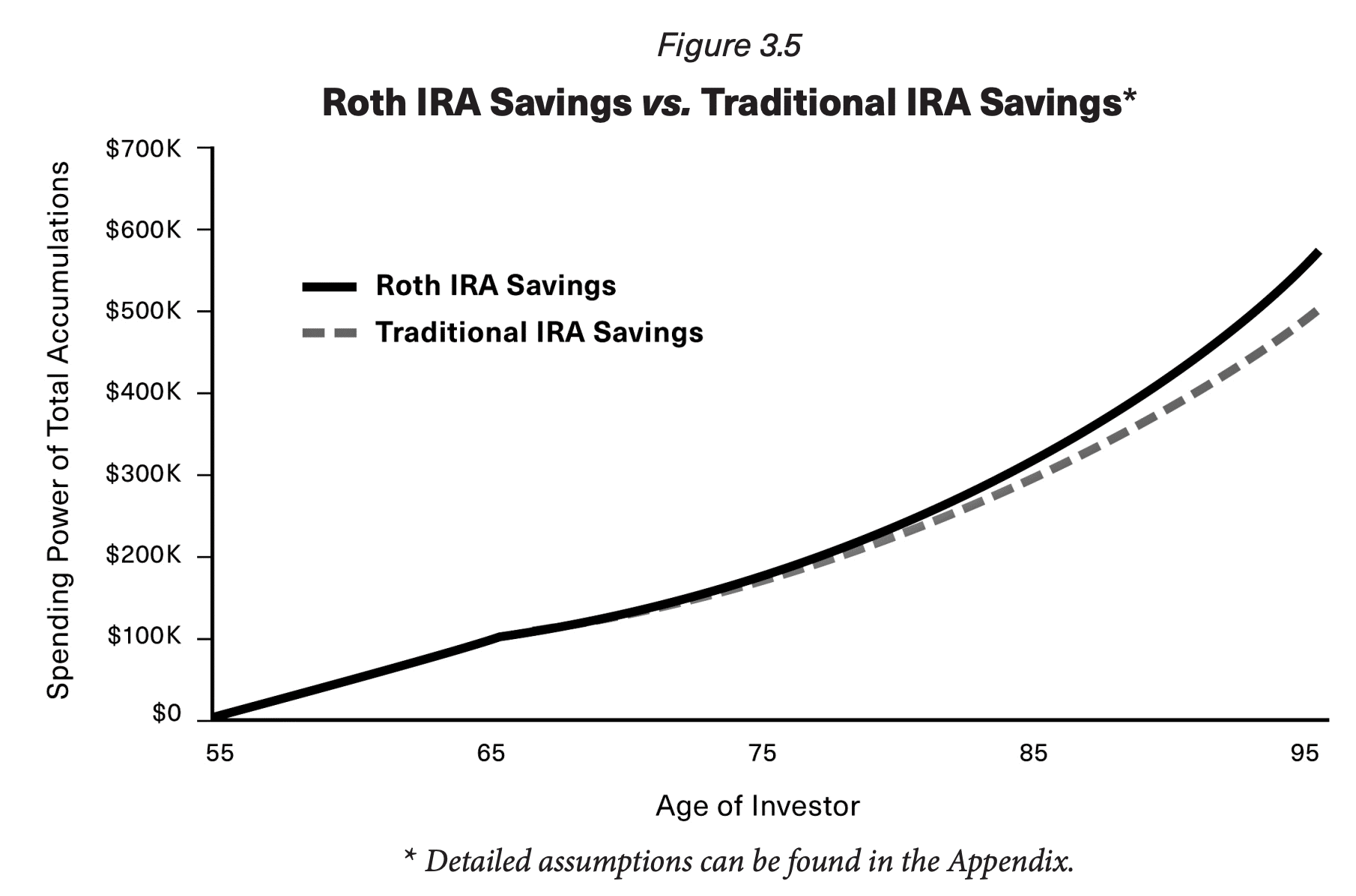
Figure 3.5 shows the value to the owner of contributing to a Roth IRA versus a regular deductible IRA measured in purchasing power.

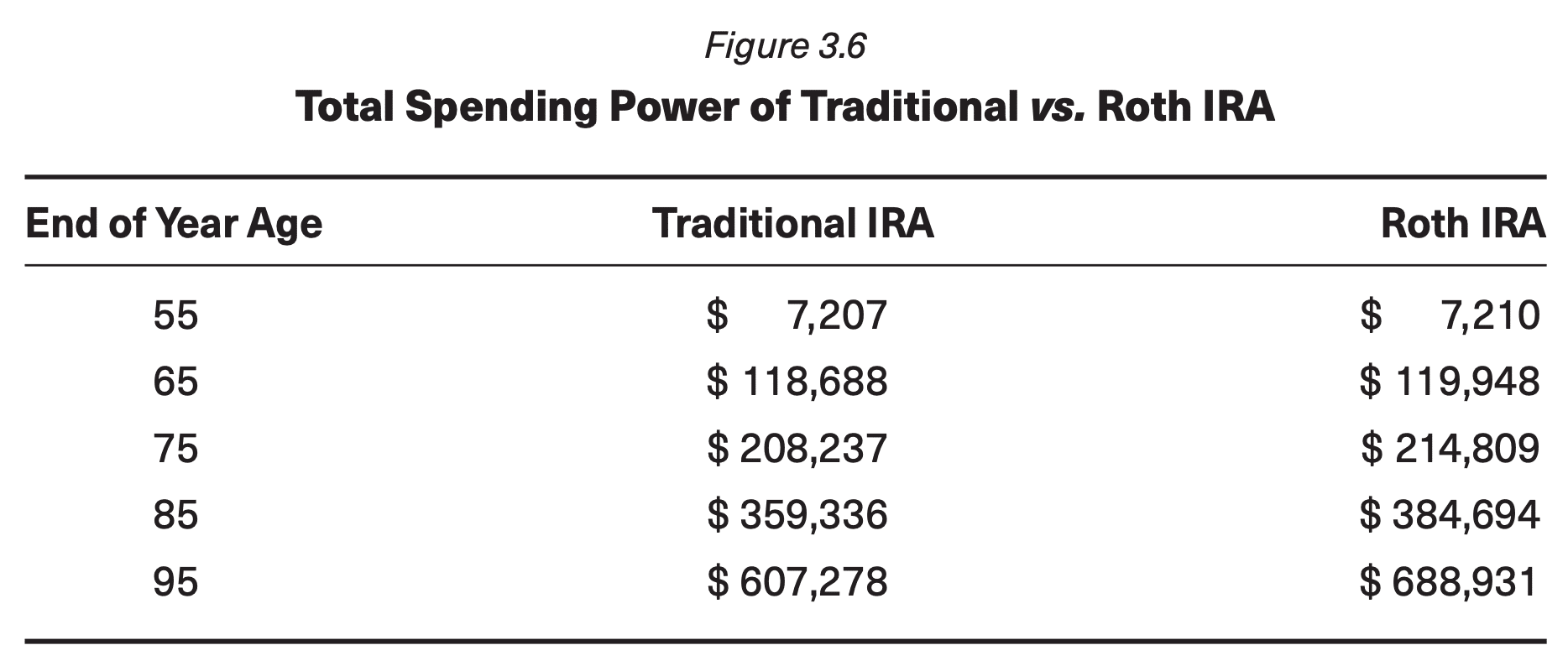
The amounts reflected in the figure show that saving in the Roth IRA is always more favorable than saving in the Traditional IRA, even if the contributions are made for a relatively small number of years. If tax rates become higher in the future, or if a higher rate of return is achieved, the overall Roth IRA advantage will be larger. Given a long-time horizon (such as when monies are passed to succeeding generations), the Roth IRA advantage becomes even bigger. The spending power of these methods at selected times is shown in Figure 3.6 on page 70.

Roth IRA vs Traditional IRA

The very limited (11-year) contribution period and very conservative (6%) rate of return. In short, it demonstrates that, even with minimal contributions, shorter time frames, and very conservative rates of return, the Roth IRA will still provide more purchasing power than a Traditional IRA.

The Effect of Lower Tax Brackets in Retirement

I will usually recommend the Traditional IRA over a Roth IRA if you drop to a lower tax bracket after retiring and have a relatively short investment time horizon. Under these circumstances, the value of a Traditional deductible IRA could exceed the benefits of the Roth IRA. It will be to your advantage to take the high tax deduction for your contribution and then, upon retirement, withdraw that money at the lower tax rate.

For example, if you are in the 24% tax bracket when you are working and make a $6,000 tax-deductible IRA contribution, you save $1,440 in federal income taxes. Then, when you retire, your tax bracket drops to 12%. Let’s assume that the Traditional IRA had no investment growth—an unrealistic assumption for a taxpayer who chooses to invest his IRA in a certificate of deposit which, at the time of writing, paid historically low interest rates. If he makes a withdrawal of $6,000 from the Traditional IRA, he will pay only $720 in tax—for a savings of $720.

Roth IRA vs Traditional IRA

If you drop to a lower tax bracket after retiring and have a short investment time horizon, I usually recommend the Traditional IRA or 403(b) over a Roth IRA or 403(b).

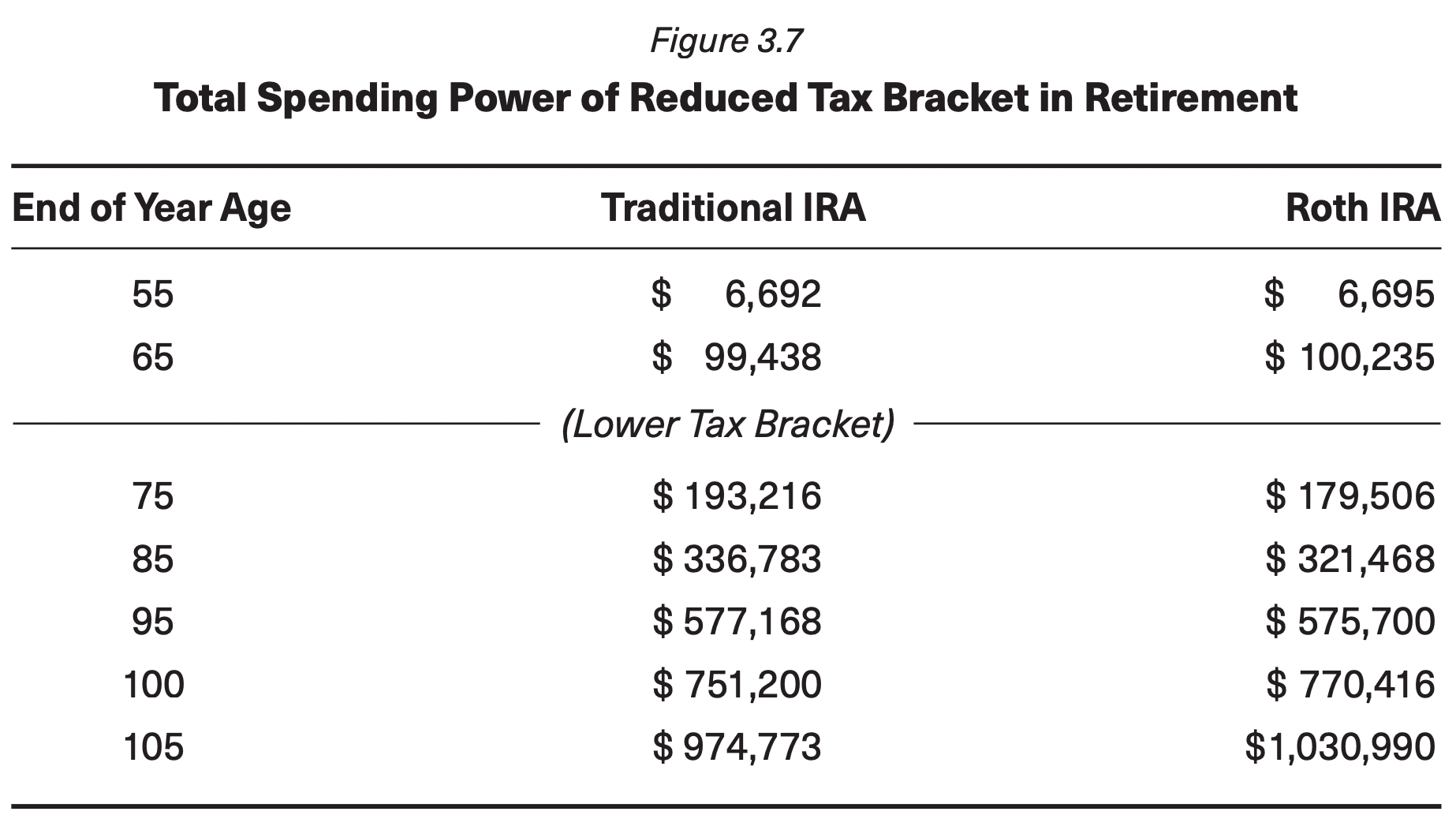
The advantage diminishes over time. So I ran the analysis again, starting with the same assumptions as in the previous example, except that, beginning at age 66, the ordinary income tax bracket is reduced from 24% to 12%.

The spending power of these methods at selected times is shown in Figure 3.7 on the next page. You can see that, under this particular set of circumstances, the Traditional IRA would be more beneficial to you during your lifetime. Note, however, that the Roth offers more spending power from age 100 on. Of course, most people will not survive until 100, but we show the analysis to point out that even facing a reduced tax bracket, the Roth IRA will become more valuable with time—an advantage for your heirs.

Roth IRA vs Traditional IRA

If you anticipate that your retirement tax bracket will always remain lower than your current tax rate and that your IRA will be depleted during your lifetime, I usually recommend that you use a Traditional deductible IRA over the Roth IRA, but that is rarely what I have observed in practice.

Unfortunately, once the RMD rules take effect for tax-deferred IRAs and retirement plans, many individuals find that they are required to withdraw so much money from their IRAs that their tax rate is just as high as their pre-retirement tax rate. And, when their RMDs are added to their Social Security income, some taxpayers find themselves in a higher tax bracket than when they were working. For these people, a Roth IRA contribution is usually preferable to a Traditional IRA.

These numbers demonstrate that even with a significant tax-bracket disadvantage, the Roth IRA can become preferable with a long enough time horizon. Furthermore, when you consider the additional estate planning advantages, the relative worth of the Roth IRA becomes more significant. (Please see Chapter 15 for a more detailed discussion of making a Roth conversion in a higher tax bracket when you will likely be in a lower tax bracket after retirement.)


Roth IRA vs Traditional IRA: Key Takeaways

When evaluating a Roth IRA vs Traditional IRA, the long-term impact of taxes often matters more than the upfront deduction. While Traditional IRAs can provide immediate tax savings, Roth IRAs offer the potential for tax-free growth and tax-free withdrawals, which may significantly increase purchasing power over time. As shown in the analysis above, factors such as future tax rates, investment time horizon, required minimum distributions, and estate planning goals all play a role in determining which account is more advantageous. Understanding these differences is essential when building a retirement strategy designed to last.

Is a Roth IRA or Traditional IRA better for long-term growth?

Are withdrawals taxed differently in a Roth IRA vs Traditional IRA?

Does a Roth IRA eliminate required minimum distributions (RMDs)?

Can I contribute to both a Roth IRA and a Traditional IRA?

How do income limits affect Roth IRA eligibility?

What happens to a Roth IRA or Traditional IRA when passed to heirs?

Does a Roth IRA protect against future tax increases?

Navigating IRA Withdrawals, RMDs, and the 10-Year Rule: Smart Tax Planning Strategies for Retirement

Navigating IRA Withdrawals, RMDs, and the 10-Year Rule Smart Tax Planning Strategies for Retirement James LangeBy Jim Lange

If you're a retiree, or about to become one, you might be sitting on a ticking tax time bomb without even realizing it.

One of the most common mistakes I see among wealthy retirees is to passively assume that the best tax strategy is to leave retirement money untouched for as long as possible. That decision can backfire. Required Minimum Distributions (RMDs), Social Security payments, the SECURE Act’s 10-year distribution rule for Inherited IRAs, increase the risk of unintended bumps into a higher tax bracket. For your heirs, the stakes could be even higher.

In this post, I’m going to walk you through what I consider the most critical strategies for optimizing your IRA, 401(k), and other retirement account withdrawals. With planning you can minimize bracket creep and taxes, and maximize the legacy you leave behind.

Why This Matters More Than Ever

Retirement planning isn’t what it used to be. If you’re like many Baby Boomers, you may have accumulated significant wealth in tax-deferred retirement accounts—exactly the types of accounts that are now under more scrutiny and tighter withdrawal timelines.

  • The SECURE Act eliminated the “stretch IRA” for most non-spouse beneficiaries. Now, most heirs must drain Inherited IRAs within 10 years.
  • Missed RMDs can result in up to a 25% penalty—something the IRS is now enforcing more strictly.
  • Changes under the SECURE Act 2.0 delay RMDs for some but also complicate planning.
  • For wealthier retirees, large RMDs can push you into higher tax brackets, affect Social Security taxation, and trigger Medicare Part B and D surcharges known as Income-Related Monthly Adjustment Amount (IRMAA).

And many beneficiaries inherit IRAs without fully understanding the tax traps—leaving them exposed to a significant and avoidable tax hit.

So let’s talk about what you can do to avoid these pitfalls.


Smart Strategies for Managing Retirement Account Withdrawals

Understand the Basics: What Are RMDs?

If you have a traditional IRA or employer-supported plan (like a 401(k) or 403(b)), the IRS requires Required Minimum Distributions beginning at age 73 (or age 75 if you were born in 1960 or later, thanks to SECURE Act 2.0).

The amount is based on your account balance as of December 31st of the previous year and your life expectancy, as defined by the IRS’s Uniform Lifetime Table. And here’s the kicker: your RMD is taxable income.

That’s where things get tricky. A $100,000 RMD may push you into a higher marginal tax rate, make more of your Social Security taxable, and even raise your Medicare premiums. It’s not uncommon for retirees to underestimate just how large these RMDs can become if accounts are left to grow unchecked for too long.

Master the 10-Year Rule for Inherited IRAs

Imagine your adult son inherits your $1 million IRA after you have begun taking your RMD. If you are still thinking that he will be able to stretch his withdrawals over his lifetime, you would be wrong. Under the SECURE Act of 2019 and Secure Act 2.0 of 2022, unless he qualifies as an Eligible Designated Beneficiary (e.g., your spouse, disabled child, etc.) your son must take annual RMDs, based on his own life expectancy, over a 10-year period, that must be liquidated. If your son took distributions during that 10-year period based on his life expectancy rather than taking distributions ratably during the 10-year period, he may have a large tax hit upon liquidation of the account in year 10.

Worse, if he fails to withdraw the funds in 10 years, he could face a 25% penalty on any amount not distributed in time.

If you die before your required beginning date for RMDs, and your son inherits the account he is not required to take annual RMDs in the years 1 through 9 of the 10-year period. He can wait until year 10 to withdraw the entire amount or take withdrawals at any time in the 10-year period. But taking our $1 million in year 10 could land him in a very painful tax bracket.

If you plan ahead, you can reduce the tax burden on your heirs—by reducing the IRA’s size before death through Roth conversions or strategic withdrawals. Then, if you die before reaching age 75, there are additional planning opportunities that your children should take.

Time Withdrawals and Roth Conversions Wisely

The years between retirement and when RMDs kick in (age 73 or later) are a golden window for Roth conversions. During this period, you may be in a relatively low tax bracket which is an ideal time to pay taxes on some of your traditional IRA funds and convert them into a Roth IRA.

Each year, you or your planner can run a tax projection to assess the optimal amount to convert. It is significantly more complicated than how much to convert without jumping into a higher marginal tax rate. These proactive conversions reduce the size of future RMDs and leave your heirs with tax-free Roth money instead of taxable IRA money.

Optimize Withdrawals Based on Tax Brackets

Many retirees withdraw too little or too much—beyond their RMD—in any given year. The secret is taking all the factors into account, not just managing withdrawals to fill, but not exceed, your current tax bracket.

For example, if you’re comfortably in the 22% tax bracket, the simple analysis is to convert to the top of the 22% bracket but it is likely that a significantly higher conversion, even at the 24% bracket is optimal. 

Also consider:

  • Using Qualified Charitable Distributions (QCDs) after age 70½ to donate from your IRA directly to charity—thus avoiding tax on the withdrawal.
  • Coordinating Roth conversions with deductions and exemptions in any low-income years—for instance, the year after you retire but before Social Security, pensions, and RMDs kick in.

Plan Around Other Income Sources

Tax planning for IRA withdrawals can’t be done in isolation. Every dollar you take affects your Modified Adjusted Gross Income (MAGI)—and that in turn affects your:

  • Social Security taxability
  • Medicare premiums (IRMAA)
  • Eligibility for other deductions or tax credits

Suppose you're drawing $40,000/year in Social Security, have a modest pension, and withdraw $70,000 from your traditional IRA. That could expose 85% of your Social Security to taxation and push you into higher IRMAA thresholds.

Mapping out anticipated income streams is critical to tax-smart planning.

Common Mistakes That Can Cost You

Let’s walk through some real-world missteps that cost retirees—and their heirs—thousands.

Mistake #1: Waiting Too Long to Start Withdrawals

Raj delayed all IRA withdrawals until RMDs began at age 73. The result? A $120,000 RMD that boosted his income, pushed him into the 32% bracket, triggered higher Medicare premiums. Taking small withdrawals earlier or executing partial Roth conversions could have mitigated this.

Mistake #2: Skipping Roth Conversion Opportunities

Emma, 65, recently retired. With low taxable income, she could have converted $30,000/year to a Roth IRA, locking in a 12% tax rate. She waited too long, and after RMDs started, she was in the 24% bracket—nearly doubling her tax cost.

Mistake #3: “Going It Alone” Without Professional Input

RMDs and inherited IRA rules now involve detailed calculations, tax projections, coordination with Medicare, and more. One oversight can trigger penalties or tens of thousands in taxes. Always consult with a qualified financial advisor or CPA.


Four Examples That Bring It All Together

Let’s review these lessons with relatable scenarios.

Example 1: Linda Manages RMDs Proactively

Linda, 74, continues teaching part-time, earning $20,000. She times her IRA withdrawals to stay just below the 22% tax bracket threshold, uses QCDs to give $10,000 to charity (satisfying part of her RMD), and converts $15,000 to a Roth.

Result? Efficient tax management and a growing Roth legacy for her children. In Linda’s case, if she converted more into Roth, it would put her in the 24% tax bracket and did not pay off, but in other situations, it does.

Example 2: Knowing the Rules for Inherited IRAs

Jake inherits a $500,000 IRA.

  • Withdraws $50,000/year over the 10-year window = steady annual tax impact.

Knowing the rules made all the difference.

Example 3: The Snowballing RMD

Raj grew his IRA to $1.5 million but took no distributions before 73. His first RMD is almost $75,000, and it keeps rising. Not only does he pay higher income taxes, but his Medicare Part B premiums increase drastically due to IRMAA.

Example 4: Early Roth Conversions Work Wonders

Emma, 65, converts $30,000/year for 6 years before RMDs. Her taxable income remains modest, and she avoids future RMDs on that money. Her heirs inherit over $200,000 in Roth funds—tax free.


What You Can Do Next

Build a Multi-Year Tax Roadmap

The most successful withdrawal plans are crafted years in advance. We help clients model out their income and taxes for the next 5–15 years and start planning strategic withdrawals and Roth conversions during low-income windows.

Review and Update Your Beneficiaries

Don’t assume your wishes will be honored unless beneficiary forms are current. Also, consider whether your heirs understand their responsibilities under the 10-year rule. In some cases, naming a trust as a beneficiary could make sense but it must be done carefully.

Consult a Retirement-Focused Professional

Working with a professional who understands the tax implications of IRA withdrawals, the nuances of inherited account rules, and estate planning coordination is absolutely essential. DIY planning carries significant risk at this stage of life.

Leverage Smart Tools and Resources

We encourage readers to:

  • Use the IRS RMD calculator to estimate future withdrawals.
  • Review current tax bracket thresholds and plan accordingly.

Next Steps

Retirement account withdrawals are no longer a simple matter of “wait as long as possible.” Between RMD rules, the SECURE Act’s 10-year requirement for heirs, and Medicare/IRMAA thresholds, poor timing can erode both your income and your legacy.

If you’d like me to help you evaluate whether your withdrawal strategy is on track—and explore whether a more complete financial plan could strengthen your retirement and estate outcomes—the first step is to see if you qualify for a complimentary Retire Secure Consultation.

Learn more at: PayTaxesLater.com/Consult

 FAQS

Converting portions of a traditional IRA to Roth in relatively low-income years pre-pays tax at known rates. Heirs then inherit Roth assets they can withdraw tax-free (still within 10 years), avoiding a big taxable spike later.

See also: Time Withdrawals and Roth Conversions Wisely

More taxable IRA income can make up to 85% of Social Security benefits taxable and can push you into higher Medicare premium brackets (IRMAA). That’s why bracket-aware withdrawals and conversions matter.

See also: Plan Around Other Income Sources

What is the SECURE Act’s 10-year rule for Inherited IRAs?

For most non-spouse beneficiaries, an inherited IRA must be fully distributed within 10 years of the original owner’s death, and future RMDs  will be based on the life expectancy of the beneficiary.  Compressing withdrawals into a decade can push heirs into higher tax brackets if they’re in peak earning years.

If a non-spouse beneficiary inherits the IRA before the original owner has begun taking RMDs the beneficiary is not required to take RMDs and could potentially withdraw the full amount in year 10—a potential tax nightmare.

Planning ahead by reducing traditional IRA balances during your lifetime or planning post-retirement withdrawals strategically  can soften the tax impact.

See also: Master the 10-Year Rule for Inherited IRAs

Spreading withdrawals across the 10-year window usually reduces bracket “spikes.” Consider increasing withdrawals during lower income tax rate years.

See also: Knowing the Rules for Inherited IRAs

After age 70½, you can donate up to the annual limit directly from your IRA to charity. QCDs count toward RMDs but don’t increase taxable income—helpful for controlling brackets, Social Security taxation, and IRMAA tiers.

Map a multi-year tax plan, review beneficiaries, test bracket-fill and conversion amounts with projections, and coordinate decisions with your advisor, CPA, and estate attorney.

See also: What You Can Do Next

Waiting too long to start withdrawals, taking an Inherited IRA as a lump sum, skipping Roth conversion windows, or ignoring beneficiary/trust updates. DIY missteps can be costly; periodic reviews help.

See also: Common Mistakes That Can Cost You

Each year, consider withdrawing or converting just enough to top off your current tax bracket without spilling into the next one. This keeps lifetime taxes lower and tames future RMDs.

See also: Optimize Withdrawals Based on Tax Brackets

RMDs generally begin at age 73 (and 75 for some younger cohorts under SECURE 2.0). RMDs are taxable income and can increase your marginal rate, make more of your Social Security taxable, and trigger Medicare IRMAA surcharges. Coordinated withdrawals and Roth conversions can help control these effects.

See also: Understand the Basics: What Are RMDs?

Trusts can protect minors, special-needs heirs, or spending-risk beneficiaries. Conduit trusts pass out distributions annually; accumulation trusts can retain them but face high trust tax rates. Draft language carefully under post-SECURE Act rules.

The Defenses Against the SECURE Act

The Best Defenses Against the SECURE Act by James Lange

photocredit: Getty


This blog post has been reposted with permission from Forbes.com

I have posted several articles explaining the most important provisions of the SECURE Act and the devasting effect that its provisions will likely have on individuals who inherit IRAs or retirement plans.  This article will address some of the proactive steps you can take now and after the SECURE Act or something similar becomes law.

Reduce Your Traditional IRA Balance With Roth IRA Conversions

If timed correctly, Roth IRA conversions can be an effective strategic planning tool for the right taxpayer. Often, a well-planned series of Roth IRA conversions will be a great thing for you and your spouse and will be one of the principle defenses from the devastation of the SECURE Act.

You and your heirs can benefit from the tax-free growth of the Roth IRA from the time you make the conversion up to ten years after you die.  One of the advantages of making a series of conversions is that the amount you convert to a Roth IRA reduces the balance in your Traditional IRA, which will reduce the income taxes your heirs after to pay on the Inherited IRA within ten years of your death.

Inherited Roth IRAs are subject to the same ten-year distribution rule after death as Inherited Traditional IRAs under the SECURE Act.  The important difference between the two accounts is that the distributions from Roth IRAs are generally not taxable.  One good thing about Trump’s Tax Cuts and Jobs Act of 2017 is that it temporarily lowered income tax rates, so this year is probably a better than average year for many IRA and retirement plan owners to consider Roth IRA conversions as part of their long-term estate planning strategy. We did several posts on Roth IRA conversions earlier this year and concluded this was a great time to look at Roth conversions.  Now, it is even more important.

In short, it may make more sense for you to pay income taxes on a series of Roth IRA conversions done over a period of years than it would for your heirs to pay income taxes on the accelerated distributions required under the SECURE Act.  The strategy of doing a series of Roth IRA conversions over several years tends to work better because you can often do a series of conversions and stay in a lower tax bracket than if you did one big Roth conversion.  Of course, there is no blanket recommendation that is appropriate for every IRA and retirement plan owner.

Spend More Money

Many of my clients and readers don’t spend as much money as they can afford.  Maybe if they realized to what extent their IRAs and retirement plans will be taxed after they die, they would be more open to spending some of it while they are alive.  Assuming you can afford it, why don’t you enjoy your money rather than allowing the government to take a healthy percentage of it?  Considering taking your entire family on a vacation and pay for everything. My father in law takes the entire family on a four-day vacation in the Poconos every year.  Yes, it costs him some money, but those family memories will be a much more valuable legacy than passing on a slightly bigger IRA – especially if your IRA is destined to get clobbered with taxes after you die.

A variation on the same idea is to step up your gifting plans – not only to charity but also to your family.   Sometimes it makes sense to give a financial helping hand to family members who might need one sooner than later. Not only might you be able to ward off additional troubles for them, but it might help your own peace of mind if you don’t have to worry about them.  What about that new grandbaby?  Consider opening a college savings plan – it could open a whole new world of opportunity for him when he reaches college age.

If you donate to charity, make sure that you “gift smart”.  The Tax Cuts and Jobs Act of 2017 made it more difficult for many Americans to itemize their charitable contributions.  If you fall into this category, you need to know about a provision in the law that allows you to make charitable contributions directly from your IRA.  Known as a Qualified Charitable Distribution (QCD), this strategy allows you to direct all or part of your Required Minimum Distribution (RMD) directly to charity.  The amount of the QCD is not an itemized deduction on your tax return – but it’s even better.  It is excluded from your taxable income completely!  So, if you are required to take RMD’s from your retirement plans and intend to donate to charity anyway, a QCD may be a much more tax-efficient way to do it.

Update Your Estate Plan

Thoughtful estate planning can provide options for survivors that will allow them to make better decisions because they can do so with information that is current at the time you die. Even if you have wills, life insurance and trusts, the changes in the laws suggest you review and possibly update your entire estate plan.   This includes your IRA beneficiary designations too, and that’s particularly true if you have created a trust that will be the beneficiary of your IRA or retirement plan.   Assuming some form of the SECURE Act is passed into law, you would likely improve your family’s prospects by updating your estate plan.

Consider Expanding Your Estate Plan

The changes brought about by the SECURE Act could make life insurance even valuable to your estate plan than in the past.  The idea is you would withdraw perhaps 1% or 2% of your IRA, pay taxes on it, and use the net proceeds to buy a life insurance policy.  The math on this type of policy stays the same as in the past.  The difference is in the past your heirs could stretch the IRA over their lives.  This makes the life insurance option much more attractive because the alternative is worse.  Charitable Trusts might also become a good option depending on the final form of the law.

One idea that we think can be a good strategy for some IRA owners under the SECURE Act are Sprinkle Trusts.  If used in an optimal manner, they can provide families with the opportunity to spread the tax burden from inherited IRAs over multiple generations by including children, grandchildren, and great-grandchildren as beneficiaries.  Sprinkle Trusts have been one of the many “tools” in the sophisticated estate planner’s repertoire for years but have become much more attractive recently because they can offer significant tax benefits to certain IRA owners.   They can also have hidden downfalls, so consider talking with an attorney who has expertise in both taxes and estate planning to help map out a strategy that is appropriate for your situation.

Combine Different Strategies

Perhaps the best response to the SECURE Act involves a combination of strategies.  For example, in some situations the most course of action might be revised estate plans, a series of Roth IRA conversions, a series of gifts, and the purchase of a life insurance policy.

Spousal IRAs

The SECURE Act will not apply directly to an IRA or retirement plan that you leave your spouse.  After your spouse dies and leaves what is left to your children, then the SECURE Act does rear its ugly head.

The SECURE Act is a money grab – an action by Congress that betrays retired Americans.  You will likely be able to at least partially defend your family against its worst provisions by taking action.  This is not one of those posts where you think “great post, now back to watching television”.  It is a post meant to create dread that the IRA you worked so hard to accumulate will get clobbered with taxes after you die unless you take action.  The ideas discussed above are some of our favorite action points.  This post should be the beginning, not the end of your research and action on this enormous problem.

For more information go to https://paytaxeslater.com/next-steps/ to take next steps to protect your financial legacy.
If you’ll be in the Pittsburgh area, go to https://paytaxeslater.com/workshops/ for updates on Jim’s FREE retirement workshops to learn even more about how to established retirement plans that will be beneficial to make the most out of what you’ve got for your family.


James Lange

The SECURE Act: Is It Good For You Or Bad For You?

Is The SECURE Act Good for You or Bad For You by CPA/Attorney James Lange on Forbes.com

Will you be able to retire safely under the SECURE Act?


This blog post is republished with permission from Forbes.com

My previous post introduced the potential consequences of the SECURE Act, which is being promoted as an “enhancement” for IRA and retirement plan owners.  This is because it includes provisions allowing some workers to make higher contributions to their workplace retirement plans. I think it is a stinking pig with a pretty bow, so I wanted to give retirement plan owners the good and bad news about it.

I am a fan of Roth IRAs because they allow you to have far more control over your finances in retirement than you might have otherwise had.  You are not required to take distributions from your Roth IRA, but the good news is that they’re not taxable if you do take them.  These tax benefits can be a critical factor for seniors, especially if you are suddenly faced with costly medical or long term care bills.   Saving money in a Roth account can offer financial flexibility to many older Americans – and one good thing about the SECURE Act is that it can help you achieve that flexibility.  Here’s how.

The Good News About The SECURE Act

Under the current law, you are not allowed to contribute to a Traditional IRA after age 70½.  (You can contribute to a Roth IRA at any age as long as you have taxable compensation, but only if your income is below a certain amount.)  The age limitation for making contributions to Traditional IRAs is bad for older workers – and that’s an important point because the Bureau of Labor Statistics estimates that about 19 percent of individuals between the ages of 70 and 74 are still in the workforce.  The SECURE Act eliminates that cutoff and allows workers of any age to continue making contributions to both Traditional and Roth IRAs.

That same provision of the SECURE Act offers a hidden bonus – it means that it will also be easier for older high-income Americans to do “back-door” Roth IRA conversions for a longer period of time.  The back-door Roth IRA conversion, currently blessed by the Tax Cuts and Jobs Act, is a method of bypassing the income limitations for Roth IRA contributions.  The current law prohibits contributions to a Roth IRA if your taxable income exceeds certain amounts.  Those amounts vary depending on your filing status.   But even if you are unable to take a tax deduction for your Traditional IRA contribution, you can still contribute to one because there are no income limitations.  Why bother?  Because, assuming you don’t have any other money in an IRA, you can immediately convert your Traditional IRA to a Roth IRA by doing a back-door conversion.  That’s a good thing because the earnings on the money you contributed can then grow tax-free instead of tax-deferred.

Here’s more good news.  The current law requires Traditional IRA owners to start withdrawing from their accounts by April 1st of the year after they turn 70 ½.  These Required Minimum Distributions (RMDs) can be bad for retirees because the distributions are taxable.  The increase in your taxable income can cause up to 85 percent of your Social Security benefits to be taxed and can also move you into a higher tax bracket.  And once you begin to take RMDs, you are no longer allowed to make additional contributions to your account, even if you are still working.  The SECURE Act increases the RMD age to 72, a change which will allow Traditional IRA owners to save more for their retirements.

There’s a hidden bonus in this change as well.  Increasing the RMD age to 72 will allow retirees more time to make tax-effective Roth IRA conversions.  What does that mean?  Once you are required to take distributions from your Traditional IRA and your taxable income increases, you may find yourself in such a high tax bracket that it may not be favorable to make Roth IRA conversions at all.

The Hidden Money Grab In The SECURE Act

Capitol Building Washington DC used in Pay Taxes Later Blog Photo Courtesy of Delgado Photos

*Please note this blog post is a repost with permission from Forbes.com

On May 23, 2019, the House of Representatives overwhelmingly passed the SECURE Act (Setting Every Community Up for Retirement Enhancement). A more appropriate name for the bill would be the Extreme Death-Tax for IRA and Retirement Plan Owners Act because it gives the IRS carte blanche to confiscate up to one-third of your IRA and retirement plans.  In other words, it’s a money grab.

The SECURE Act is wrapped with all kinds of goodies that are unfortunately of limited benefit to most established IRA and retirement plan owners.  But if you have an IRA or a retirement plan that you were hoping you could leave to your children in a tax-efficient manner after you are gone, you need to be concerned about one provision in the fine print that could cost them dearly. Non-spouse beneficiaries of IRAs and retirement plans are required to eventually withdraw the money from its tax-sheltered status, but the current law allows them to minimize the amount of their Required Minimum Distributions by “stretching” them over their own lifetimes.  This is called a “Stretch IRA”.  Distributions from a Traditional Inherited IRA are taxable, so the longer your beneficiaries can postpone or defer them (and hence the tax), the better off they will be.   The bad news is that the government wants their tax money, and they want it sooner than later.  The ticking time bomb buried in the SECURE Act is a small provision that changes the rules that currently allow your beneficiaries to take distributions from Traditional IRAs that they have inherited and pay the tax over their lifetimes,  virtually cementing “the death of the Stretch IRA.” (The provisions of the SECURE Act also apply to Inherited Roth IRAs, but the distributions from a Roth IRA are not taxable.)

If there is any good news about the SECURE Act, it’s that it does not require your beneficiary to liquidate and pay tax on your entire Traditional IRA immediately after your death.  For many people, that would be a costly nightmare because they would likely be bumped into a much higher tax bracket.  Under the provisions of the SECURE Act, if you leave a Traditional IRA or retirement plan to a beneficiary other than your spouse, they can defer withdrawals (and taxes) for up to 10 years.   (There are some exceptions for minors and children with disabilities etc.) If you leave a Roth IRA to your child, they will still have to withdraw the entire account within 10 years of your death, but again, those distributions will not be taxable.  But any way you look at it, the provisions of the SECURE Act are a huge change from the old rules that allow a non-spouse heir to “stretch” the Required Minimum Distributions from a Traditional Inherited IRA over their lifetime and defer the income tax due.

That’s not the end of the bad news.  Once your beneficiary withdraws all the money from your retirement account, it will no longer have the tax protection that it currently enjoys.  In other words, even if your children inherited a Roth IRA from you and the distributions themselves weren’t taxable, the earnings on the money that they were required to withdraw are another story.  Even if they wisely reinvest all the money they withdrew from their Inherited Traditional or Roth IRA into a brokerage account, they’re still going to have to start paying income taxes on the dividends, interest and realized capital gains that the money earns.

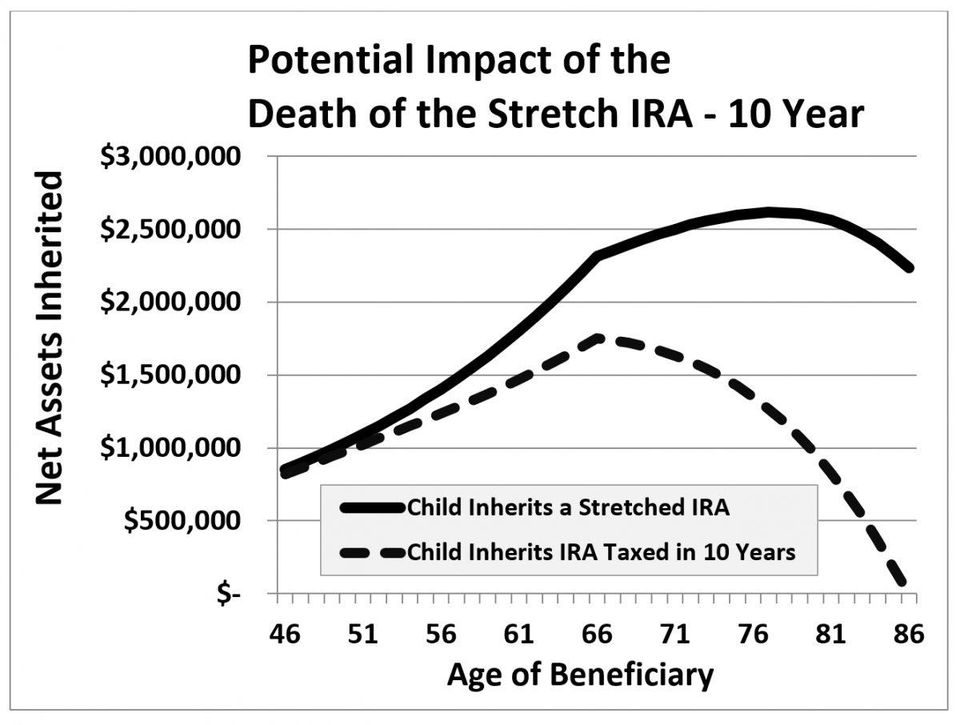
I know there are readers out there who are thinking “it can’t be all that bad”.  Yes, it is that bad.  Here is a graph that demonstrates the difference between you leaving a $1 million IRA to your child under the existing law, and under the SECURE Act:

Child Inherits Stretched IRA Under Existing Law versus Child Inherits 10 Year IRA Under SECURE Act Reprinted with Permission from Forbes.com for Pay Taxes Later website

Child Inherits Stretched IRA Under Existing Law versus Child Inherits 10 Year IRA Under SECURE Act – James Lange

This graph shows the outcome if a $1 million Traditional IRA is inherited by a 45-year old child, and the Minimum Distributions that he is required to take are invested in a brokerage account that pays a 7 percent rate of return.  Other assumptions are listed below*.  The only difference between these two scenarios is when your child pays taxes! The solid line represents a child who can defer (or “stretch”) the taxes over his lifetime under the existing rules. At roughly age 86, that beneficiary who was subject to the existing law in place still has $2,000,000+.  The dashed line represents the same child if he is required to take withdrawals under the provisions of the SECURE Act.  At age 86, that same beneficiary has $0. Nothing. Nada. The SECURE Act can mean the difference between your child being financially secure versus being broke, yet Congress is trying to gloss over this provision buried in the fine print. I don’t think so!

The House of Representatives passed the SECURE Act by an overwhelming majority, so the probability that the Senate will pass a version of this legislation is quite good. In 2017, the Senate Finance Committee recommended the Death of the Stretch IRA by proposing the Retirement Enhancement and Savings Act (RESA).  In true government fashion, RESA was unbelievably complicated. It allowed your non-spouse beneficiaries to exclude $450,000 of your IRA and stretch that portion over their lifetime – but anything over that amount had to be withdrawn within five years and the taxes paid. And if you had more than one non-spouse beneficiary, the amount that they’d be able to exclude from the accelerated tax would have depended on what percentage of your Traditional IRA they inherited.  Imagine trying to plan your estate distribution around those rules!

The Senate is now floating an updated RESA 2019 that seems to say that it will change the original exclusion amount to $400,000.  It will be a good change if it is passed.  That is because instead of each IRA owner getting a $400,000 exclusion, the new version includes language to allow a $400,000 exclusion per beneficiary. When I first read that provision I thought I had either read it wrong or that it was a typo.    That little detail would be extremely valuable (and make estate planning for IRAs and retirement plans far more favorable), especially for families with more than one child. But even in the Senate version, anything over and above that exclusion amount will have to be distributed (and the taxes paid) within five years of your death (instead of ten years like the House version).

Unfortunately, our “peeps” think the House version of the bill (which has a 10-year deferral period, but no exclusion) will be what eventually becomes law. This is particularly troubling because the Senate version would allow room for far more creative planning opportunities (and tax savings, because of the $400,000 per beneficiary exclusion).  As of the time of this post, Senator Cruz is attempting to hold up the bill, but his reasons have nothing to do with the fine print that affects Inherited IRAs.  The original version of the Act contained provisions about college tuition (Section 529) plans, but those provisions were stripped in the version the House voted on and Senator Cruz wants them restored.  Unfortunately, no one is arguing about the biggest issue with the SECURE Act, which is the massive acceleration of distributions and taxes on your IRA after your death.  And unless someone in Congress objects to the provision in the SECURE Act about Inherited IRAs, your non-spouse beneficiaries will find out the hard way that their elected officials have quietly arranged to pick your pockets upon your death.

I have been a popular guest on financial talk radio lately. Many of the hosts want to blame one political party or the other. I blame all of Congress. This is one of the few truly bipartisan bills that has potential devasting consequences, at least for my clients and readers, and it is highly likely to pass both sides of Congress.  I wonder how many of our legislators in the House actually read this bill or understood what is was they voted for.  Did they realize they are effectively—by accelerating income-tax collection on inherited IRAs and other retirement plans—imposing massive taxes on the families of IRA and retirement plans owners – even those with far less than a million dollars?    Or perhaps they did understand it and hoped that the American public wouldn’t.

If you can’t tell by my tone, I am upset. I am also motivated to examine every strategy that we can use to legally avoid, or at least mitigate, the looming hammer of taxation on your Traditional IRAs and retirement plans. I’m going to address these strategies in a series of posts, so please read them to see how this proposal could affect someone in your specific situation.  Even though the Senate version has a five-year tax acceleration instead of a ten-year, the Senate version could be better for most readers because of the value of the exclusion – especially if you have multiple beneficiaries.

Please check for follow-up posts on this subject.   I will show you some strategies to protect your family from the Death of the Stretch IRA and keep more of your hard-earned money in your hands.

James Lange

  • Assumptions used for Graph
  1. $1 Million Traditional IRA inherited by 45-Year Old Married Beneficiary
  2. 7% rate of return on all assets
  3. Beneficiary’s salary $100,000
  4. Beneficiary’s annual expenses $90,000
  5. Beneficiary’s Social Security Income at age 67 $40,000


The Potentially Dire Consequences to Your Legacy with the “Death of the Stretch” IRA

The Death of the Stretch IRA is rearing its ugly head again.


Death of the Stretch Inherited IRAs by James Lange CPA/Attorney in Pittsburgh, PAAs I have written about, this is personal to me. I was hoping that distributions from my Roth IRA and IRA would be “stretched” over the life of my daughter and maybe grandchildren.  It could make a difference of well over a million dollars to my family.

If you have a million dollar or more IRA or retirement plan, this threatened (but as yet not totally defined) legislation could be just as devastating to you and your family.  Once the two houses reconcile their differences (see the above post for the details of the different proposals), established estate plans will likely need to be reevaluated.  This threat increases the merits of Lange’s Cascading Beneficiary Plan or a similar flexible estate plan. It also creates an even greater incentive for IRA owners considering significant Roth IRA conversions.

I wrote two books on this topic based on the proposal that advanced through the Senate Finance Committee beginning in 2016. While the changes to IRA and retirement plan distribution rules weren’t included in the last set of tax changes (much to our surprise), clearly the idea still has a huge bipartisan appeal.

The action points in both books was to reconsider and revisit the idea of converting more of your IRAs to Roth IRAs. This is consistent with my most recent recommendations encouraging higher conversions because of the low income-tax rates we are currently enjoying.  The threat of losing the ability to stretch distributions from IRAs and retirement plans for generations only makes looking into Roth IRA conversions more compelling. If you have an IRA and/or other retirement plan and were hoping to leave it to your heirs with a favorable tax treatment and want to be kept up to date with this information, please call our offices at 412-521-2732.

The Death of the Stretch is Back On Congress’ Agenda

The Death of the Stretch is Back On Congress’ Agenda

This just in.

Stretch IRA James Lange Pittsburgh PennsylvaniaThe House is scheduled to vote on Thursday, May 23, 2019, on the SECURE ACT. Then, it will be in the Senate’s court to vote on RESA. Then the House and Senate will need to reconcile the differences between the bills. Experts, including us, think a compromise will be found and that the “stretch IRA” as we know it, will be gone, dealing a severe blow to IRA and retirement plan owners who were hoping their heirs would be able to continue deferring the distributions on their inherited IRAs and retirement plans for decades.
Here is the story so far.

In mid-April, Senate Finance Committee Chairman Chuck Grassley, R-Iowa, and ranking member Ron Wyden, D-Ore., reintroduced their Retirement Enhancement and Savings Act (RESA).

Under this bill, which we’ve been talking about since 2016, the account balance in a defined contribution plan or IRA must be distributed and included in income by the beneficiary five years after the employee’s or IRA owner’s death. Surviving spouses, beneficiaries who are disabled or chronically ill individuals, individuals who are not more than 10 years younger than the employee (or IRA owner), or the child of the employee (or IRA owner) who has not reached the age of maturity are excluded from this rule. Plus, an exception to the five-year distribution deadline is provided for each beneficiary to the extent that the balance of the account they receive from the deceased employee or IRA owner does not exceed $400,000.

Also in April, the House Ways and Means Committee passed a bill known as the Secure Act (Setting Every Community Up for Retirement Enhancement Act of 2019). What was remarkable about the Secure Act is that it was fast-tracked and approved with lightning speed, with the intention “To amend the Internal Revenue Code of 1986 to encourage retirement saving, and for other purposes.” And while it does include some incentives for people to participate in retirement plans, it also proposes the “death of the stretch IRA.” The House version of the bill differs from RESA in that it proposes a 10-year time limit on holding an inherited IRA or inherited Roth IRA or other defined contribution plan before all of the funds in the account must be distributed.  According to the summary provided by the House Committee on Ways and Means:

Section 401. Modifications to Required Minimum Distribution Rules: The legislation modifies the required minimum distribution rules with respect to defined contribution plan and IRA balances upon the death of the account owner. Under the legislation, distributions to individuals other than the surviving spouse of the employee (or IRA owner), disabled or chronically ill individuals, individuals who are not more than 10 years younger than the employee (or IRA owner), or child of the employee (or IRA owner) who has not reached the age of majority are generally required to be distributed by the end of the tenth calendar year following the year of the employee or IRA owner’s death.

We have been anticipating the death of the stretch IRA for years and wrote two books about its consequences.  We were pretty convinced it was going to be eliminated in the last round of tax law changes, and frankly, we were surprised when the limit on non-spouse heirs stretching distributions from inherited IRAs over their lifetimes was not included. But, it’s back, and once again the devil is in the details which will have to be hashed out between the two houses. In the next post, I will offer some insight into the consequences and preliminary recommendations.

If you have an IRA and/or other retirement plan and were hoping to leave it to your heirs with a favorable tax treatment and want to be kept up to date with this information, please contact our offices at 412-521-2732.

Protect Your Social Security from Cyber Criminals

Social Security Fraud Blog for PayTaxesLater.com
As many of you know, I am a strong proponent of waiting until age 70 to apply for Social Security, because I want both you and your surviving spouse to receive the highest benefit possible during your lifetimes. And one of the technical points about Social Security that I’ve never covered in detail in my books – because it’s only been in rare cases that I have recommended that my clients do it – involves applying for benefits retroactively. But in order to make you understand how your future Social Security benefits could be at risk from cyber criminals, I find myself in the strange position of having to give you a quick lesson on how retroactive benefits work.

Suppose that you could have applied for Social Security at your Full Retirement Age (FRA) of 66, but you took my advice and waited so that you can receive the highest benefit possible at age 70. When you turn 67, you go to your doctor for your annual physical. There, the doctor gives you some terrible news – you have six months to live! Now you’re cursing at me because you missed out on all of this Social Security money that you could have collected since you were 66 – or did you? Not necessarily. In certain instances, Social Security will allow you to apply for retirement benefits retroactively. If you qualify, Social Security will send you up to six months of retroactive benefits, paid as a lump sum.

A True Horror Story of a Social Security Fraud Victim

I won’t waste time telling you how you can qualify for retroactive benefits because it’s a complicated topic, and I will not recommend you do it because it will result in lower monthly benefits for the rest of your life. I am going to tell you something very important that you need to understand about retroactive benefits: if you are at least Full Retirement Age but are waiting until age 70 to file for Social Security so that you can earn Delayed Retirement Credits, your account may be compromised by cyber criminals who are trying to get their hands on any lump sum retroactive benefits to which you might be entitled, but have no intention of ever claiming. Here’s a real-life example of what I’m talking about:

I have a client who received an unexpected letter from the Social Security Administration. She and her husband had intended to hold off applying for benefits so that they could earn Delayed Retirement Credits. The letter they received, however, stated that Social Security had approved their request for a lump-sum retroactive benefit payment, which amounted to almost $12,000. Immediately my client and her husband went to their local Social Security office, and in the several hours spent there, discovered that the criminal(s) had called the office and pretended to be her husband. During the conversation, which was on a recorded line, the criminal simply said that he had changed his mind and wanted to apply for benefits retroactively! And the Social Security office complied with his request!

It Seems to Have Become Easier for Criminals

I found this situation to be so unbelievable that I called the Social Security office myself and asked how it could happen. What I learned might shock you. In order to access my client’s Social Security account, the criminals had to provide them with only the husband’s full name, date and place of birth, mother’s maiden name, and his current address and phone number. Personal information like this is widely available online through sites such as Facebook and Ancestry.com, not to mention what is available on the dark web thanks to the infamous Equifax hack in 2017.

My client spent hours at the Social Security office trying to put a hold on the “lump sum withdrawal,” and were assured that everything had been resolved. We thought that the criminals had been thwarted and everything was fine, but yesterday they received a 1099 from the Social Security Administration saying that they had received $12,000 in benefits that they needed to report on their tax return! So now we’re back to square one, and are still trying to get this mess sorted out. It’s bad enough that the IRS has been notified that they need to pay tax on money they never received, but now I’m wondering whether my client is still earning Delayed Retirement Credits after these criminals filed for benefits under his name!

How Can You Protect Yourself?

The bottom line is that you need to treat your Social Security account like a bank or investment account. Even though you might not think of it as being an asset, it is – because if a criminal manages to take control of it, the consequences could be costly and far-reaching. One way to protect yourself is to open an account with Social Security online, at this website: https://www.ssa.gov/myaccount/. Even if you do not plan to file for benefits in the near future, this action can prevent someone else from opening an account in your name without your knowledge. For your security you will be required to create a user name and password, and they’ll send a one-time security code to your email or phone.

Once you’ve established your account, you should check it periodically to make sure that information such as your name, address and phone number is correct. They also have a feature called “Block Electronic Access,” which prevents anyone (including you) from changing your personal information online or over the telephone. If you block access to your account and then change your mind, you have to ask Social Security to unblock it for you.
Years ago, the fear of Social Security theft was largely confined to the possibility of armed thugs waiting outside the bank for retirees who had just cashed their monthly checks. Unfortunately, criminals are constantly looking for ways to liberate you from your money, and their creativity can be surprising. Remember, protect yourself and your spouse by making sure that your benefits are safe – even if you don’t plan to apply in the near future!

Are you interested in learning more about Social Security maximization strategies? Visit our Social Security section of our website here for more information.