The SECURE Act: Is It Good For You Or Bad For You?

Is The SECURE Act Good for You or Bad For You by CPA/Attorney James Lange on Forbes.com

Will you be able to retire safely under the SECURE Act?


This blog post is republished with permission from Forbes.com

My previous post introduced the potential consequences of the SECURE Act, which is being promoted as an “enhancement” for IRA and retirement plan owners.  This is because it includes provisions allowing some workers to make higher contributions to their workplace retirement plans. I think it is a stinking pig with a pretty bow, so I wanted to give retirement plan owners the good and bad news about it.

I am a fan of Roth IRAs because they allow you to have far more control over your finances in retirement than you might have otherwise had.  You are not required to take distributions from your Roth IRA, but the good news is that they’re not taxable if you do take them.  These tax benefits can be a critical factor for seniors, especially if you are suddenly faced with costly medical or long term care bills.   Saving money in a Roth account can offer financial flexibility to many older Americans – and one good thing about the SECURE Act is that it can help you achieve that flexibility.  Here’s how.

The Good News About The SECURE Act

Under the current law, you are not allowed to contribute to a Traditional IRA after age 70½.  (You can contribute to a Roth IRA at any age as long as you have taxable compensation, but only if your income is below a certain amount.)  The age limitation for making contributions to Traditional IRAs is bad for older workers – and that’s an important point because the Bureau of Labor Statistics estimates that about 19 percent of individuals between the ages of 70 and 74 are still in the workforce.  The SECURE Act eliminates that cutoff and allows workers of any age to continue making contributions to both Traditional and Roth IRAs.

That same provision of the SECURE Act offers a hidden bonus – it means that it will also be easier for older high-income Americans to do “back-door” Roth IRA conversions for a longer period of time.  The back-door Roth IRA conversion, currently blessed by the Tax Cuts and Jobs Act, is a method of bypassing the income limitations for Roth IRA contributions.  The current law prohibits contributions to a Roth IRA if your taxable income exceeds certain amounts.  Those amounts vary depending on your filing status.   But even if you are unable to take a tax deduction for your Traditional IRA contribution, you can still contribute to one because there are no income limitations.  Why bother?  Because, assuming you don’t have any other money in an IRA, you can immediately convert your Traditional IRA to a Roth IRA by doing a back-door conversion.  That’s a good thing because the earnings on the money you contributed can then grow tax-free instead of tax-deferred.

Here’s more good news.  The current law requires Traditional IRA owners to start withdrawing from their accounts by April 1st of the year after they turn 70 ½.  These Required Minimum Distributions (RMDs) can be bad for retirees because the distributions are taxable.  The increase in your taxable income can cause up to 85 percent of your Social Security benefits to be taxed and can also move you into a higher tax bracket.  And once you begin to take RMDs, you are no longer allowed to make additional contributions to your account, even if you are still working.  The SECURE Act increases the RMD age to 72, a change which will allow Traditional IRA owners to save more for their retirements.

There’s a hidden bonus in this change as well.  Increasing the RMD age to 72 will allow retirees more time to make tax-effective Roth IRA conversions.  What does that mean?  Once you are required to take distributions from your Traditional IRA and your taxable income increases, you may find yourself in such a high tax bracket that it may not be favorable to make Roth IRA conversions at all.


How Does the Tax Reform Affect Retirees?

How does the Tax Reform Affect Retirees? Read More on https://paytaxeslater.com/how-does-the-tax-reform-affect-retirees/

How does the Tax Reform affect Retirees?

I was able to spend some time reading over the holiday, and of course much of my efforts were devoted to finding out how people were reacting to the new tax reform bill. In quick succession, I came across three articles published by three different media outlets. The first said that the tax reform would hurt poor people; the second insisted that the tax reform would hurt the middle class, and the third swore that the tax reform would hurt the rich. Many of our clients are retired, and they are asking “how will the tax reform affect me?” So I thought I would give you some ideas about how the tax reform might affect retirees.

One concern for retirees involves the changes made to the rules affecting Schedule A, Itemized Deductions. Will the tax reform affect you if you are retired, and you have been able to itemize? The short answer is that, depending on what and how much you deduct, the tax reform may affect you because some of the itemized deductions were reduced or even eliminated. Let’s look at specifics.

Tax Reform and Medical Expenses

Many retirees have high medical costs – and the good news is that medical expenses will still be deductible in 2017 assuming that they exceed a certain threshold. What makes this statement less than straightforward, though, is that there were two different thresholds when you did your taxes last year. Prior to the tax reform, individuals who were younger than age 65 had to have medical expenses that exceeded 10% of their adjusted gross income in order to be able to use the deduction.

If you or your spouse were 65 or older, though, the threshold was lower – only 7.5%. And whatever your age, you could only deduct the medical expenses that were in excess of your threshold. The bottom line for retirees? If you itemize, tax reform shouldn’t affect your medical deductions unless both you and your spouse are younger than 65 years old. The tax reform may actually benefit younger individuals who have high medical costs because, starting in 2017, everyone regardless of their age will have to meet a threshold of only 7.5% before they can deduct any medical expenses.

Tax Reform and Property Taxes

Many retirees could be affected by the changes in state and local tax (or, SALT) itemized deductions. Through 2017, you can deduct all of your state, local, real estate, sales and personal property taxes on Schedule A if you itemize. In 2018, those deductions will be capped at $10,000. How does this affect retirees? It depends. If you didn’t deduct these expenses because you used the standard deduction last year, this provision in the tax reform won’t affect you at all.

But if your income is high enough that it is subject to state and local tax, or if you own a home on which you pay high property taxes, any deduction that you might be able to take after the tax reform could be reduced. If this sounds like you, you will need to check the Schedule A on your prior year return to see exactly how much of the taxes you paid were deductible in the past. The tax reform could affect you negatively if you’ve been able to deduct more than $10,000 because, starting in 2018, your deduction will be limited to that amount.

Tax Reform and Mortgage Interest

Many retirees prefer to have the mortgages on their homes paid off before they leave the work force. If that’s you, the changes to the mortgage interest deduction rules, by themselves, shouldn’t affect you. Prior to the tax reform, married couples could deduct the interest they paid on mortgages that were less than $1,000,000. Under the tax reform, that mortgage limit is lowered to $750,000 – which means that individuals who have large mortgages may not be able to deduct as much of the interest as in the past. If you are retired, this change should not affect you unless you are planning to buy a new home in 2018 or later. If you do buy a new home and finance more than $750,000 (and you itemize) you will not be able to deduct as much as you would have prior to the tax reform.

Tax Reform and Miscellaneous Deductions

How about miscellaneous itemized deductions? The big ones for my clients are their investment account fees and, in some cases, employee business expenses, but includes smaller deductions such as tax preparation fees and safety deposit box fees. The new law temporarily repeals all of those, so if you itemize and have taken advantage of them in the past, the tax reform may hurt you in this area of your return.

Tax Reform and Charitable Contributions

What about charitable contributions? The tax reform will not affect charitable contributions at all. If you don’t itemize, your charitable contributions weren’t deductible in prior years and so nothing has changed for you. If you do qualify to itemize, contributions that you make to legitimate charities will still be deductible in 2018.

This leads me to my big finale! My theme throughout this post has been, “assuming that you qualify to itemize”. Even if you were able to itemize in the past, you may not need to itemize after the tax reform because the standard deduction (or, the amount that the government gives to everybody with no strings attached) has almost doubled. In 2017, the standard deduction for married couples filing jointly is $12,700 but in 2018 it will be $24,000. So even if you fall into one of the categories where you believe the tax reform might initially hurt you – for example, if you have a significant amount of investment account fees that are no longer deductible – it might be a moot point if the government is going to just give you more than what you would have gotten by itemizing anyway.

Confusing? You bet! So please bear with us during tax season as we try to sort this out!

Stop back soon!

-Jim

Learn how Jim Nabors saved $4.8 Million by marrying his husband.

Jim Nabors Saved $4.8 Million in Taxes By Marrying His Husband

How Jim Nabors saved $4.8 Million in taxes by marrying his husband. Courtesy of PayTaxesLater.com


Jim Nabors: Actor, Singer, and Comedian

On November 30, 2017, Jim Nabors, perhaps most famous for his role as Gomer Pyle, died at the age of 87.  Jim is survived by his husband Stan Cadwallader, whom he married in 2013. Their marriage came one month after same-sex marriages became legal in Washington State.

It is quite eye-opening to look at the tax consequences of their decision to get married; Mr. Nabors died with a $13M estate.  The terms of his will are not public, but for the sake of argument let’s assume he left his estate to his husband. Because of the marriage, no Federal or Hawaiian estate or inheritance taxes are due at death because of the unlimited marital deduction.

Smart Estate Planning

If Jim and Stan had remained unmarried partners the payout to the Government would have been astronomical. A $3,000,000 payment in federal estate taxes alone is bad enough. A payment of over $1,800,000 in Hawaiian inheritance taxes would add a total of $4,800,000 in total taxes. These numbers don’t include the income taxes that will be saved because of the longer “stretch” a spouse receives on an inherited IRA or retirement plan.

The moral of the story is that for many life-long partners, gay or straight: Get Married for the Money.  Obviously the decision to marry hinges on more than whether marriage is a financially strategic move. But if you are simply avoiding the formalities, it might make sense to think about the long-term tax consequences on your financial security—for both you and your partner. Marriage is usually a big plus for purposes of Social Security, especially if one partner has a much stronger earnings record than the other partner.

More Information Is Always Available

For more information visit www.paytaxeslater.com. To schedule an appointment with Jim Lange, please call his office at 412-521-2732. You can always contact Jim at jim@paytaxeslater.com.

James Lange, CPA/Attorney of Lange Financial Group, LLC, is the author of several books on retirement and estate planning, including Live Gay, Retire Rich.  His books on retirement strategies have been endorsed by Charles Schwab, Larry King, Jane Bryant Quinn, Ed Slott, and many more.  He hosts a weekly financial show on KQV News Radio in Pittsburgh. PA.


Tax Cuts and Jobs Act of 2017: Ten Huge Take-Aways

Ten Huge Take-Aways from the Tax Cuts and Jobs Act by Jim Lange


Ten Huge Take-Aways from the Tax Cuts and Jobs Act of 2017

by James Lange, CPA/Attorney

The first thing to consider about the proposed Tax Cuts and Jobs Act is that it is just a proposed tax bill.  It is possible it will face stiff resistance in the Senate and possibly get no votes from the Republicans.  Jeff Flake, John McCain, Bob Corker, and Lisa Murkowski might be on that list of Republican “no” votes. So, like health care it is possible, and even likely, that nothing will happen this year and maybe not in the foreseeable future.

Depending on your personal circumstances, the Tax Cuts and Jobs Act of 2017 could be good or bad for your family.  Critical factors like how many children you have, whether you live in a high-tax state and itemize your deductions or take the standard deduction, whether you own a home or are looking to buy one could sway you from benefiting from these changes or suffering from them.

In fact, there are so many variables to consider that it is difficult to make a blanket statement that the proposal will offer you tax relief.  Corporate America is a clear winner. Reducing the corporate tax rate from 35 to 20 percent, Speaker Paul Ryan argues, will create more jobs and drive up wages.  But critics, even Republican critics, say it is not a given that companies will pass their savings on to workers vs. shareholders through higher dividends.

However, the bill as it stands now is far from becoming law.  Ultimately, the Senate will introduce more changes and what we will end up with and whether it will pass are still great unknowns.  But, going forward it will still be helpful to understand some of the main provisions the bill advances so you can begin to assess the impact on you and your family.

Champions and underdogs in the Tax Cuts & Jobs Act of 2017:

  1. This doesn’t appear to be an overall tax-cut for the middle class, as promised. What we see in this bill is a tax cut for some, and a tax hike for others.  As usual, it all depends on how much you make, how you earn your living, where you live, the mortgage on your home, your property taxes, student loans, etc.  The Tax Policy Center commented that the bill wasn’t really tax reform but rather it was more of a complicated tax cut.  We have compared differences for different hypothetical clients and the results were less dramatic than we thought.  In one case, the elimination of the alternative minimum tax was helpful, but the dis-allowance of state and local income taxes netted out to a tax increase for one client.
  2. The bill reduces the number of tax brackets from seven to four. Currently the brackets are 10-15-20-28-33-35-39.6%.  Under the new provisions there will be a zero bracket (in the form of an enhanced standard deduction according to the bill), and from there the brackets will be 12-25-35-36.9%.  Here is how they break down:
2017 Single Filer 2017 Married Filing Jointly 2017 Head of Household
$0- $9,325 – 10% $0-18,650 – 10% $0- $13,350 – 10%
$9,326- $37,950 – 15% $18,651- $75,900 – 15% $13,351- $50,800 – 15%
$37,951- $91,900 – 25% $75,901- $153,100 – 25% $50,801- $131,200 – 25%
$91,901- $191,650 – 28% $153,101- $233,350 – 28% $131,201- $212,500 – 28%
$191,651- $416,700 – 33% $233,351- $416,700 – 33% $212,501- $416,700 – 33%
$416,701-$418,400 – 35% $416,701- $470,700 – 35% $416,701- $444,550 – 35%
$418,401 + – 39.6% $470,701+ – 39.6% $444,551 + – 39.6%


Proposed Single Filer Proposed Married Filing Jointly Proposed Head of Household
$0-$44,999 – 12% $0-$89,999 – 12% $0-$67,499 – 12%
$45,000-$199,999 – 25% $90,000-$259,999 – 25% $67,500-$229,999 – 25%
$200,000-$499,999 – 35% $260,000-$999,999 – 35% $230,000-$499,999 – 35%
$500,000+ – 39.6% $1,000,000+ – 39.6% $500,000+ – 39.6%

Additionally, the bill would eliminate the alternative minimum tax (AMT), a second tax calculation for people earning about $130,000 which reduces the impact of many tax breaks.

  1. The bill doubles the current standard deduction, giving $12,000 to single filers, $24,000 for married filing jointly, and $18,000 for heads of household.
  1. But before you get too excited about a larger deduction, they’ve decided to repeal the personal exemption—currently $4,050 per person—and the deductions for state and local taxes. So, it isn’t as much of a break as you think it is.
  1. They are taking away one of our favorite, and edgiest strategies. No more recharacterization of Roth IRAs. If you’ve heard me talk about Roth IRAs, you’ve probably heard me mention recharacterization.  The ability to recharacterize, basically undo the Roth conversion, adds enormous flexibility in our Roth IRA conversion planning.  This will mean that the days of do-it-yourself Roth IRA conversion calculations will be highly risky.  Having a professional you can trust, who knows the system in and out, and who has the experience to get it right will become incredibly important.
  1. Taxpayers with a net worth of $10 million or more (and their children) have a reason to cheer as the plan almost doubles the current federal estate tax exemption from $5,490,000 to $10,000,000 per individual, with spouses exempt from any limits. The Joint Committee on Taxation has commented that this provision, while being a boon for business owners and wealthier Americans will reduce the federal revenue by around $172 billion over 2018-2027.  Oh, yeah…and after 2023, the estate tax will be repealed all together.  Compensating for that loss of revenue is a huge stumbling block for the proposed tax reform.  Though hard to confirm, rumor has it that originally they were going to eliminate the estate tax entirely but put this provision in to secure the support of Alaska.
  1. While the bill does simplify many areas, it also complicates many areas. It is not a major tax simplification.  I do not fear that our CPA firm will lose business because clients will find it so easy to complete their tax returns.
  1. While corporations and businesses will see a reduced corporate tax rate—from 35% to 20% – it will come with a price¾a much more involved and complicated filing process. New anti-abuse rules, complicated multi-national corporation rules, new tax treatments on interest, and changes in international income rules will make navigating your business tax return much more difficult.  Shareholders of pass through entities, like Subchapter S corporations will get a big break, but the complications for claiming that break are considerable.
  1. The Act is silent on the Death of the Stretch IRA. We still aren’t sure if and when this will happen.  It is very possible that they are holding it in reserve to for future negotiations pertaining to reducing the deficit.  The tax cuts in this bill will massively reduce federal revenue.  We’re talking in the trillions of dollars here.  To get any version of this to pass, it is very likely that the GOP will have to come up with ways to offset some of the deficit.  Killing the ability to stretch IRAs and retirement plans for generations is one way to do that.
  1. Even the Republican’s admit that this bill will increase the deficit by $1.5 trillion dollars over the next ten years, and that is a huge issue. Critics on both sides see increasing the deficit as unacceptable.  Further, the Tax Policy Center and other tax policy commentators on both sides of the aisle think that this estimate is too low or too high, and many do not believe that this bill will provide the economic growth or tax-relief promised to the middle class.

If you want to read an excellent 82-page summary of the bill, check out The Fiscal Times online:

http://www.thefiscaltimes.com/2017/11/02/Read-House-GOPs-Tax-Bill-or-Summary-Key-Points

If you are looking for more of a brief overview summary, these are excellent resources:

https://taxfoundation.org/details-tax-cuts-jobs-act/

http://www.taxpolicycenter.org/taxvox/house-gop-tax-bill-mostly-business-tax-cut-will-create-new-winners-and-losers

As I mentioned above, this bill is simply the first iteration of what the final bill might look like, and it isn’t clear that anything in it is going to become law.  But it bears some scrutiny since some of the main points are likely to provoke debates.  We will continue to watch as the process evolves.  We might even have to interrupt our series on Lange’s Cascading Beneficiary Plan once again!  If that happens, I hope you will bear with us.  But unless there is major news, we will see you next week as we continue exploring the advantages of the LCBP

Disclaimer: Please note that the Tax Cuts and Jobs Act of 2017 removed the ability for taxpayers to do any “recharacterizations” of Roth IRA conversions after 12/31/2017. The material below was created and published prior the passage of the Tax Cuts and Jobs Act of 2017. 

How will your Required Minimum Distributions Work After the Death of the Stretch IRA Legislation?

What does your required minimum distribution look like now and after the Stretch IRA is no more?

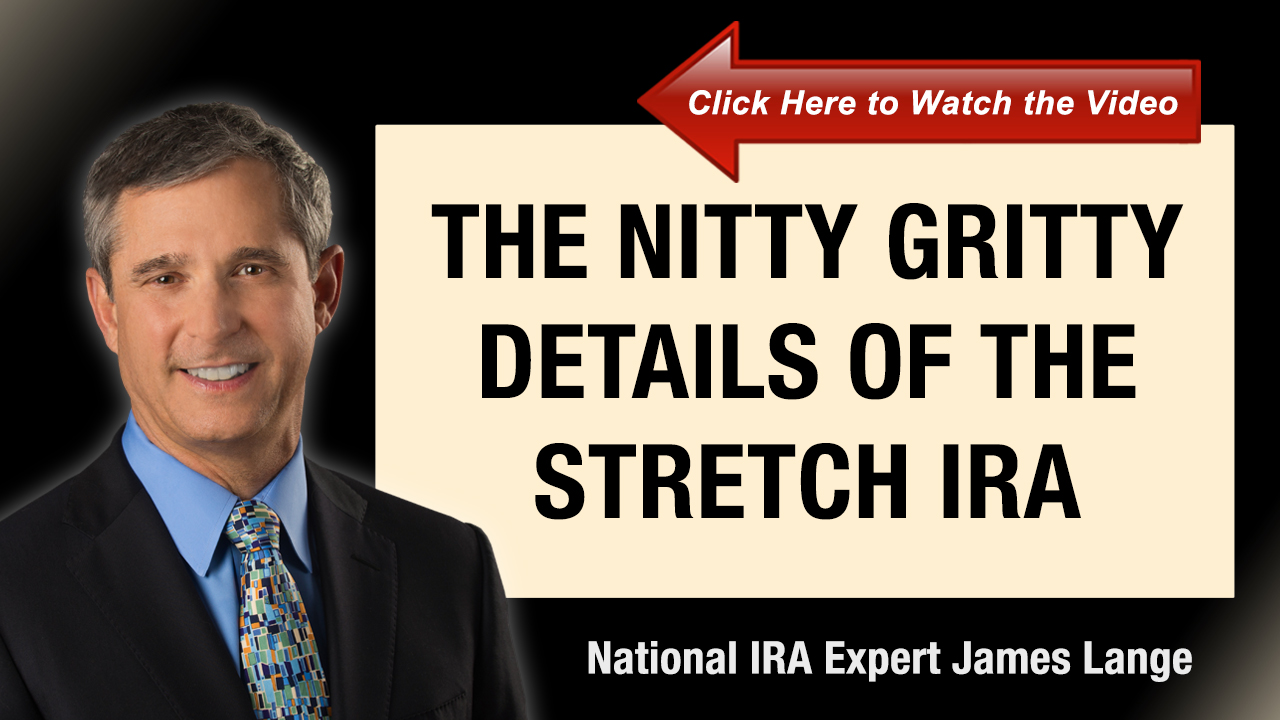
The Nitty Gritty Details of the Stretch IRA James Lange

Those of you who have read by books know that I am a believer in paying taxes later, rather than paying taxes now. Even if you do your best to stick to that game plan, though, you will eventually have to withdraw money from your IRAs and qualified retirement plans because the IRS wants their tax money. This post goes into the nitty gritty details of how those required minimum distributions are calculated, and how you can use the current rules to your advantage.

How do the required minimum distribution rules affect you?

As of this writing, you’re required to begin taking distributions from your IRAs by April 1st of the year following the year that you turn 70½. The IRS won’t let you decide how much you want to take out. In their Publication 590, they spell out the rules, provide factors that you have to use, and let you know how much it will cost you in penalties if you don’t do the math right. There are three tables that they have created that contain the factors you have to use. The most popular is Table III, which is for unmarried individuals and married individuals whose spouses are not more than 10 years younger. Table II is for IRA owners who have spouses who are 10 or more years younger, and Table I is for beneficiaries of IRAs. The factors in those tables are based on an average life expectancy and have nothing to do with your own health and life expectancy. So when you turn 70 ½, you have to look up the factor that you must use, divide it into your IRA balance as of December 31st, and that will give you the required minimum distribution you must take by April 1st.

These required minimum distributions can cause huge problems for retired people because they can increase your tax bracket, cause more of your Social Security to be taxed, and even make your Medicare premiums go up. And while you can’t generally avoid them while you’re living (unless you continue to work), you can use the rules to your advantage to minimize the tax bite that your surviving spouse and children will have to pay. Under the current rules, your children are allowed to take only the required minimum distributions from your IRA after your death. The good news is that, since they have a longer life expectancy, their required minimum distributions will be lower. Keeping more money inside the tax shelter of the IRA for a longer period of time is what the Stretch IRA is all about.

If you’ve always been the kind of person who enjoys numbers, then you may find this short video interesting. It walks you through required minimum distribution calculations for your own IRA or retirement plan, as well as the calculations your beneficiaries will use after your death. It also discusses the tax implications of those distributions. The Senate Finance Committee, though, has voted 26-0 to eliminate the Stretch IRA for most beneficiaries. When it is enacted into law, your children will have to withdraw your IRA and pay tax on it within five years. Even your Roth IRAs aren’t safe – your children will have to withdraw the entire Roth account within five years of your death. And even though withdrawals from Roth accounts aren’t taxable, the greater loss is that the future growth on your IRA money will no longer be tax-free.

This is big news, and I want to make sure that you stay informed about the latest developments. Please stop back soon!

-Jim

For more information on this topic, please visit our Death of the Stretch IRA resource.


P.S. Did you miss a video blog post? Here are the past video blog posts in this video series.

Will New Rules for Inherited IRAs Mean the Death of the Stretch IRA?

Are There Any Exceptions to the Death of the Stretch IRA Legislation?

How will your Required Minimum Distributions Work After the Death of the Stretch IRA Legislation?

Can a Charitable Remainder Unitrust (CRUT) Protect your Heirs from the Death of the Stretch IRA?

What Should You Be Doing Now to Protect your Heirs from the Death of the Stretch IRA?

How Does The New DOL Fiduciary Rule Affect You?

Why is the Death of the Stretch IRA legislation likely to pass?

The Exclusions for the Death of the Stretch IRA

Using Gifting and Life Insurance as a Solution to the Death of the Stretch IRA

Using Roth Conversions as a Possible Solution for Death of the Stretch IRA

How Lange’s Cascading Beneficiary Plan can help protect your family against the Death of the Stretch IRA

How Flexible Estate Planning Can be a Solution for Death of the Stretch IRA

Save

Save

Save

Save

Save

Will New Inherited IRA Rules Wipe Out your Retirement Savings?

The Ultimate Retirement and Estate Plan for Your Million-Dollar IRA BookAs election time nears, we’re being bombarded with the usual campaign promises from both sides: “Vote for me, and I will fix the country’s financial problems!” Sound familiar? Well, I listen to campaign promises with a cynical ear. Being a financial guy, I’m the one who always looks at the numbers to figure out how they’re planning to pay for all of these grand plans! So I wanted to let my readers know that there is a proposal in the works that just might allow these politicians to pay for all of these things that they promise us. There has been legislation has been written that, if passed, will funnel billions of dollars in revenue into the government coffers. It doesn’t create fair trade agreements or increase taxes on the wealthy. What it does do is accelerate the income tax on your previously untaxed IRAs and retirement accounts! And if this proposed legislation is passed, the cost to your beneficiaries could be devastating.

I am so concerned about the proposed change to the Inherited IRA rules that I have written a new book called “The Ultimate Retirement and Estate Plan for Your Million Dollar IRA.” The book discusses the government’s plan in detail and shows you why it will be so costly for your beneficiaries. Better yet, it offers solutions that you can implement if the proposed legislation is passed.

The book will be available through Amazon on Monday, November 28, 2016, and I encourage you to reserve a copy now by clicking here. I will be posting some general details on my blog about the proposed new inherited IRA rules, but you need to read the book to understand the scope of the problem.
Please stop back soon!

Jim

Save

Save

Save

Save

Save

Save

Donations to Charity: Is There Still a Tax Benefit if I Donate?

donations-to-charity-james-lange-the-roth-revolution-blogImagine 100 years in to the future: Two people are playing a word association game. One player gives the clue, “Bill Gates.” Today, you’d probably say, “The founder of Microsoft,” right? Well, I’m going to go out on a limb and suggest that, 100 years from now, Microsoft’s importance will have faded because of ever-evolving technology and many people will not recognize the company name, much less know who its founder was. However, I’m confident that Bill Gates will still be a household name. Why? It is because Bill and his wife Melinda have donated, and continue to donate, the vast majority of their immense wealth to charity. The impact of their generosity is astonishing. Thanks to their largesse, it is possible – maybe even likely – that diseases such as malaria will be eradicated within our lifetimes. Certainly, their philanthropy will save millions of lives, and improve the lives of virtually everyone on the planet. My own charitable gifting is nowhere near the scale of Bill and Melinda’s, but, even so, I can see how my donations benefit others. And it makes me happy to think that I can make someone else’s life better, even in my own small way.

The American Taxpayer Relief Act of 2012 reinstated a phase-out of itemized deductions for high income taxpayers. For those individuals, it meant that they were unable to receive the full benefit of their charitable contributions on their tax returns, and they were very unhappy. A few taxpayers didn’t care. I have a client who donates an unusually significant amount of her annual income to charity every year, and who steadfastly refused to give me a list of the donations so that I could deduct them on her tax return. She felt that it was morally wrong for her to receive any benefit from them. It was an admirable position, to be sure, but then I pointed out that the government does not do a very good job of dealing with social problems in this country. I told her that I believe that the reason charities don’t have to pay taxes is because they do a much more efficient job of distributing money and services to the needy than our government does. Under those circumstances, it seemed wasteful to me to not deduct the donations. She listened to me, and the following year presented me with hundreds of donation receipts, which I deducted on her return. She received a significant tax refund, which she promptly used to donate even more to charity!

If donating to charity is important to you, you may find it worthwhile to review the ideas discussed in Chapter 18. Many readers will be surprised to learn that there are strategies available that can give them far more bang for their charitable buck than they may have thought possible. Charitable gifting does not necessarily have to come at the expense of family members either, and in some instances it may even benefit them! Your distant dreams of establishing a scholarship fund, building a bicycle trail, or providing ongoing medical care to people in need are more achievable than you may realize. The secret is to take advantage of all of the gifting strategies that are available to you.

See you soon!

Jim

Jim Lange, Retirement and Estate Planning A nationally recognized IRA, Roth IRA conversion, and 401(k) expert, he is a regular speaker to both consumers and professional organizations. Jim is the creator of the Lange Cascading Beneficiary Plan™, a benchmark in retirement planning with the flexibility and control it offers the surviving spouse, and the founder of The Roth IRA Institute, created to train and educate financial advisors.

Jim’s strategies have been endorsed by The Wall Street Journal (33 times), Newsweek, Money Magazine, Smart Money, Reader’s Digest, Bottom Line, and Kiplinger’s. His articles have appeared in Bottom Line, Trusts and Estates Magazine, Financial Planning, The Tax Adviser, Journal of Retirement Planning, and The Pennsylvania Lawyer magazine.

Jim is the best-selling author of Retire Secure! (Wiley, 2006 and 2009), endorsed by Charles Schwab, Larry King, Ed Slott, Jane Bryant Quinn, Roger Ibbotson and The Roth Revolution, Pay Taxes Once and Never Again endorsed by Ed Slott, Natalie Choate and Bob Keebler.

If you’d like to be reminded as to when the book is coming out please fill out the form below.

Thank you.

Save

Required Minimum Distributions: The Government Wants Their Money!

Required Minimum Distributions, The Government Wants Their Money, James Lange - The Roth Revolution BlogOver the years, I’ve met with many clients who have managed to accumulate small fortunes over the course of their working careers – even though their incomes were never even high enough to put them in the top two or three tax brackets. I call these clients my “savers.” These individuals seem to share one trait – mainly that they simply don’t feel the need to spend money if they don’t have to. Instead, they set the money aside for the times when they absolutely must spend and, more often than not, they spend far less than what they could.

It’s these clients who seem to suffer the greatest shock when they turn 70 ½ and are required to start withdrawing money from their qualified retirement plans. They object, “But I don’t need the money! I just want to leave it sit there in case I need it some day!” And I have to tell them that it doesn’t matter if they need the money or not. The money that they squirreled away in their retirement plans for a rainy day has grown all these years without being taxed, and now the government wants their tax money!

There’s no avoiding the Required Minimum Distribution rules on traditional retirement plans. Failure to take a distribution when required, in fact, will cost you a penaly tax of 50% on the amount not withdrawn. Individuals who hate the RMD rules and have a spiteful streak might enjoy an interesting (and legal) tip presented in Chapter 5 that allows them to take advantage of the withholdings on the distribution to wait until the very last minute to pay the IRS their due, while also avoiding a late payment penalty. They can also learn of a possible way to completely avoid tax on their Required Minimum Distributions – and also a general increase in their tax bracket – by sending their RMD direct to a charity. I encourage everyone, though, to read Chapter 5 so that you have a good understanding of the RMD rules. Later chapters address proposed legislative changes to the rules that may not strike you as being significant, and unless you have a good understanding of how they currently work.

My next post will talk about rolling your old retirement plan to an IRA. There have been a lot of changes in the laws about this, so I hope you will stop back to get a summary of what you can expect.

Happy Reading!

Jim

Jim Lange A nationally recognized IRA, Roth IRA conversion, and 401(k) expert, he is a regular speaker to both consumers and professional organizations. Jim is the creator of the Lange Cascading Beneficiary Plan™, a benchmark in retirement planning with the flexibility and control it offers the surviving spouse, and the founder of The Roth IRA Institute, created to train and educate financial advisors.

Jim’s strategies have been endorsed by The Wall Street Journal (33 times), Newsweek, Money Magazine, Smart Money, Reader’s Digest, Bottom Line, and Kiplinger’s. His articles have appeared in Bottom Line, Trusts and Estates Magazine, Financial Planning, The Tax Adviser, Journal of Retirement Planning, and The Pennsylvania Lawyer magazine.

Jim is the best-selling author of Retire Secure! (Wiley, 2006 and 2009), endorsed by Charles Schwab, Larry King, Ed Slott, Jane Bryant Quinn, Roger Ibbotson and The Roth Revolution, Pay Taxes Once and Never Again endorsed by Ed Slott, Natalie Choate and Bob Keebler.

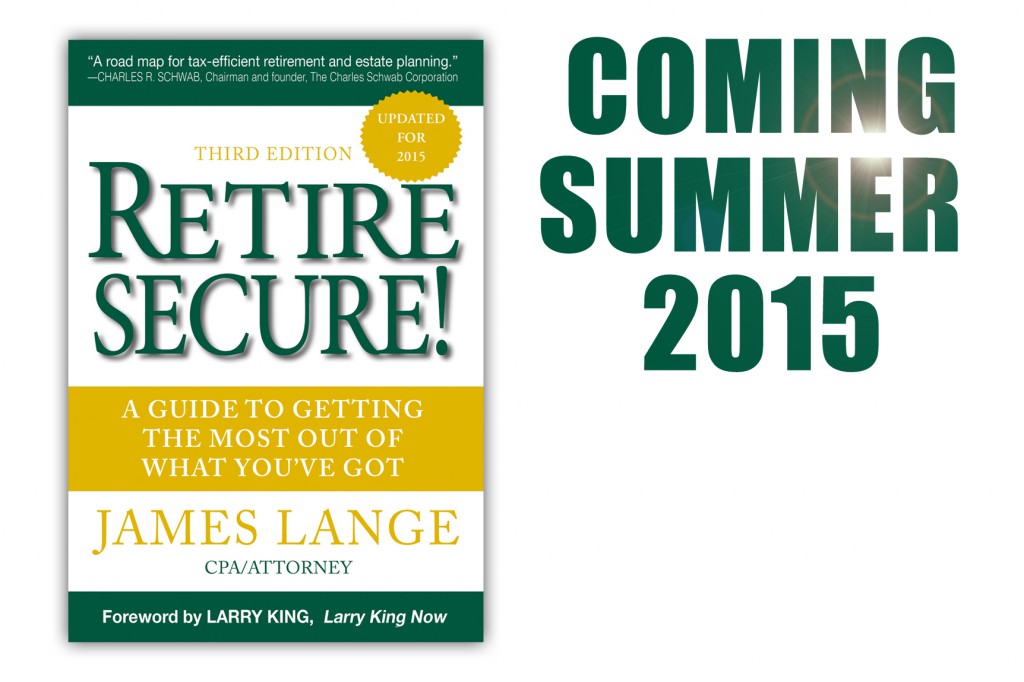
If you’d like to be reminded as to when the book is coming out please fill out the form below.

Save

Which Is Better the Traditional or the Roth IRA

Retire Secure! Third Edition, A Guide To Making The Most Out Of What You've Got, James Lange
A theme which appears consistently throughout the third edition of Retire Secure! is the question of which is better – the traditional or Roth IRA. Changes in the law since Edition Two was written, as well as additional changes that our current administration is pressing for, make it the million dollar question.

In order to answer the question, we dedicated Chapter 2 to comparing the pros and cons of each type of account as they exist under the current law. If you are not familiar with the rules of each IRA account, it is probably worth your time to read this chapter. Subsequent chapters address the proposed changes to the rules, and how they might affect your decision when reviewing your retirement plan options. And, due to popular demand, I’ve added a section about the IRS ordering rules, which explains how to avoid tax and penalty if you need to withdraw money from a Roth account before five years has passed.

The IRA illustrations were calculated using a 6% rate of return, and the maximum contribution amount as established by the IRS. We also ran an illustration that shows, for those who don’t have a lot of time left to save, the difference in the accounts when contributions are made for a very limited number of years.

A final note about tax brackets: when Edition Two was written, the maximum tax rate was 35%. Subsequent changes in the tax laws increased the maximum rate to 39.6%. This difference of almost 5% is more significant than you might think. The impact of the increased tax brackets is discussed in detail in subsequent chapters, but the concept is first introduced in Chapter 2.

Check back soon for an update on Chapter 3!

Jim

Jim Lange A nationally recognized IRA, Roth IRA conversion, and 401(k) expert, he is a regular speaker to both consumers and professional organizations. Jim is the creator of the Lange Cascading Beneficiary Plan™, a benchmark in retirement planning with the flexibility and control it offers the surviving spouse, and the founder of The Roth IRA Institute, created to train and educate financial advisors.

Jim’s strategies have been endorsed by The Wall Street Journal (33 times), Newsweek, Money Magazine, Smart Money, Reader’s Digest, Bottom Line, and Kiplinger’s. His articles have appeared in Bottom Line, Trusts and Estates Magazine, Financial Planning, The Tax Adviser, Journal of Retirement Planning, and The Pennsylvania Lawyer magazine.

Jim is the best-selling author of Retire Secure! (Wiley, 2006 and 2009), endorsed by Charles Schwab, Larry King, Ed Slott, Jane Bryant Quinn, Roger Ibbotson and The Roth Revolution, Pay Taxes Once and Never Again endorsed by Ed Slott, Natalie Choate and Bob Keebler.

If you’d like to be reminded as to when the book is coming out please fill out the form below.

Save

Retire Secure! Third Edition: The Rate of Return You Earn Makes a Big Difference

Retire Secure A Guide to Getting the Most Out of What You've Got, James Lange 2015

I love it when clients give me feedback, good or otherwise. When I wrote the second edition of Retire Secure!, I got a lot of complaints about the fact that our calculations assumed an investment rate of return of 8%. Our more conservative clients told me that 8% was just not realistic for them, and that our numbers must therefore be inaccurate.

Chapter 1 compares the difference between saving in pre-tax and after-tax accounts, but in order to keep those conservative clients happy, the assumed rate of return has been lowered to 6%. As expected, the difference in the two accounts was not quite as dramatic as when we used an 8% rate of return, but the results showed that it is still better to save using a pre-tax account. Then we looked at the significant reduction in the wealth accumulated by both savers and, being the number crunchers that we are, we said, “What do they have to do in order to get that wealth back?” The answer was to increase the amount contributed to the account each year and the rate of return you earn makes a big difference over the long term.

Do you want to teach your children and grandchildren the benefits of starting to save early in their lives? We introduce two new types of retirement savings plans that make it possible for low-income taxpayers such as students to contribute to a retirement account that has no fees and very low minimum contributions. There is also a new section devoted to a discussion on the growing trend of using loans against retirement plans to pay for expenses such as college education. It must be okay because it’s your own money, right? Read Chapter 1 to learn the pros and cons of this strategy.

Have you been seeing the term “underfunded pension plan” a lot lately? If you haven’t, you might want to Google that term and look at what comes up. The number of underfunded pension plans in this country has reached an alarming level, and, even if you are eligible for benefits under such a plan, you might want to consider establishing a back-up plan. Chapter 1 addresses this problem.

Check back soon, and I’ll give you can idea of what you can expect in Chapter 2!

Thanks,

Jim

Jim Lange A nationally recognized IRA, Roth IRA conversion, and 401(k) expert, he is a regular speaker to both consumers and professional organizations. Jim is the creator of the Lange Cascading Beneficiary Plan™, a benchmark in retirement planning with the flexibility and control it offers the surviving spouse, and the founder of The Roth IRA Institute, created to train and educate financial advisors.

Jim’s strategies have been endorsed by The Wall Street Journal (33 times), Newsweek, Money Magazine, Smart Money, Reader’s Digest, Bottom Line, and Kiplinger’s. His articles have appeared in Bottom Line, Trusts and Estates Magazine, Financial Planning, The Tax Adviser, Journal of Retirement Planning, and The Pennsylvania Lawyer magazine.

Jim is the best-selling author of Retire Secure! (Wiley, 2006 and 2009), endorsed by Charles Schwab, Larry King, Ed Slott, Jane Bryant Quinn, Roger Ibbotson and The Roth Revolution, Pay Taxes Once and Never Again endorsed by Ed Slott, Natalie Choate and Bob Keebler.

If you’d like to be reminded as to when the book is coming out please fill out the form below.

Save

Save