
Trusts as Beneficiaries of Retirement Plans: A Possible Alternative to the Stretch IRA?

trusts james langeIf you’ve read my earlier posts, you know that much of the new edition of Retire Secure! addresses the ramifications of the legislation that, if passed, will kill the Stretch IRA. If this potential change is a concern for your family, then Chapter 17 is a “must-read” for you because it offers a possible alternative that will allow them to continue the tax deferral of your retirement plan for many years.

Trusts may be appropriate in many situations. We use them for young beneficiaries who, by law, cannot inherit money, and for older beneficiaries who can’t be trusted with money. Trusts can also be used to help minimize taxes at death (although this is not as common as in previous years). With more frequency, though, our office is using trusts to replace the benefits of the Stretch IRA. This application started when all of these campaigns to kill the Stretch IRA began, and we began to seek alternatives for our clients. Chapter 17 compares the value of an IRA assuming that the non-spouse beneficiary must withdraw the proceeds within 5 years, to the value of an IRA when it is protected by a specific type of trust. I think you will find the results very surprising.

The rules governing trusts are very complex, and, if you are interested in incorporating them in to your own estate plan, you will need the assistance of a competent professional.

Do you donate to charity? If so, my next post will cover the changes in the laws that affect charitable contributions.

All the best,

Jim

Jim Lange, Retirement and Estate Planning A nationally recognized IRA, Roth IRA conversion, and 401(k) expert, he is a regular speaker to both consumers and professional organizations. Jim is the creator of the Lange Cascading Beneficiary Plan™, a benchmark in retirement planning with the flexibility and control it offers the surviving spouse, and the founder of The Roth IRA Institute, created to train and educate financial advisors.

Jim’s strategies have been endorsed by The Wall Street Journal (33 times), Newsweek, Money Magazine, Smart Money, Reader’s Digest, Bottom Line, and Kiplinger’s. His articles have appeared in Bottom Line, Trusts and Estates Magazine, Financial Planning, The Tax Adviser, Journal of Retirement Planning, and The Pennsylvania Lawyer magazine.

Jim is the best-selling author of Retire Secure! (Wiley, 2006 and 2009), endorsed by Charles Schwab, Larry King, Ed Slott, Jane Bryant Quinn, Roger Ibbotson and The Roth Revolution, Pay Taxes Once and Never Again endorsed by Ed Slott, Natalie Choate and Bob Keebler.

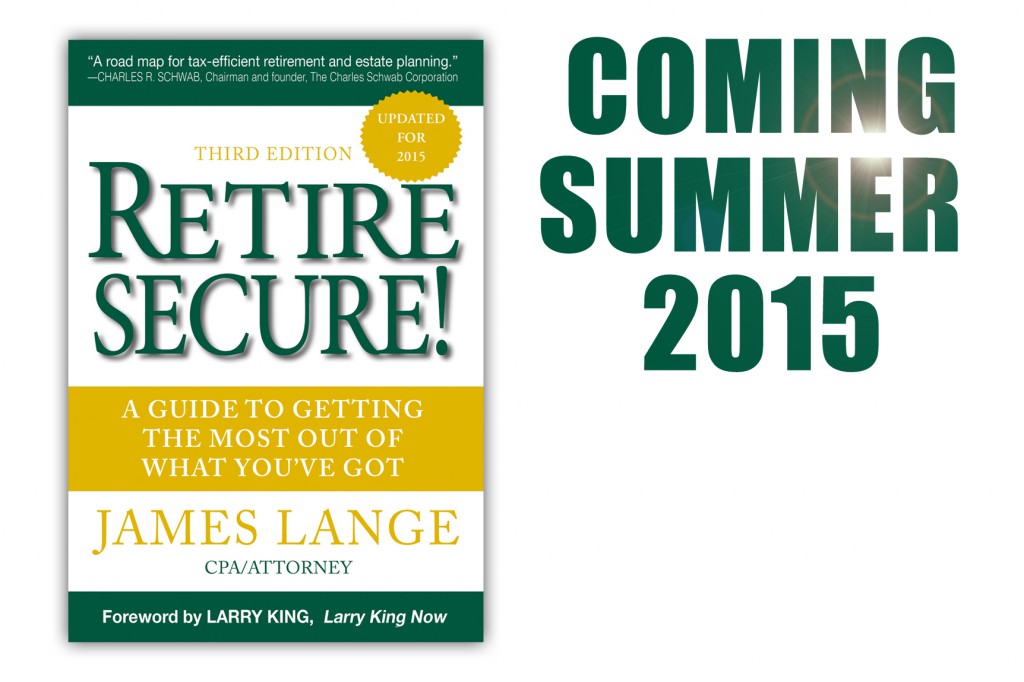
If you’d like to be reminded as to when the book is coming out please fill out the form below.

Save

The Ideal Beneficiary for your IRA or Retirement Plan

beneficiary-designation-retirement-plan-james-langeGive Your Heirs as Much Flexibility as Possible


I gave serious thought to changing the title of Chapter 15, which discusses the ideal beneficiary for your retirement plan, to “My Pet Peeve”. This is because of how annoying I find it to see people spend thousands of dollars to create elaborate wills and trusts, only to render them useless because they carelessly listed the wrong beneficiary on their retirement plan. Unfortunately, it’s an all too common mistake.

What follows here is one of the most, if not THE most, important concepts in the book. Your will and trust documents do not control the distribution of your IRA or retirement plans. Any account that has a specific beneficiary designation will be distributed to the individuals listed on that beneficiary form, regardless of what your will or trust says. Why is this important? Well, I’ll tell you about a situation I became aware of recently. A gentleman who had been married and divorced twice prepared a will that left all of his assets to his children from his first marriage. Most of his wealth was in his retirement plan, though.   He died unexpectedly, before he could get around to changing the beneficiary designation of that plan from his second ex-wife to his children. After his death, the second ex-wife (who had since remarried) received the very large retirement plan, and his children received the non-retirement assets, which were worth far less than the retirement plan. To add insult to injury, the second ex-wife made sure that his children knew that she had used her inheritance to buy herself and her new spouse very expensive cars – even going so far as to post photos on social media websites as proof! So your beneficiary designations are very, very important – so important that, in fact, if you’re my client I won’t even let you fill them out by yourself!

I like to give my clients as many options as I can. The beneficiary designation that I usually recommend gives your heirs as much flexibility as possible. It allows both your surviving spouse and your adult child, assuming that the child is the contingent beneficiary, to disclaim or refuse the inheritance to his or her own children (your children and/or grandchildren). Under current laws, this allows the children and grandchildren to take minimum distributions based on their own life expectancy. Will I still do this if the law changes? More than likely, yes, but the financial benefits will not be as significant as they were in previous years. If this topic interests you, then you’ll probably want to read Chapter 15 to learn about all the changes.

My next post will continue on the topic of beneficiary designations, and why they are important if your estate plan includes trusts. Stop back soon!

Jim

Jim Lange, Retirement and Estate Planning A nationally recognized IRA, Roth IRA conversion, and 401(k) expert, he is a regular speaker to both consumers and professional organizations. Jim is the creator of the Lange Cascading Beneficiary Plan™, a benchmark in retirement planning with the flexibility and control it offers the surviving spouse, and the founder of The Roth IRA Institute, created to train and educate financial advisors.

Jim’s strategies have been endorsed by The Wall Street Journal (33 times), Newsweek, Money Magazine, Smart Money, Reader’s Digest, Bottom Line, and Kiplinger’s. His articles have appeared in Bottom Line, Trusts and Estates Magazine, Financial Planning, The Tax Adviser, Journal of Retirement Planning, and The Pennsylvania Lawyer magazine.

Jim is the best-selling author of Retire Secure! (Wiley, 2006 and 2009), endorsed by Charles Schwab, Larry King, Ed Slott, Jane Bryant Quinn, Roger Ibbotson and The Roth Revolution, Pay Taxes Once and Never Again endorsed by Ed Slott, Natalie Choate and Bob Keebler.

If you’d like to be reminded as to when the book is coming out please fill out the form below.

Thank you.

Save

Save

Save

Disclaimers: Who on Earth Would Refuse to Accept an Inheritance?

inheritance stretch ira james lange the roth revolution blogWho on Earth Would Refuse to Accept an Inheritance?

Plenty of people!

The concept of disclaiming, which means that you refuse to accept an inheritance, is often surprisingly difficult for clients to accept. Who on earth would refuse to accept an inheritance? When I get this question, I have to laugh because the obvious assumption is that the beneficiary is turning away a rare opportunity to increase his or her wealth with little or no effort. So let’s look at a hypothetical situation. Suppose your rich uncle wrote his will twenty years before he died, and the will provided that, at his death, you would inherit a small apartment building that he owned. In the twenty years since his will was written, though, your uncle’s health declined and he did no maintenance at all on the building. The angry tenants moved out long ago, and the building has been vacant for ten years. Vandals broke the windows and stripped the building of its plumbing and wiring. The city has condemned it because it is a nuisance, and the owner is going to have to pay to have it demolished. Do you still want your inheritance now?

Beneficiaries always have the right to disclaim (or refuse) all or part of an inheritance. This idea has traditionally been a cornerstone when planning for the multi-generational benefits of a Stretch IRA. Under the current law, if the named beneficiary chooses to disclaim an IRA or retirement plan, the contingent beneficiary is able to use his or her own life expectancy to determine the Required Minimum Distribution from that account. In a case where a surviving spouse disclaims to children, this allows the IRA to be “stretched”, allowing maximum growth as well as income tax savings.

If the Stretch IRA is eventually eliminated, disclaimers will likely play less of a role in estate settlements. There is, however, a rapidly growing group of attorneys (including me) who use and will continue to use at least some form of disclaimer in the estate plans of most clients. I have used them in my practice for years, and have found that they can give families a lot of flexibility during what is usually a very stressful time.

One final note about disclaimers: beneficiaries who are on Medicaid may be disqualified from their benefits if they receive an inheritance. They may be able to refuse the inheritance and keep those benefits, but this depends on the laws of the state that they live in and the terms of the grantors will.

These ideas are presented in Chapter 14.

My next post will continue to expand on the concept of the Stretch IRA, but will specifically address the ramifications of choosing one beneficiary over another. Stop back soon!

Jim

Jim Lange, Retirement and Estate Planning A nationally recognized IRA, Roth IRA conversion, and 401(k) expert, he is a regular speaker to both consumers and professional organizations. Jim is the creator of the Lange Cascading Beneficiary Plan™, a benchmark in retirement planning with the flexibility and control it offers the surviving spouse, and the founder of The Roth IRA Institute, created to train and educate financial advisors.

Jim’s strategies have been endorsed by The Wall Street Journal (33 times), Newsweek, Money Magazine, Smart Money, Reader’s Digest, Bottom Line, and Kiplinger’s. His articles have appeared in Bottom Line, Trusts and Estates Magazine, Financial Planning, The Tax Adviser, Journal of Retirement Planning, and The Pennsylvania Lawyer magazine.

Jim is the best-selling author of Retire Secure! (Wiley, 2006 and 2009), endorsed by Charles Schwab, Larry King, Ed Slott, Jane Bryant Quinn, Roger Ibbotson and The Roth Revolution, Pay Taxes Once and Never Again endorsed by Ed Slott, Natalie Choate and Bob Keebler.

If you’d like to be reminded as to when the book is coming out please fill out the form below.

Thank you.

Save

Save

Save

Save

The Death of the Stretch IRA: It’s Time to Review the Retirement Plan Beneficiary Rules

The Death of the Stretch IRA, James LangeThose of you who have been following me for a while know that that one of my most cherished mantras is “Pay Taxes Later!” An extension of that mantra was my recommendation that, upon your death, your beneficiaries continue to take advantage of the minimum distribution rules to “stretch” your IRA for as long as possible so that they could achieve the maximum tax-deferred growth possible. This used to be a fairly straightforward concept but, with the increase in second and third marriages, as well as non-traditional marriages, it has become much more complicated.

To add to the confusion, there is increasing pressure from Congress to eliminate the Stretch IRA. This would be a very good time to review your retirement plan beneficiary rules, because you might want to change your designations. Non-spousal beneficiaries may soon be required to withdraw and pay taxes on inherited IRAs within five years. This idea was first introduced by Senate Finance Committee Chair Max Baucus in 2013, and was thankfully withdrawn for lack of support. It reappeared in 2013 as part of President Obama’s budget proposals, and again in 2013 as part of a bill to reduce student loan debt. Killing the Stretch IRA, they felt, would provide enough revenue to reduce student loan rates for college tuition for one year. That bill was passed by the House but died in the Senate by only two votes. Then in 2014 and 2015, President Obama’s budget proposals again included a provision to kill the Stretch IRA. It seems clear to me that this measure, or a similar one, may eventually pass.

So who should be named the beneficiary of your retirement plan? Is one option better than another? Chapter 13 answers these questions assuming that the benefits of the Stretch IRA will continue under the current rules, and also presents some options that you can consider if the Stretch IRA is eventually eliminated. This chapter also offers some guidance in naming trusts as beneficiaries. If done properly, this can protect your assets from your child’s creditors, including their former spouses.

Don’t forget to stop back soon for a sneak peek at Chapter 14, which expands on some concepts critical to understanding the benefits of the Stretch IRA!

Jim

P.S. Here’s a video on The Death of the Stretch:

Jim Lange, Retirement and Estate Planning A nationally recognized IRA, Roth IRA conversion, and 401(k) expert, he is a regular speaker to both consumers and professional organizations. Jim is the creator of the Lange Cascading Beneficiary Plan™, a benchmark in retirement planning with the flexibility and control it offers the surviving spouse, and the founder of The Roth IRA Institute, created to train and educate financial advisors.

Jim’s strategies have been endorsed by The Wall Street Journal (33 times), Newsweek, Money Magazine, Smart Money, Reader’s Digest, Bottom Line, and Kiplinger’s. His articles have appeared in Bottom Line, Trusts and Estates Magazine, Financial Planning, The Tax Adviser, Journal of Retirement Planning, and The Pennsylvania Lawyer magazine.

Jim is the best-selling author of Retire Secure! (Wiley, 2006 and 2009), endorsed by Charles Schwab, Larry King, Ed Slott, Jane Bryant Quinn, Roger Ibbotson and The Roth Revolution, Pay Taxes Once and Never Again endorsed by Ed Slott, Natalie Choate and Bob Keebler.

If you’d like to be reminded as to when the book is coming out please fill out the form below.

Save

Save

Save

Life Insurance: Is It Right for Your Estate Plan?

Insurance salesmen are often maligned and are frequently the butt of some pretty bad jokes. At the risk of being categorized with those poor men and women, I’ll tell you that I don’t hesitate to recommend life insurance to many of my own clients after evaluating their estate planning needs. Why? Because when it is appropriate and structured properly, life insurance has a number of benefits that make it an excellent and possibly the best wealth transfer strategy.

If you read the earlier chapters, you learned that legislative changes since 2009 mean that federal estate tax is an issue for far fewer taxpayers than in the past. The IRS wasn’t feeling guilty about charging estate tax on your assets, they just gave more people a reason to worry about a completely different problem called federal income tax. Chapter 12 of Retire Secure! delves into some techniques that show how life insurance can be used to help minimize the damage to the estate caused by income taxes at death. It also discusses how life insurance can be used to provide liquidity for a number of estate settlement needs, and also how it can be used to benefit the estate if there is a disabled beneficiary. While life insurance can be extremely beneficial it is important to remember that in situations where taxes and other estate needs aren’t a concern, the cost of the life insurance – especially for a senior citizen – might not be worth it.
Life Insurance, Retire Secure, James Lange

In earlier chapters, there are several references to the possibility that Congress may eliminate the benefits of the Stretch IRA. Chapter 12 introduces some new ideas regarding the inclusion of a Charitable Remainder Unitrust (CRUT) in certain estate plans. How do you think your children would react if you named a charitable trust as the sole beneficiary of your retirement plan? They might react very favorably when they find out that, in the long run, they could end up with a lot more money.

This is a very complicated estate planning technique that is not appropriate for everyone. Under the right set of circumstances, though, life insurance can be a very effective addition to an estate plan – especially if the owner of the IRA has always supported charities. Would you like to endow a chair at your local university or symphony orchestra, or perhaps provide financial support for your favorite hospital or religious organization long after your death? Read Chapter 12 to learn the basics of this strategy, and how life insurance can play a key role.

Stop back soon for an update on some really big news about the possible death of the Stretch IRA.

Jim

Jim Lange, Retirement and Estate Planning A nationally recognized IRA, Roth IRA conversion, and 401(k) expert, he is a regular speaker to both consumers and professional organizations. Jim is the creator of the Lange Cascading Beneficiary Plan™, a benchmark in retirement planning with the flexibility and control it offers the surviving spouse, and the founder of The Roth IRA Institute, created to train and educate financial advisors.

Jim’s strategies have been endorsed by The Wall Street Journal (33 times), Newsweek, Money Magazine, Smart Money, Reader’s Digest, Bottom Line, and Kiplinger’s. His articles have appeared in Bottom Line, Trusts and Estates Magazine, Financial Planning, The Tax Adviser, Journal of Retirement Planning, and The Pennsylvania Lawyer magazine.

Jim is the best-selling author of Retire Secure! (Wiley, 2006 and 2009), endorsed by Charles Schwab, Larry King, Ed Slott, Jane Bryant Quinn, Roger Ibbotson and The Roth Revolution, Pay Taxes Once and Never Again endorsed by Ed Slott, Natalie Choate and Bob Keebler.

If you’d like to be reminded as to when the book is coming out please fill out the form below.

Save

Retirement and Estate Planning Case Study: Plan with the Big Picture in Mind

Knowing that many people aren’t as enthusiastic as I am about topics like taxes, interest rates and so on, I tried to make Retire Secure! as reader friendly as possible.  Even so, I know there are still folks out there who find it difficult to apply the concepts outlined in the book to their own personal situations.  It’s for those people that I wrote Chapter 10, a Retirement and Estate Planning Case Study on Eddie & Emily.  It is a real life retirement story loosely based on an actual client who came to me with some concerns.

Chapter 10 is written from this couple’s point of view.  It walks the reader through the thought process that these clients went through as they entered retirement, and how we helped them achieve peace of mind about their concerns.  Every client’s situation is different, so it would wrong to imply that one course of action is always better than another.  Since we helped them plan with the big picture in mind, though, they were confident that the decisions that they made were the best possible for themselves and their children.

Stop back soon for a peek at Chapter 11.  It’s a lot more technical than Chapter 10, but contains important information on the best ways to transfer wealth to your heirs.

See you soon!

Jim

Jim Lange, Retirement and Estate Planning A nationally recognized IRA, Roth IRA conversion, and 401(k) expert, he is a regular speaker to both consumers and professional organizations. Jim is the creator of the Lange Cascading Beneficiary Plan™, a benchmark in retirement planning with the flexibility and control it offers the surviving spouse, and the founder of The Roth IRA Institute, created to train and educate financial advisors.

Jim’s strategies have been endorsed by The Wall Street Journal (33 times), Newsweek, Money Magazine, Smart Money, Reader’s Digest, Bottom Line, and Kiplinger’s. His articles have appeared in Bottom Line, Trusts and Estates Magazine, Financial Planning, The Tax Adviser, Journal of Retirement Planning, and The Pennsylvania Lawyer magazine.

Jim is the best-selling author of Retire Secure! (Wiley, 2006 and 2009), endorsed by Charles Schwab, Larry King, Ed Slott, Jane Bryant Quinn, Roger Ibbotson and The Roth Revolution, Pay Taxes Once and Never Again endorsed by Ed Slott, Natalie Choate and Bob Keebler.

If you’d like to be reminded as to when the book is coming out please fill out the form below.

Save

Net Unrealized Appreciation (NUA): Don’t Pay More Taxes Than You Need To

Net Unrealized Appreciation (NUA) Don’t Pay More Taxes Than You Need To, James LangeSome employees have Stock Options, or the option to buy the stock of the company that they work for within their retirement plans. A unanimous Supreme Court decision in 2014 might discourage employers from offering their employees a stake in the business in future years, because they can now be held liable if the value of the stock drops. Employers can now also be held liable under insider trading laws for certain actions they make within the retirement plan, with respects to company stock.

But what if you do happen to have some company stock in your retirement plan? If you do, be sure to read Chapter 9 for some very important tax planning tips! When you retire and take a lump sum distribution from your retirement plan, the distribution may include employer stock that is (hopefully) worth more than the fair market value at the time it was purchased in your plan. The difference between the value of the company stock at the time you take your lump sum distribution and its value at the time it was purchased is called Net Unrealized Appreciation (NUA).

If you own company stock within your retirement plans, you should make sure that you understand Net Unrealized Appreciation (NUA) rules outlined in Chapter 9 before you roll over or take distributions from the plan. Many financial advisors don’t understand these rules and, if you don’t, you could end up paying significantly more in taxes than you need to. This is especially true if the company stock in your 401(k) has increased in value!

Stay tuned for an update on our classic case study of Eddie & Emily from Chapter 10!

– Jim

Jim Lange A nationally recognized IRA, Roth IRA conversion, and 401(k) expert, he is a regular speaker to both consumers and professional organizations. Jim is the creator of the Lange Cascading Beneficiary Plan™, a benchmark in retirement planning with the flexibility and control it offers the surviving spouse, and the founder of The Roth IRA Institute, created to train and educate financial advisors.

Jim’s strategies have been endorsed by The Wall Street Journal (33 times), Newsweek, Money Magazine, Smart Money, Reader’s Digest, Bottom Line, and Kiplinger’s. His articles have appeared in Bottom Line, Trusts and Estates Magazine, Financial Planning, The Tax Adviser, Journal of Retirement Planning, and The Pennsylvania Lawyer magazine.

Jim is the best-selling author of Retire Secure! (Wiley, 2006 and 2009), endorsed by Charles Schwab, Larry King, Ed Slott, Jane Bryant Quinn, Roger Ibbotson and The Roth Revolution, Pay Taxes Once and Never Again endorsed by Ed Slott, Natalie Choate and Bob Keebler.

If you’d like to be reminded as to when the book is coming out please fill out the form below.

Save

Annuities: Good or Bad?

Annuities, Retirement Planning, Pittsburgh Pennsylvania, James LangeThe Center for Disease Control annually publishes a document called the National Vital Statistics Report. This report estimates the life expectancy of men and women in the United States. At birth, the life expectancy for a male is 76.7 years and, for a female, 81.4 years. What is interesting about the report, however, is that it shows that, the longer you do live, the more your life expectancy increases. If you’ve already made it to age 65 and are male, you are likely to continue to live until age 83. If you’re a 65-year old female, you can be expected to live until age 85.5. If you’re a male and you’ve already made it to age 80, you can expect to live until age 88.3; an 80-year old female can expect to live until age 89.7. When your life expectancy continues to increase, how can you possibly make sure that the money you’ve saved for retirement lasts for your entire life?
Financial professionals are sharply divided on the topic of annuities. Some love them, and some hate them.  My goal in the Third Edition of Retire Secure! is to point out the advantages and disadvantages of annuities, and let you make up your own mind as to whether they would be good or bad for your own retirement. There are many different kinds of annuities, but most can be used to provide a guaranteed lifetime income for both you and your spouse. This can provide peace of mind to individuals who are concerned that the Social Security system might go bankrupt after they retire and are no longer able to earn income. As of June 2014, employees are permitted to buy a specific type of annuity called a qualified longevity annuity contract (or QLAC) within their retirement plan. While you can’t avoid taking Required Minimum Distributions completely, this type of annuity allows owners to defer retirement distributions until age 85. This means that owners would receive the maximum pension benefit possible for the rest of their lives. Once distributions are started, the owner receives a guaranteed income for the rest of his or her life. Being able to exempt a portion of retirement income from minimum required distributions from age 70 ½ to age 85 can be a powerful estate planning tool, however, there are rules you have to follow. Those rules are covered in Chapter 8.

Annuities are also playing a growing role in estate planning for adult children. Many retirees have adult children who have been financially devastated because they were not adequately prepared for the cost of sending their own children to college. Others simply live beyond their means and believe that balancing their budget means robbing Peter to pay Paul. For some, the unexpected loss of a steady income from a job can spell financial disaster. Chapter 8 contains some tips on how you can use annuities to put your spendthrift children on a budget or, if necessary, even protect them from their creditors.   In some cases, annuities can offer the means to provide your children with the highest possible degree of financial security.

Check back soon for a tip on how to avoid a common and expensive mistake when taking distributions from a retirement plan that includes company stock!

– Jim

Jim Lange A nationally recognized IRA, Roth IRA conversion, and 401(k) expert, he is a regular speaker to both consumers and professional organizations. Jim is the creator of the Lange Cascading Beneficiary Plan™, a benchmark in retirement planning with the flexibility and control it offers the surviving spouse, and the founder of The Roth IRA Institute, created to train and educate financial advisors.

Jim’s strategies have been endorsed by The Wall Street Journal (33 times), Newsweek, Money Magazine, Smart Money, Reader’s Digest, Bottom Line, and Kiplinger’s. His articles have appeared in Bottom Line, Trusts and Estates Magazine, Financial Planning, The Tax Adviser, Journal of Retirement Planning, and The Pennsylvania Lawyer magazine.

Jim is the best-selling author of Retire Secure! (Wiley, 2006 and 2009), endorsed by Charles Schwab, Larry King, Ed Slott, Jane Bryant Quinn, Roger Ibbotson and The Roth Revolution, Pay Taxes Once and Never Again endorsed by Ed Slott, Natalie Choate and Bob Keebler.

If you’d like to be reminded as to when the book is coming out please fill out the form below.

Thank you.

Save

More on The Traditional IRA vs Roth IRA

Retire Secure A Guide to Getting the Most Out of What You've Got, James Lange 2015Over the years, I’ve been challenged by clients who present me with questions that even King Solomon in his infinite wisdom couldn’t answer. Other questions, complicated though they might be, are much easier to manage because they can be solved by running the numbers.

Chapter 3 of the new edition of Retire Secure! quantifies a number of “what if” scenarios that are frequently presented to me by my clients. What if I’m in an average tax bracket, and I need to cash in my retirement account? What if I’m in the highest tax bracket, and I need to withdraw all or part of my retirement account? What if I’m in a high tax bracket now, but am in a lower tax bracket when I need to withdraw all or part of my retirement account? What happens if I’m in a high tax bracket now, but I lose my job and am in a very low tax bracket when I need to withdraw all or part of my retirement account? What happens if I’m in a high tax bracket, but my heir is in a low tax bracket? All of these are very significant considerations if you have to choose between a Traditional IRA vs a Roth IRA.

Questions like these can be accurately answered by using quantitative analysis. Chapter 3 presents a series of hypothetical scenarios which prove that certain tax situations definitely do favor the use of one type of account over another. In some situations, the Traditional IRA is better, and in others, the Roth IRA is better. If your choice is Traditional IRA vs Roth IRA, you may find some of these scenarios thought-provoking. As with the previous chapters, the assumed rate of return has been reduced to a conservative 6%, so the differences in the illustrations will be even more pronounced if you earn a higher rate of return on your own investments. The illustrations should only be used as a general guide. In order to get the most accurate answer for your specific situation, please consider asking us to run the numbers for you.

All this discussion about the Traditional IRA vs Roth IRA debate reminds me: you really should take a look at my next post about Chapter 4. It delves into some surprising new details about spending retirement accounts!

Jim

Jim Lange A nationally recognized IRA, Roth IRA conversion, and 401(k) expert, he is a regular speaker to both consumers and professional organizations. Jim is the creator of the Lange Cascading Beneficiary Plan™, a benchmark in retirement planning with the flexibility and control it offers the surviving spouse, and the founder of The Roth IRA Institute, created to train and educate financial advisors.

Jim’s strategies have been endorsed by The Wall Street Journal (33 times), Newsweek, Money Magazine, Smart Money, Reader’s Digest, Bottom Line, and Kiplinger’s. His articles have appeared in Bottom Line, Trusts and Estates Magazine, Financial Planning, The Tax Adviser, Journal of Retirement Planning, and The Pennsylvania Lawyer magazine.

Jim is the best-selling author of Retire Secure! (Wiley, 2006 and 2009), endorsed by Charles Schwab, Larry King, Ed Slott, Jane Bryant Quinn, Roger Ibbotson and The Roth Revolution, Pay Taxes Once and Never Again endorsed by Ed Slott, Natalie Choate and Bob Keebler.

If you’d like to be reminded as to when the book is coming out please fill out the form below.

Retire Secure! Third Edition: The Rate of Return You Earn Makes a Big Difference

Retire Secure A Guide to Getting the Most Out of What You've Got, James Lange 2015

I love it when clients give me feedback, good or otherwise. When I wrote the second edition of Retire Secure!, I got a lot of complaints about the fact that our calculations assumed an investment rate of return of 8%. Our more conservative clients told me that 8% was just not realistic for them, and that our numbers must therefore be inaccurate.

Chapter 1 compares the difference between saving in pre-tax and after-tax accounts, but in order to keep those conservative clients happy, the assumed rate of return has been lowered to 6%. As expected, the difference in the two accounts was not quite as dramatic as when we used an 8% rate of return, but the results showed that it is still better to save using a pre-tax account. Then we looked at the significant reduction in the wealth accumulated by both savers and, being the number crunchers that we are, we said, “What do they have to do in order to get that wealth back?” The answer was to increase the amount contributed to the account each year and the rate of return you earn makes a big difference over the long term.

Do you want to teach your children and grandchildren the benefits of starting to save early in their lives? We introduce two new types of retirement savings plans that make it possible for low-income taxpayers such as students to contribute to a retirement account that has no fees and very low minimum contributions. There is also a new section devoted to a discussion on the growing trend of using loans against retirement plans to pay for expenses such as college education. It must be okay because it’s your own money, right? Read Chapter 1 to learn the pros and cons of this strategy.

Have you been seeing the term “underfunded pension plan” a lot lately? If you haven’t, you might want to Google that term and look at what comes up. The number of underfunded pension plans in this country has reached an alarming level, and, even if you are eligible for benefits under such a plan, you might want to consider establishing a back-up plan. Chapter 1 addresses this problem.

Check back soon, and I’ll give you can idea of what you can expect in Chapter 2!

Thanks,

Jim

Jim Lange A nationally recognized IRA, Roth IRA conversion, and 401(k) expert, he is a regular speaker to both consumers and professional organizations. Jim is the creator of the Lange Cascading Beneficiary Plan™, a benchmark in retirement planning with the flexibility and control it offers the surviving spouse, and the founder of The Roth IRA Institute, created to train and educate financial advisors.

Jim’s strategies have been endorsed by The Wall Street Journal (33 times), Newsweek, Money Magazine, Smart Money, Reader’s Digest, Bottom Line, and Kiplinger’s. His articles have appeared in Bottom Line, Trusts and Estates Magazine, Financial Planning, The Tax Adviser, Journal of Retirement Planning, and The Pennsylvania Lawyer magazine.

Jim is the best-selling author of Retire Secure! (Wiley, 2006 and 2009), endorsed by Charles Schwab, Larry King, Ed Slott, Jane Bryant Quinn, Roger Ibbotson and The Roth Revolution, Pay Taxes Once and Never Again endorsed by Ed Slott, Natalie Choate and Bob Keebler.

If you’d like to be reminded as to when the book is coming out please fill out the form below.

Save

Save